
Elite families often rely on rankings when making high-stakes admissions decisions, but understanding what these numbers actually mean is just as important as the rankings themselves. In this blog, we break down the 25 best private schools in the U.S. for 2026, with a heavy concentration of top-performing institutions located in California.
Note: This ranking is based on Cardinal Education’s professional experience as educational consultants and feedback from hundreds of families we have worked with. It reflects our informed opinion and is intended to provide insight for families exploring private school options. This content is not affiliated with, endorsed by, or officially representative of any of the schools mentioned.
In This Guide
Quick Answer for Busy Parents
The top private schools in the U.S. for 2026 have been determined by considering a variety of factors, including academic excellence, arts and sports programs, and school culture. Some of the most prominent schools in these aspects are Harvard-Westlake, The Harker School, and Sidwell Friends because they provide a great environment for developing students with excellent college placements and AP/IB programs. But the “best” school remains a subjective choice.
| # | School | State | Key Strength | Grades |
| 1 | Harvard-Westlake School | CA | Liberal Arts | 7-12 |
| 2 | Collegiate School | NY | Liberal Arts | K-12 |
| 3 | The Harker School | CA | STEM | K-12 |
| 4 | Sidwell Friends School | DC | Leadership | PK-12 |
| 5 | Crossroads School | CA | Arts | K-12 |
| 6 | Lakeside School | WA | STEM | 5-12 |
| 7 | Menlo School | CA | STEM | 6-12 |
| 8 | Castilleja School | CA | Leadership | 6-12 |
| 9 | The Branson School | CA | Liberal Arts | 9-12 |
| 10 | Oaks Christian School | CA | Faith-Based | TK-12 |
| 11 | SF University High School | CA | Liberal Arts | 9-12 |
| 12 | The Nueva School | CA | Gifted Education | PK-12 |
| 13 | Marin Academy | CA | Liberal Arts | 9-12 |
| 14 | Head-Royce School | CA | Liberal Arts | K-12 |
| 15 | Crystal Springs Uplands School | CA | STEM | 6-12 |
| 16 | Woodside Priory School | CA | Faith-Based | 6-12 |
| 17 | Kehillah School | CA | Faith-Based | 9-12 |
| 18 | Convent of the Sacred Heart | CA | Faith-Based | K-12 |
| 19 | Pinewood School | CA | Liberal Arts | K-12 |
| 20 | San Domenico School | CA | Arts | PK-12 |
| 21 | Quarry Lane School | CA | STEM | PK-12 |
| 22 | The Athenian School | CA | Leadership | 6-12 |
| 23 | Silicon Valley International School | CA | Global/Multilingual | PK-12 |
| 24 | The Bay School of San Francisco | CA | Liberal Arts | 9-12 |
| 25 | Bowman School | CA | Gifted Education | PK-12 |
What Are The Top Private Schools in the U.S.?
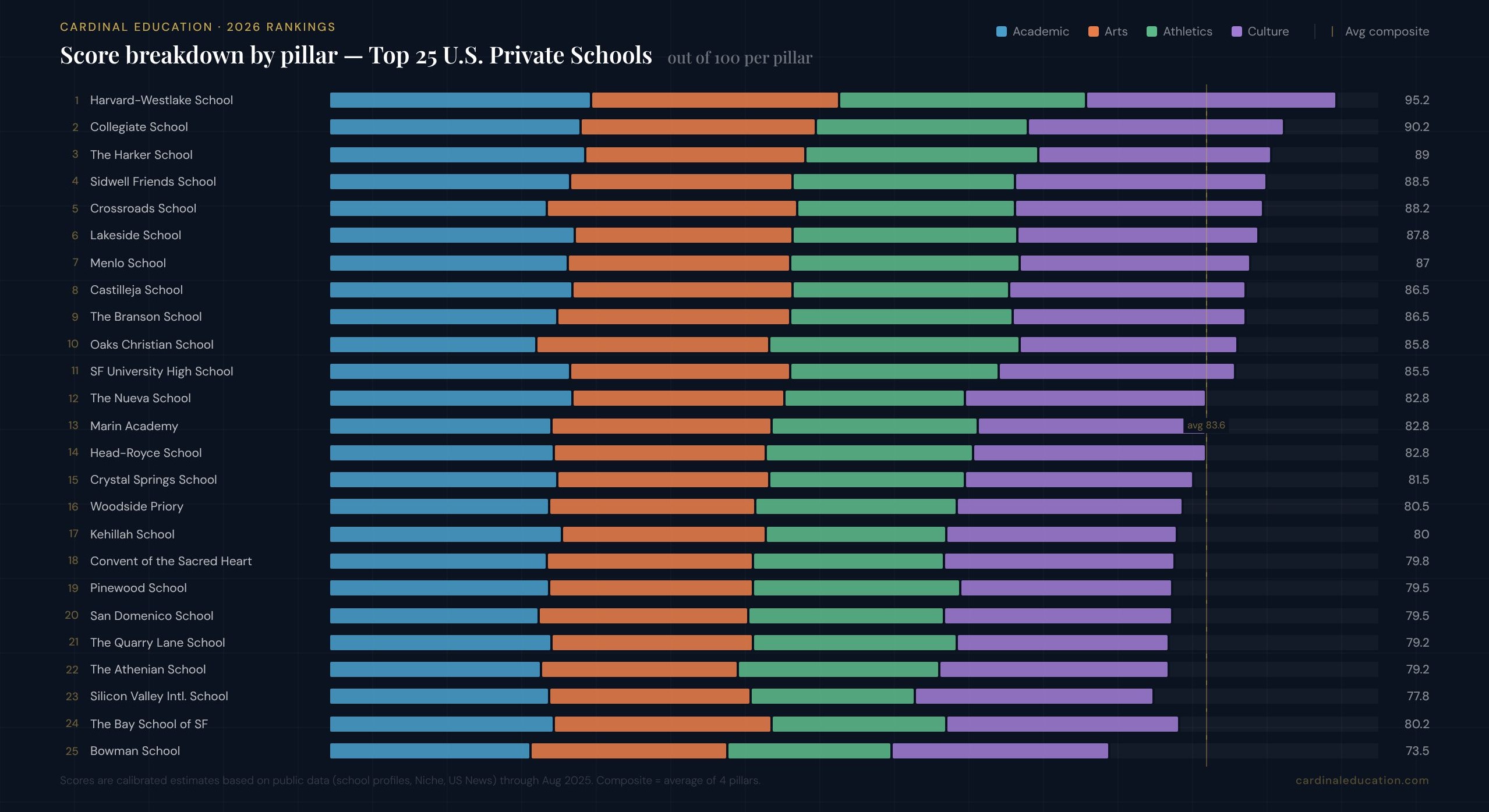
Based on composite scoring across academic rigor, arts, athletics, and culture, the top-ranked schools for 2026 are:
Harvard-Westlake School — Los Angeles, CA | Grades 7–12
Harvard-Westlake sends roughly 19% of its graduates to Harvard, Yale, Princeton, Stanford, and MIT, one of the highest rates of any day school in the country. It offers 58 Honors courses and caps AP enrollment to encourage more balanced curricular choices and excellent programs in arts and sports. The students are consistently accepted into some of the best colleges in the country because of good academics and college guidance. Best for students who want the academic intensity of a top boarding school without leaving Los Angeles.
Collegiate School — New York, NY | Grades K–12
One of the oldest independent schools in the United States, founded in 1628, Collegiate is an all-boys school in Manhattan known for its rigorous humanities curriculum and consistent Ivy League placement. It prides itself on academic excellence and a very competitive college preparatory program. Small class sizes and a culture of intellectual seriousness attract students who thrive in discussion-heavy, writing-intensive environments and humanities education. The school draws heavily from Manhattan’s professional and academic families and is among the most selective independent schools on the East Coast.
The Harker School — San Jose, CA | Grades K–12
Harker School places approximately 62% of its graduates into top-25 national universities. The school is STEM-dominant, with deep AP and extracurricular offerings in math, science, and engineering, but it also has competitive humanities programs. Harker serves a significant international and first-generation student population, which shapes the campus culture that differentiates it from the more homogeneous schools in the Peninsula. Best for students with clear STEM ambitions and the academic drive to compete at a high level from the start.
Sidwell Friends School — Washington, DC | Grades PK–12
Long associated with Washington’s political and diplomatic community, three U.S. presidents have sent children here. Sidwell brings a Quaker educational philosophy to an intensely academically ambitious student body. The emphasis on service, reflection, and leadership development sits alongside rigorous college preparation. The result is a school that produces graduates who are intellectually serious and civically oriented. For families relocating to the DC area, Sidwell is the benchmark against which every other independent school is measured.
Crossroads School — Santa Monica, CA | Grades K–12
Crossroads occupies a distinct position in the Los Angeles independent school landscape: it is the school for students who are serious about the arts alongside academics, not as an afterthought. The performing arts, visual arts, and music programs are genuinely exceptional. Graduates regularly matriculate to conservatories, top film programs, and Ivy League schools. The campus culture is progressive and student-centered. Best for families who want strong college preparation without the pressure-cooker atmosphere of Westside competitors like Harvard-Westlake.
Lakeside School — Seattle, WA | Grades 5–12
Notable alumni include Bill Gates and Paul Allen. Lakeside has maintained a reputation for producing intellectually independent, entrepreneurially minded graduates. The school has genuine STEM depth but is not exclusively science-focused with an equally strong humanities. College placement rates rival the most selective Bay Area schools. For Seattle families, Lakeside is the clear first choice among independent schools.
Menlo School — Atherton, CA | Grades 6–12
Located on the mid-Peninsula in one of the wealthiest zip codes in the country, Menlo draws heavily from Silicon Valley’s tech and finance communities. The school has strong STEM programs and a highly motivated student body. Families favor the overall balance in academics, athletics, and community. College placement rates are strong, with significant representation at top-25 universities. A good fit for students who want rigorous academics without Harker’s intensity.
Castilleja School — Palo Alto, CA | Grades 6–12
Castilleja is the only non-sectarian, all-girls middle and high school in the San Francisco Bay Area. With approximately 57% of graduates placing into top-25 universities, Castilleja’s college placement rates rival any co-ed school on the Peninsula. The Bourn Idea Lab, the first FabLab@School established in a U.S. school, built in collaboration with Stanford University, is a genuine differentiator in STEM education for young women. Castilleja is secular, academically intense with strong STEM and humanities programs.
The Branson School — Ross, CA | Grades 9–12
Branson is a founding member of the Global Online Academy, a consortium of leading independent schools that enables students to take courses with peers from top schools worldwide. The Senior Capstone Project, an independent project conceived and designed entirely by the student, and Junior Summer Fellowships for independent scholarly work distinguish Branson’s academic culture from more conventionally structured schools. The campus in Ross is small and tight-knit, which makes it a great fit for students who want rigor in a close community.
Oaks Christian School — Westlake Village, CA | Grades TK–12
Oaks Christian stands out in the Los Angeles private school landscape for combining serious college preparation with nationally competitive athletics. Several NFL and NBA draft picks have come through its sports programs. The faith-based environment is explicitly evangelical Christian, which is a great fit for families seeking that combination of rigorous academics, elite athletics, and Christian values in the LA area.
San Francisco University High School — San Francisco, CA | Grades 9–12
SFUHS is the most academically selective traditional independent school within San Francisco. It places approximately 25% of graduates into top-15 liberal arts colleges, one of the strongest among Bay Area day schools. The curriculum is notably writing-intensive and humanities-focused relative to Peninsula peers. The school attracts students who are intellectually curious and verbal rather than primarily STEM-oriented. Its location shapes a campus culture that is urban, diverse, and socially engaged.
The Nueva School — Hillsborough, CA | Grades PK–12
Nueva is the only school on this list designed specifically for gifted learners. The school offers project-based learning and innovation-driven academics that teaches advanced problem-solving skills. It operates on the premise that exceptionally capable students learn differently and need a different kind of school. The college placement outcomes are strong, but the more meaningful differentiator is the academic culture where students are encouraged to pursue ideas deeply and independently in ways that more conventional schools don’t. Best for students who are intellectually advanced, internally motivated, and potentially mismatched with traditional classroom environments.
Marin Academy — San Rafael, CA | Grades 9–12
Marin Academy is Marin County’s most academically prestigious independent school and occupies a distinctive position, rigorous enough to place graduates at highly selective universities, but progressive enough that students take genuine ownership of their learning rather than follow a prescribed path. It offers a progressive, student-centered curriculum that combines academic rigor with creative expression, encouraging independent thinking, intellectual curiosity, and strong college readiness. It places approximately 25% of graduates into top-15 liberal arts colleges.
Head-Royce School — Oakland, CA | Grades K–12
Head-Royce is the most academically rigorous independent school in the East Bay, serving Oakland and the surrounding communities. It offers a balanced liberal arts education with rigorous academics, strong extracurricular opportunities, and personalized academic support. The school is more racially and socioeconomically diverse than most peers on this list. For families in Oakland, Berkeley, and the inner East Bay who want a serious college-prep environment without the commute to the Peninsula, Head-Royce is typically the first call.
Crystal Springs Uplands School — Hillsborough, CA | Grades 6–12
Crystal Springs occupies the mid-Peninsula market alongside Menlo and Sacred Heart Preparatory, but with a distinct identity: smaller, more intimate, and known for particularly strong teacher-student relationships. The school’s STEM programs are rigorous, and its college placement outcomes are consistently strong for its size. For families who want a serious college-prep environment without the scale of Harker or the social intensity of some larger Peninsula schools, Crystal Springs is often the right fit.
Woodside Priory School — Portola Valley, CA | Grades 6–12
Woodside Priory School in Portola Valley, California, combines Benedictine values with a rigorous college-preparatory curriculum, offering small class sizes, individualized attention, and a supportive learning environment that fosters academic growth and personal development. The school is also one of the few on this list to offer both day and boarding options, making it relevant for families who want the flexibility of a boarding program within the Bay Area. Class sizes are small and the student-teacher ratio is among the most favorable on the Peninsula.
Kehillah School — Palo Alto, CA | Grades 9–12
Kehillah is the only Jewish independent high school in Silicon Valley. It offers an innovative interdisciplinary curriculum that emphasizes critical thinking, academic flexibility, and personalized learning, helping students build strong college-ready skills and achieve successful admissions outcomes. For families who want their child’s Jewish identity to be central to, rather than separate from, their high school experience, Kehillah is typically the only school that delivers that.
Convent of the Sacred Heart — San Francisco, CA | Grades K–12
Convent of the Sacred Heart High School provides an all-girls Catholic education that combines academic excellence, leadership development, and character formation, preparing students for admission to selective colleges and universities nationwide. Its K–12 structure also means a longer relationship with the school and community. Many families enroll daughters in kindergarten and graduate them twelve years later.
Pinewood School — Los Altos Hills, CA | Grades PK–12
Pinewood occupies a quieter position in the South Bay independent school market, but serving families who want a rigorous academic environment at a smaller scale with less competitive social pressure. The PK–12 structure builds community over time, and the school’s individualized approach suits students who benefit from consistent teacher attention. A good option for families who want strong academics without the intensity of the most prominent Peninsula competitors.
San Domenico School — San Anselmo, CA | Grades PK–12
San Domenico is the only school in Marin County that offers both day and boarding programs, making it uniquely positioned for North Bay families who want boarding-school-level resources without sending their child out of the region. The school’s Dominican Catholic tradition is reflected in its emphasis on service and character development. The arts program is notably strong. San Domenico is known for its music and performing arts which distinguish it from academic-focused peers.
Quarry Lane School — Dublin, CA | Grades PK–12
Quarry Lane serves the Tri-Valley: Dublin, Pleasanton, and Livermore, a market largely underserved by the prominent Peninsula and San Francisco schools. For East Bay families who don’t want the commute to Oakland or Contra Costa County, Quarry Lane offers a genuine STEM-focused college-prep alternative with strong AP outcomes. The school attracts the area’s South Asian and Chinese American communities, and that demographic reality shapes the school’s academic culture, and families should visit to understand firsthand.
The Athenian School — Danville, CA | Grades 6–12
Athenian is distinctive for its Wilderness Experience program, a required three-week outdoor education component that is genuinely unusual among academic schools and reflects the school’s commitment to developing students beyond the classroom. The school offers both day and boarding options. For families in the Tri-Valley and Contra Costa County who want a rigorous college-prep program with a meaningful experiential learning component, Athenian has no close equivalent in the region.
Silicon Valley International School — Palo Alto, CA | Grades PK–12
SVIS is the Bay Area’s only fully multilingual international school, offering instruction in English, French, and Mandarin across grade levels. For families with international backgrounds, diplomatic or corporate relocations, or a specific interest in raising genuinely bilingual or trilingual children within a rigorous academic environment, SVIS fills a need that no other school on this list addresses. College placement is strong, with graduates regularly matriculating to selective U.S. and European universities.
The Bay School of San Francisco — San Francisco, CA | Grades 9–12
Bay School is the youngest school on this list, founded in 2004, and its youth is reflected in its pedagogical approach explicitly designed from the ground up rather than inherited from a traditional model. The school is known for its Foundations curriculum, an interdisciplinary program that all students complete in ninth grade covering ethics, theory of knowledge, and seminar-style discussion. For students who are intellectually adventurous and want something genuinely different from a conventional college-prep experience, Bay School is worth serious consideration.
Bowman School — Palo Alto, CA | Grades PK–8
Bowman is an elementary and middle school, not a high school, which means it shouldn’t be directly compared to most schools on this list on the basis of college placement. Its strength is in the early grades having a Montessori-based, approach that builds strong academic foundations and genuine intellectual curiosity before students transition to competitive high schools like Harker, Castilleja, or Menlo. For Silicon Valley families thinking about the K–8 foundation before the high school admissions race, Bowman is among the most respected options in Palo Alto.
Need help finding the right school?
Not sure which school fits your child’s profile? Schedule a consultation with an advisor to discuss your options and admissions strategy.
Top Tips for Parents Comparing the Best Private Schools in the U.S.
- Prioritize school fit over rank position alone.
- Evaluate extracurricular balance (arts, sports, academics).
- Consider long-term student development, not just admissions prestige.
Best Practices for Choosing a Top-Ranked Private School
- Visit campuses to observe culture and student engagement
- Review AP/IB and elective course offerings carefully.
- Match school strengths with your child’s interests.
Common Questions Parents Ask About the Best Private Schools in the U.S.
Q: How do I know if a top-ranked private school is truly the right academic and social fit for my child?
A: Observe how your child feels about the environment, teaching style, and daily experience. A good fit means they feel supported and challenged.
Q: Do elite private schools automatically guarantee Ivy League or top college admissions outcomes for students?
A: No. These schools can help prepare students well, but college admissions still depend on the student’s performance and application.
Q: How important are AP courses, IB programs, and standardized test scores when evaluating private school quality?
A: They matter, but they are not the only factors. Teaching quality and student support are just as important.
Q: What should parents prioritize more when choosing a private school: rankings, culture, academics, or extracurricular opportunities?
A: Culture and fit should come first. Students do best in schools where they feel comfortable and supported.
Related Articles
Top 20 Bay Area Private Schools: The Very Best San Francisco Has To Offer
Best Private Schools in New York
Best Private Schools in Los Angeles
How Do You Select the Right Top Private School for Your Child?
Selecting the top private school means finding a balance between great academics and fit. Although leading schools provide many opportunities, the environment is not fit for all students. Considering factors like homework, teaching methods, activities, and atmosphere is key. In the end, the best school is where your child faces challenging classes yet gets social and emotional support too.
What Should Parents Consider Beyond Rankings When Comparing Private Schools?
Parents considering different private schools must think beyond rankings. Class size, teaching techniques, and support provided to students matter more. The school environment and co-curricular activities will define the student’s overall school experience. Remember, after all, that even premium schools may not suit every student.
Top Tips for Choosing the Right Top-Ranked Private School for Your Child
- Match school strengths to your child’s long-term interests.
- Consider student well-being and support services.
- Look at alumni outcomes beyond college admissions.
Best Practices for Evaluating Top Private Schools for Academic Fit and Culture
- Attend campus tours during school sessions.
- Ask about workload expectations per grade level.
- Compare counseling and college advising programs.
Common Questions Parents Ask About Finding the Best School for Their Child
Q: How do I know if a school is the right fit?
A: A good fit is when your child feels supported, challenged, and comfortable in the environment.
Q: Should I choose STEM strength over overall ranking?
A: Choose the school that best supports your child’s interests and strengths, not just rankings.
Q: Do arts-focused schools still offer strong academics?
A: Yes, many arts-focused schools maintain strong academic programs alongside creative development.
Q: How important is school culture in decision-making?
A: Very important. School culture strongly affects how happy and successful a student will be day to day.
Related Articles
Tips on Choosing the Right Private School with Your Child
Evaluating Campus Culture and Fit: How to Choose the Right School Environment
Private School vs Public School: Which is Right for Your College Goals
What Makes Top U.S. Private Schools Different From Other College Preparatory Programs?
The distinguishing feature of top private schools compared to other preparatory schools is their ability to blend academic excellence with the best extracurricular ecosystem and excellent college placements. Such schools usually have between 25 and 100+ Advanced Placement and International Baccalaureate courses, as well as research projects, that prepare students for top colleges.
How Do Elite Private Schools Prepare Students for Ivy League and Top College Admissions?
Selective private schools prepare learners through advanced coursework and personal college counseling. The students get assistance in terms of choosing the right courses and writing the correct essay and interview questions as they develop good extracurricular records through participating in activities like leadership roles, research, and sports.
What Advanced Academic Opportunities Are Offered at Leading Private Schools?
Top private schools provide advanced academic programs such as AP/IB classes, conducting research on one’s own, completing a capstone project, and STEM programs. Additionally, students receive training in the form of interdisciplinary subjects where several subjects are studied together. This helps them improve their research and analysis skills and prepare for college admissions.
Top Benefits of Attending Leading U.S. Private Schools for College Preparation and Student Growth
- They provide advanced academic pathways.
- They offer a strong extracurricular ecosystem.
- There are plenty of leadership development opportunities.
Best Practices for Maximizing the Private School Experience for College Readiness and Academic Success
- Enroll in the most rigorous courses available.
- Develop leadership roles in extracurriculars.
- Maintain balance to avoid burnout.
Common Questions Families Ask About Top U.S. Private Schools and College Preparation
Q: What makes elite private schools different?
A: They combine rigorous academics, strong extracurricular programs, and structured college preparation in one environment.
Q: Do all top schools offer AP or IB?
A: Most do, but the number of AP or IB courses and program structure varies by school.
Q: How important is college counseling?
A: It is important because it helps students choose courses, build strong college lists, and prepare competitive applications.
Q: Do these schools guarantee Ivy League admission?
A: No, admission is never guaranteed. However, they do provide strong preparation and support for highly competitive colleges.
Related Articles
Private School Admissions: Understanding What Schools Look for in Applicants
What Holistic Admissions Really Means for Today’s Applicants
What Colleges Really Look for in Holistic Admissions: The Truth Behind the Process
How Competitive Are Admissions at the Best Private Schools in the U.S.?
The process of admission into the best private schools in America is highly competitive, with acceptance rates being low in most institutions. The admission panel considers the academic prowess, test scores, interviews, recommendations, and level of participation in extracurricular activities.
Most parents underrate the importance of proper preparation and growth in terms of academics. Many students strengthen their profiles through engaging in academic coaching, essay writing, and executive functioning training, among other processes provided by Cardinal Education.
What GPA, Test Scores, Interviews, and Extracurriculars Do Top Schools Expect?
Successful applicants typically demonstrate strong academic performance, high test scores (when required), meaningful extracurricular engagement, and strong interview presence. However, what separates accepted students from waitlisted applicants is often depth—how consistently they demonstrate passion, leadership, and intellectual curiosity over time rather than surface-level participation.
What Common Mistakes Hurt Applications to Elite Private Schools?
Common mistakes include generic essays, weak interview preparation, lack of extracurricular depth, and applications that fail to demonstrate fit or personality. Schools can quickly identify when applications feel overly polished but not authentic, which can significantly reduce admission chances.
Top Tips for Improving Your Child’s Chances in Highly Competitive Private School Admissions
- Start preparation early in the admissions timeline.
- Focus on consistent academic performance.
- Strengthen writing and communication skills.
Best Practices for Navigating Highly Selective Private School Admissions Successfully
- Maintain steady academic habits throughout the year.
- Highlight authentic strengths in essays and applications.
- Seek academic or admissions support when needed.
Common Questions Parents Ask About Private School Admissions Competitiveness and Selectivity
Q: How competitive is admission to the best private schools in the U.S.?
A: Admission is very competitive, with some top schools accepting only a small percentage of applicants. Schools look for strong academics, character, and overall fit, not just grades alone.
Q: Do elite private schools require entrance exams or standardized test scores?
A: Many schools require entrance exams like the SSAT or ISEE, while some are test-optional. Requirements vary, so families should always check each school’s admissions policy.
Q: How can my child stand out in a highly selective private school applicant pool?
A: Students stand out by showing strong academics, authentic interests, and meaningful extracurricular involvement. Personal essays and interviews also play a big role in demonstrating fit.
Q: When should families start preparing for private school admissions?
A: Ideally, families should start planning at least one year in advance. Early preparation allows time for testing, school visits, and building a strong application profile.
Related Articles
Common Mistakes in Private School Applications and How to Avoid Them
How to Make a Great Impression During a Private School Interview
How to Create a Winning Private School Application Portfolio
Find the Right Top Private School With Cardinal Education
Navigating the private school admissions process can be complex due to rising competition and increasing academic expectations. Families often seek expert guidance to better understand school fit, academic readiness, and long-term admissions strategy.
Cardinal Education provides integrated support across private school consulting, academic coaching, tutoring, executive function development, and college admissions planning to help students succeed beyond admission and into long-term academic growth.
Find the best private school for your child. Contact us today!