
Private school admissions can feel like a black box. Parents know grades matter, but they rarely know how much, or what’s actually sitting next to the transcript when an admissions committee makes its decision. The honest answer is that most selective schools are reading for a full picture of the student, not a single number.
This guide breaks down what private schools actually weigh, in roughly the order most committees weigh it, so you can spend your family’s time and energy where it counts.
In This Guide
Quick Answer for Busy Parents
Private school admissions are holistic. Grades and test scores are the baseline for entry, but they don’t decide admission on their own. Admissions committees look for depth in extracurriculars, character in essays, genuine teacher recommendations, and fit during interviews. Focus your family’s efforts on fostering the student’s unique interests and character growth rather than just chasing grades.
Academic Records Are the Floor, Not the Whole Story
Transcripts come first because they have to. A school needs evidence a student can handle its coursework before it evaluates anything else. Admissions officers look for consistency across core subjects, mathematics, English, science, and for signs a student has chosen rigor when it was available: honors sections, AP courses, IB tracks.
But strong grades alone rarely separate one applicant from another at a competitive school, because most applicants in the pool already have them. Grades establish that a student belongs in the conversation. They don’t win it.
What actually helps a transcript stand out:
- Consistent performance over time, not just a strong final semester
- Coursework that gets harder as the student advances, not flatter
- An upward trend if there was a rough patch, schools notice recovery as much as perfection
Extracurriculars and Leadership: Depth Over a Long List
Admissions officers read a lot of activity lists, and most of them look the same: a sport, an instrument, a club, some community service. What stands out isn’t the number of lines, it’s whether a student went deep somewhere and took on real responsibility.
A student who ran a club, captained a team, or built something from scratch tells an admissions committee more than a student who joined six things for one semester each. Leadership roles matter specifically because they demonstrate initiative and follow-through, not just interest.
The Essay: Where Character Actually Shows Up
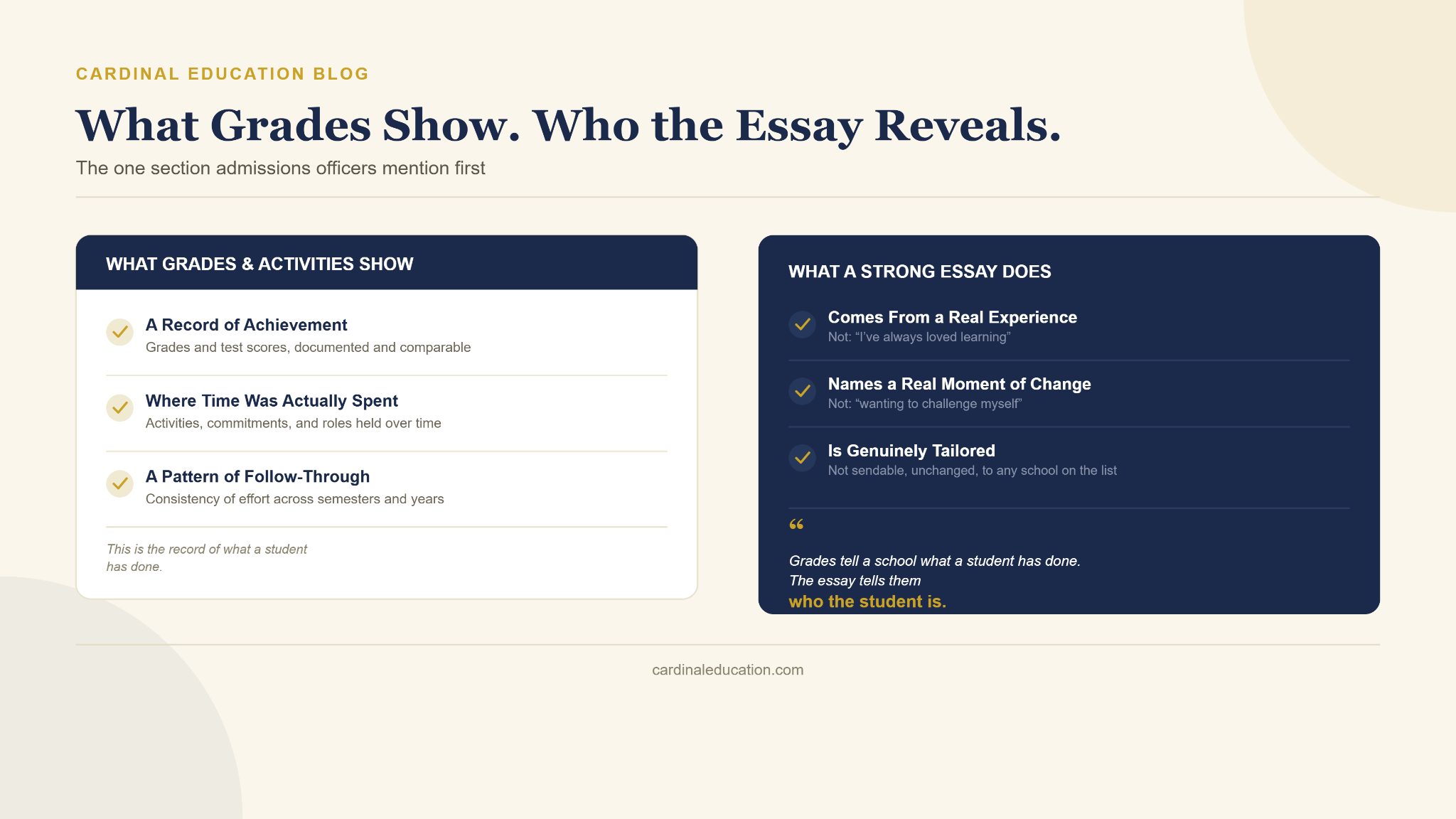
Grades and activities tell a school what a student has done. The personal statement tells them who the student is. This is the section admissions officers usually mention first when asked what actually moves a decision.
A strong essay is specific, not aspirational. It’s built from a real experience, a real interest, a real moment of change, rather than a general statement about “loving to learn” or “wanting to challenge myself.” Tailoring matters too: an essay that could be sent to any school on the list rarely reads as genuine to the one reading it.
Letters of Recommendation: Who Vouches for the Student
A recommendation letter is the one part of the application the student doesn’t write, which is exactly why schools weight it heavily. A specific, detailed letter from a teacher who has actually taught the student, especially in a core subject, carries far more weight than a generic one from someone with a bigger title but less direct contact.
Families can influence this indirectly, by helping a student build a genuine relationship with a teacher well before application season, rather than requesting a letter from someone who barely knows them.
The Interview: A Two-Way Conversation
Not every school interviews, but many competitive ones do. It’s less a test than a conversation: admissions officers want to hear a student talk about their own interests and reasons for applying in their own words, not a rehearsed script. Parents are sometimes included, particularly at younger grade levels.
The goal isn’t a flawless performance. It’s genuine engagement with the school and a clear sense that the student has actually thought about why this particular place is a fit.
What Schools Are Really Assessing: Growth, Not Just Résumé
Underneath all of the individual pieces, admissions committees are asking one underlying question: is this student likely to grow here? That shows up in a few concrete ways:
Curiosity and initiative. A student who picked up something outside their usual lane, a language, a coding project, a niche academic interest, signals they’re self-directed rather than only responding to what’s assigned.
Resilience. Every strong applicant has had a setback somewhere: a hard class, a bad season, a difficult year at home. What schools care about is what came after it. An essay or interview that names a real difficulty and shows how the student worked through it is more persuasive than one that pretends everything went smoothly.
A track record of seeking out growth, whether that’s a leadership program, a new role in an existing activity, or simply trying something the student wasn’t already good at.
None of this needs to be dramatic. A quietly consistent pattern of effort and follow-through reads as more credible than a single big story engineered for the essay.

The Bottom Line
Private schools are evaluating character and fit as seriously as they evaluate transcripts, sometimes more so. The strongest applications come from students who’ve had real opportunities to develop genuine interests and take on real responsibility well before senior year, not from a checklist assembled the summer before applications are due.