
Getting into a top private school in the United States is more competitive than ever, with elite institutions. This guide breaks down acceptance rates, what schools are looking for, and what families need to know to navigate the process confidently.
Explore
Quick Answer For Busy Parents: What’s The Level of Competitiveness In Private Schools In The U.S.?
Top private schools in the U.S. are genuinely competitive. The most elite boarding schools like Andover, Exeter, and Groton accept just 10–15% of applicants, while selective urban day schools typically land between 15–30% (though elite programs in major metropolitan hubs can plummet into the single digits). Applications require strong grades, SSAT or ISEE test scores, a personal interview, and teacher recommendations, and the process has grown more competitive over the past two decades as international demand has surged.
Level of Competitiveness In Top Private Schools |
|
| Acceptance Rate: Andover, Exeter, Groton | Acceptance Rate: Urban Day Schools |
| 10-15% Applicants | 10-30% Applicants |
| Requirements | |
| SSAT or ISEE scores
Personal Interview Teacher Recommendations |
|
| Reason for the Increase in Competitiveness | |
| International demand | |
What Factors Do Private Schools Have That Make Admissions So Competitive?
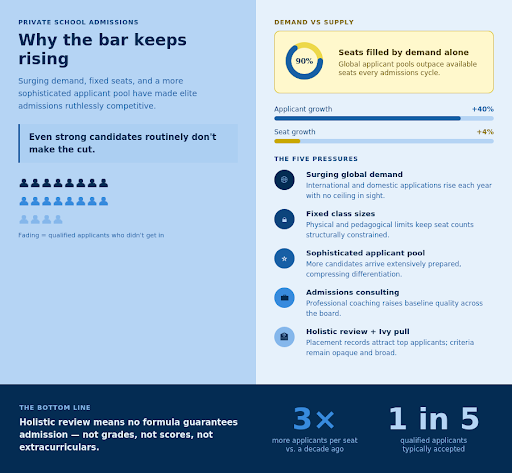
Private school admissions have grown increasingly competitive due to surging global demand, fixed class sizes, and a more sophisticated applicant pool. The rise of admissions consulting, combined with a holistic review process and the magnetic pull of Ivy League placement records, means even strong candidates routinely don’t make the cut. A few things to also consider are the focus on wealth, reputation, and prestige that a school is associated with.
Why Private Schools Attract A Globalized Applicant Pool
International applications, particularly from China, South Korea, and Southeast Asia, have doubled or tripled at many boarding schools over the past 15 years. Private schools also have a large network linking themselves to the top universities in America. They bring value and prestige to the academe as a whole, as well as bringing in an impeccable reputation for the institution and its students.
Do Private Admissions Consulting Firms Significantly Help In Admissions?
Professional educational consultants have made elite boarding schools visible to families to have well-prepared, polished applications, which adds an entirely new layer of competition. What’s pivotal about consulting firms is that they aid students and their families by explaining the process of private school admissions. For someone who’s fairly new to the process, it can be overwhelming. Perhaps a sound decision a student can make is to hire an admissions consultant to help them navigate the way.
Do Network And Prestige Drive Demand For Students To Apply?
The college placement records of schools like Andover, Exeter, and Groton, where alumni routinely attend Ivy League universities, make them uniquely attractive to ambitious families. That reputation creates self-reinforcing demand: the more successful their graduates, the more applications they receive in the following cycle.
Top Tips For Building A Strong, Competitive Academic Record Before Applying
- Start strong early. Top private schools review grades as far back as 5th or 6th grade, so consistent performance across all subjects matters—not just the final year.
- Challenge yourself academically. Taking honors or advanced courses signals intellectual ambition, even if it means a slightly lower GPA than easier classes would earn.
- Address weaknesses before they become patterns. A recurring dip in one subject can raise flags, so seek tutoring or extra support early to keep your transcript clean.
Best Practices For Getting Accepted In A Private School In The U.S.
- Begin the admissions process at least 12–18 months ahead, giving your child time to strengthen grades, prep for entrance exams, and identify the right schools.
- Build a genuine, focused profile. Schools favor applicants with deep passion in one or two areas over a long list of surface-level activities. Authenticity stands out far more than a packed resume.
- Practice for the interview. The personal interview carries significant weight, so help your child speak confidently about their interests and goals in a natural, conversational way.
Common Questions About The Competitiveness In Top Private Schools In The U.S.
Q: What are the most prestigious private schools in the USA?
A: The most prestigious private schools in the U.S. include Phillips Academy Andover, Phillips Exeter Academy, Groton School, Deerfield Academy, and The Hotchkiss School. These institutions are all renowned for their rigorous academics and strong Ivy League placement records.
Q: Are private schools in the US worth it?
A: For many families, the benefits that private schools offer can justify the cost. With generous financial aid available, the investment can be more accessible than it appears.
Q: How competitive are top private schools in America for international students?
A: Top private schools are highly competitive for international students, with applications from China, South Korea, and Southeast Asia having doubled or tripled over the past 15 years.
Q: What are the average admission rates for highly selective private high schools in the US?
A: The most selective private high schools in the U.S. typically accept between 10% and 20% of applicants. Selective urban day schools tend to be slightly less restrictive, averaging between 15% and 30%.
Related Articles
Understanding the U.S. Education System: How American Schools Work from K-12 to College
Understanding Different Educational Philosophies American Private Schools Utilize
How Early Should You Start Private School Admissions
What Are Schools Actually Evaluating?
Top private schools evaluate grades in context, expect SSAT or ISEE scores in the 85th percentile or above, and place significant weight on the personal interview and specific teacher recommendations. Schools also favor “pointy” applicants, those with one deep passion over a long list of activities. They also assess students for their academic readiness and curiosity, character, sense of community, and interview evaluation.
How Significant Are The Students’ Academic Records?
Grades matter enormously, but context matters too. A 3.8 GPA from a rigorous public school may be weighted more favorably than a 4.0 from a less demanding environment. Admissions readers are trained to read school profiles and understand grade distributions. It’s a big factor to consider, although it’s not the only factor that has weight on a student’s admission.
How Much Impact Do Standardized Tests and Interviews Have On Admissions?
Top private schools require either the SSAT or ISEE, with competitive applicants typically scoring in the 85th percentile or above. Though exceptional candidates can earn offers with lower scores offset by other strengths. Equally important is the personal interview, conducted by an admissions officer and carrying significant weight; a student who comes across as genuinely curious, self-aware, and articulate can move meaningfully up an admissions committee’s ranking.
Why Are Students’ Extracurricular Activities Considered Vital?
The era of the well-rounded student has largely been supplanted by the era of the “pointy” applicant; someone with a genuine, demonstrable passion rather than a long list of clubs. Admissions committees at boarding schools are building communities with musicians, athletes, debaters, coders, and entrepreneurs through extracurriculars. Fitting into a perceived “need” can be an advantage. These kinds of activities make for a more well-rounded student.
Top Tips When Looking For An Established And Elite Private School
- Check the school’s academic excellence. One of the main points to consider is their university placement rates, most especially their Ivy League and top-tier admissions
- Look for schools that put a premium on multi-disciplinary activities. Some of the most notable private schools offer solid programs in the arts, STEM, and athletics.
- Understand the selective admissions process. Private schools’ acceptance rates are low and usually range under 20-30%
Best Practices For Choosing An Admissions Consulting Firm To Work With
- Credentials and experience are key; it’s best to check those first. Usually, consultants with a successful track record are an indication of future positive outcomes
- Know what their expertise is. Not all consulting firms are the same, nor do they focus on the same area in admissions. Do a little research and find what fits.
- Assess their communication style and see if you’re compatible with it. The admissions process can bring a lot of stress, so if you choose consultants who can communicate directly and concisely, all the better.
Common Questions About the Admissions In American Private Schools
Q: What percentage of American students go to private schools?
A: 9-10% of American K-12 students study in private schools. This means that roughly 4.7 million students are enrolled all across the country. Attendance rates, however, vary by location; Washington, D.C., and Hawaii have two of the highest rates.
Q: What is the number 1 private school in America?
A: Based on consistent rankings, Phillips Exeter Academy in Exeter, New Hampshire, is the number 1 private high school in America as ranked by Niche. The school’s mission is to “unite goodness and knowledge and inspire youth from every quarter to lead purposeful lives”.
Q: What American high school is the hardest to get into?
A: The Stuyvesant High School in New York is the hardest high school to get into. They have what they call the Specialized High Schools Admissions Test (SHSAT), an exclusive standardized exam. With fewer than 900 spots up for grabs and around 30,000 students who apply yearly, it’s definitely challenging to get in.
Q: What are the pros and cons of private education in America?
A: When it comes to the pros, private education can be able to give students a more conducive and supportive environment to study in: smaller class sizes, robust academic programs, college prep, and shared community values. On the other hand, there are limits to what private schools can offer students: high cost, lack of diversity, fewer special education services, and fewer state regulations.
| Pros | Cons |
| Smaller class sizes | High cost |
| Robust academic programs | Lack of diversity |
| College prep | Fewer special education services |
| Shared community values | Fewer state regulations |
Related Articles
Private School Admissions: Understanding What Schools Look For In Applicants
Why Admissions Consulting Is A Game-Changer for Competitive Schools
Crafting A Winning Personal Statement
Competition Is Steep, But It’s Still Possible To Win
A student’s resilience and fervor may be tested through all of this. With all of the academic, extracurricular, and admissions responsibilities to think about, it can get tiring. But at the end of the day, all is not lost. One may be thinking: Is there really potential? Can I get into a prestigious school? Not only is there potential, but it is also actually possible.
Here at Cardinal Education, we aim to design a student’s potential and turn it into possibilities through well-thought-out approaches and strategies. Bespoke consultations, essay coaching, and top-tier tutoring are a few of the services our admissions consulting firm offers. No matter how challenging it gets, we’re right here with you.
Schedule a confidential consultation with us today.