
Building a balanced boarding school list that’s got an edge over the competition? Explore the steps for choosing the schools that are most advantageous to your admission chances.
In This Guide
Quick Answers for Busy Parents
To create a high-caliber boarding school list, you must have a diverse group of schools that fall into specific categories: Safety, Match, and Reach Schools. By assessing your child’s academic profile, you’ll be able to know which type of school a certain school falls under. Safety Schools have the highest acceptance rates, Match Schools have a good cultural and program fit, and Reach Schools have low acceptance rates but still give a possible chance of admission.
Key Terms: What Are Safety, Match, and Reach Schools?
Navigating boarding school admissions requires a strategic approach. Understanding how schools categorize applicants—and how you can categorize schools—is the first step in building a balanced list. The following framework serves as your roadmap for balancing ambition with realistic outcomes based on your child’s unique academic and extracurricular profile.
| Summary | ||
| Safety | Academic stats significantly above the school’s median. | These are schools where your child is a strong candidate and highly likely to gain admission, providing a solid foundation for your list. |
| Match | Academic stats consistent with the school’s median. | These are schools where your child fits the academic profile and cultural community, offering a balanced chance of acceptance. |
| Reach | Academic stats at or below the school’s lower median range. | These are highly selective schools where admission is competitive and never guaranteed, even for strong candidates; these are your ‘aspirational’ choices. |
Why Is the Safety, Match, Reach Framework Essential for Competitive Boarding School Applicants?
Competition in boarding school admissions is tough. Applicants go through a meticulous process that takes time, effort, and energy just to stay in the game or get ahead.
There are instances when dealing with admission decisions, you can’t always gauge the results. At times, there’s so much certainty that getting a child in is inevitable. Other times, uncertainty takes over so much that it leaves a child blindsided. This framework helps build a realistic and solid foundation for your child to navigate the process of getting accepted into a school that’s the right fit for them.
How Do I Know If a Boarding School Is a Reach, Match, or Safety?
For determining whether a school is a reach, match, or safety, these main factors are considered:
| Determining Your Child’s Safety, Match, and Reach Schools | ||||
| Category | Acceptance Odds | Test Scores | GPA | Admission |
| Reach | Under 25% or your child’s profile is below the school’s median | Below the 50th percentile for admits | Below the school’s published average | Admission is possible, but not guaranteed |
| Match | 25-50%, and your child’s profile is within their range | Within their typical range | At or near their average | Balanced chance of admission |
| Safety | 50%+ and your child’s profile is clearly above median | Above their median | Comfortably above
their average |
Highly likely to gain admission |
Your Child’s Academic Profile (Grades and Test Scores)
An academic profile is a data-driven summary that showcases a student’s educational identity. This profile includes the student’s GPA, transcripts, and standardized test scores.
A school is considered a reach when your child’s scores fall below the 50th percentile for admitted students, whereas a match school indicates that their profile is within the school’s typical range. Conversely, a safety school is one where your child’s academic scores are comfortably above the median of the admitted class.
Understanding School Competitiveness and Acceptance Rates
Top-tier schools like Exeter, Andover, and Choate are highly selective, admitting only 10-18% of applicants, which makes them a reach for the vast majority of students. Mid-tier schools typically have acceptance rates between 25-40% and can serve as either a match or a reach, depending on the specific academic profile of the applicant. Less selective schools admit 50% or more of their applicants and are more likely to represent a match or safe territory for competitive candidates.
What Makes Your Child Unique (The “Whole Student” Approach)
The holistic approach to admissions considers extracurricular distinction in athletics, arts, and competitions alongside legacy status and demonstrated interest through campus visits and alumni engagement. Geographic background also plays a critical role, as schools seek to broaden their footprint by admitting students from underrepresented regions, while financial aid needs can also influence decisions depending on whether a school is need-blind or favors full-pay families.
Our Admissions Consultant’s Insight: These holistic factors often act as hooks that align with a school’s annual institutional needs. For instance, a student with specialized STEM research capabilities, a rare athletic position (like a left-handed pitcher or a crew coxswain), or specific artistic talents (such as playing an underrepresented orchestral instrument) can significantly impact an application. When a school needs to fill a specific gap in its incoming class, these unique strengths can shift an applicant from “Reach” to “Match” status, as the student offers a high-value contribution that goes beyond mere academic statistics.
How the Safety, Match, and Reach Framework Is Applied to Build a Balanced Boarding School List
There are 6 steps to creating a strategic boarding school list for competitive students.
Step 1. Assess the Academic Profile
Build the list around data. Most families overestimate the “reach” odds. But honest calibration is vital. These are the requirements for your child:
- SSAT / ISEE percentile
- Extracurricular depth
- Recommendation letters
Step 2. Define Non-Negotiables First
Before talking selectivity, filter by what actually matters:
- Boarding vs Day School
- Coed vs. Single-Sex School
- Geographical location
- Special programs
Step 3. Build by Tier, Not by Prestige
Resist the urge to stack reaches. Put realistic estimates on your matches, safeties, and reaches. More gets unmanageable. Your child may need approximately seven to nine schools in total, and a balanced distribution.
Step 4. Research Fit, Not Just Rankings
Curriculum model matters. Different models of learning produce different experiences. Consider the curriculum model and your child’s own learning style.
Step 5. Visit and Interview Strategically
Interview performance can meaningfully move the needle, especially at match schools. Campus visits show genuine interest and often reveal culture, student energy, and advisor accessibility.
Step 6. Track Yield and Demonstrated Interest
Some schools monitor interest closely. Early outreach, campus visits, and thoughtful communication with admissions can tip decisions, especially at competitive match and safety schools where your child is a strong fit.
What Is the Ideal Number of Safety, Match, and Reach Schools for a Competitive Applicant’s List?
In estimate, two to three for Reach, three to four for Match, and two to three for Safety. These are general guidelines, not hard rules. There are also particular factors to consider when considering your child’s ideal number of schools, including your child’s level of competitiveness, the number of schools your family can realistically manage, and geographic or program constraints.
With all this being said, the core principle behind the numbers is this: balance matters. It’s the definite one out of all the uncertainties that you may come across while building your child’s school list. Enough Reaches to be ambitious, enough Matches to have a solid backbone, and enough Safeties to ensure real options—this is what is ideal.
Our Admissions Consultant’s Insight: Top elite schools are highly selective. The most competitive boarding schools are selective not just because of prestige and history, but because demand far outstrips the number of available spots. And admissions is less about meeting the bar and more about fitting a class.
Top Tips for Shortlisting Competitive Boarding Schools for Reaches
- Research each school’s published acceptance rate and compare it honestly to your child’s current GPA and test scores.
- Identify two to three unique programs or values at each school that genuinely align with your child.
- Visit or attend info sessions early so your child can speak authentically about “fit” in their application essays.
- Work backward from application deadlines to make sure your child has time to strengthen weak spots before submitting.
Best Practices in Finding Match Boarding Schools for Competitive Students
- Define “match” by academic profile and learning style. A school that challenges without overwhelming is the ideal spot.
- Use SSAT/ISEE score percentiles as a benchmark, not just raw scores, to accurately gauge where your child sits in the applicant pool.
- Cross-reference school culture (arts-progressive vs. athletic vs. STEM) with what actually motivates your child day-to-day.
Common Questions Asked About Safety Boarding Schools for Competitive Students
Q: Should we still take safeties seriously?
A: Yes. Competitive students sometimes get surprised by rejections, so having a strong safety for your child is essential.
Q: Can a safety still be a great fit?
A: Absolutely. Some students thrive more at a less pressurized school that fits them well.
Q: What if my child doesn’t want to attend their safety?
A: That’s something to revisit on the list. Every school on it should be one that your child would genuinely attend.
Q: Is it okay if my child’s safety school is less academically rigorous than their reach schools?
A: Yes. What matters is that it’s still a good fit for your child, not that it offers the same intensity of their reaches.
Related Articles
What Successful Boarding School Applicants Have in Common
Why Boarding Schools Value Authenticity Over Polish
Why Boarding School Is Popular with International Families
How Is the Reach, Match, and Safety Framework Applied for Ivy League-Bound Students?
For students with an Ivy League trajectory, the stakes at the boarding school level are higher because the boarding school itself becomes part of the college application story.
Below is a sample boarding school list from an Ivy-Targeting student:
| Category | School | Why |
| Reach | Phillips Exeter | Top Ivy feeder, highly selective |
| Reach | Phillips Andover | Same caliber, very low acceptance rate |
| Reach | Groton | Small, elite, strong Ivy placement |
| Match | Choate Rosemary Hall | Rigorous, well-regarded by Ivies, more accessible |
| Match | Deerfield Academy | Strong academics, solid college placement |
| Match | Hotchkiss | Consistently sends students to top universities |
| Safety | Northfield Mount Hermon | Solid academics, lower selectivity |
| Safety | Proctor Academy | Supportive environment, still college-focused |
| Safety | Pomfret School | Good fit options, less competitive applicant pool |
Our Admissions Consultant’s Insight: Ivy League colleges don’t just look at which boarding school a student attended; they look at what the student did with the opportunity. A student who excels at a match or safety school can absolutely outperform a student who just survives at a reach school. It’s about setting the student up to thrive in their chosen college, which is what ultimately drives Ivy outcomes.
Which Boarding Schools Offer Strong College Placements, and How Is the Likelihood of Admission Determined?
Based on the past several years, these boarding schools have had offers of strong college placement:
For the likelihood of admission, schools typically weigh:
- Academic Profile
- Extracurriculars
- Essays
- Recommendations
- Interview
- Demonstrated Interest
- Institutional needs
Top Tips for Building a Highly Strategic Boarding School List for Competitive Students
- Balance your list across reach, match, and safety tiers so your student has real options, not just a wishlist.
- Research each school’s college placement data, not just its reputation, to verify it actually delivers Ivy outcomes.
- Factor in your student’s learning style and environment needs when weighing each tier, not just selectivity.
- Apply to schools where your student’s specific strengths fill a genuine gap in that year’s incoming class.
Best Practices for Shortlisting the Best Boarding Schools with High College Placements
- Look beyond the school’s name and dig into where their graduates actually land. School profiles and Common Data Sets don’t lie.
- Prioritize schools with strong faculty mentorship and college counseling, not just a prestigious alumni network.
- Shortlist schools where your student’s academic profile sits at or above the median admitted student.
- Visit campuses and talk to current students. Culture fit directly impacts performance, which drives college outcomes.
Common Questions About Ivy League-Boarding School Connections
Q: Do Ivy League schools prefer boarding school applicants?
A: Not automatically. But top boarding schools build the rigor, profile, and polish that Ivy League admissions respond to.
Q: Which boarding schools have the strongest Ivy League pipelines?
A: Exeter, Andover, Groton, Choate, and Deerfield consistently place the highest numbers at Ivy League universities.
Q: Can a student get into an Ivy League from a lesser-known boarding school?
A: Absolutely. What matters is the student’s record, not the school’s brand.
Q: Does attending a reach boarding school guarantee better Ivy League odds?
A: No. A student who thrives at a match school often outperforms one who struggles at a reach.
It’s not just a school list; it’s risk management, opportunity optimization, and strategic design.
Related Articles
How to Ace Boarding School Admissions: Tips to Stand Out and Get Accepted
The Very Best Boarding Schools In America
What the Top Boarding Schools Look For in Today’s Applicants
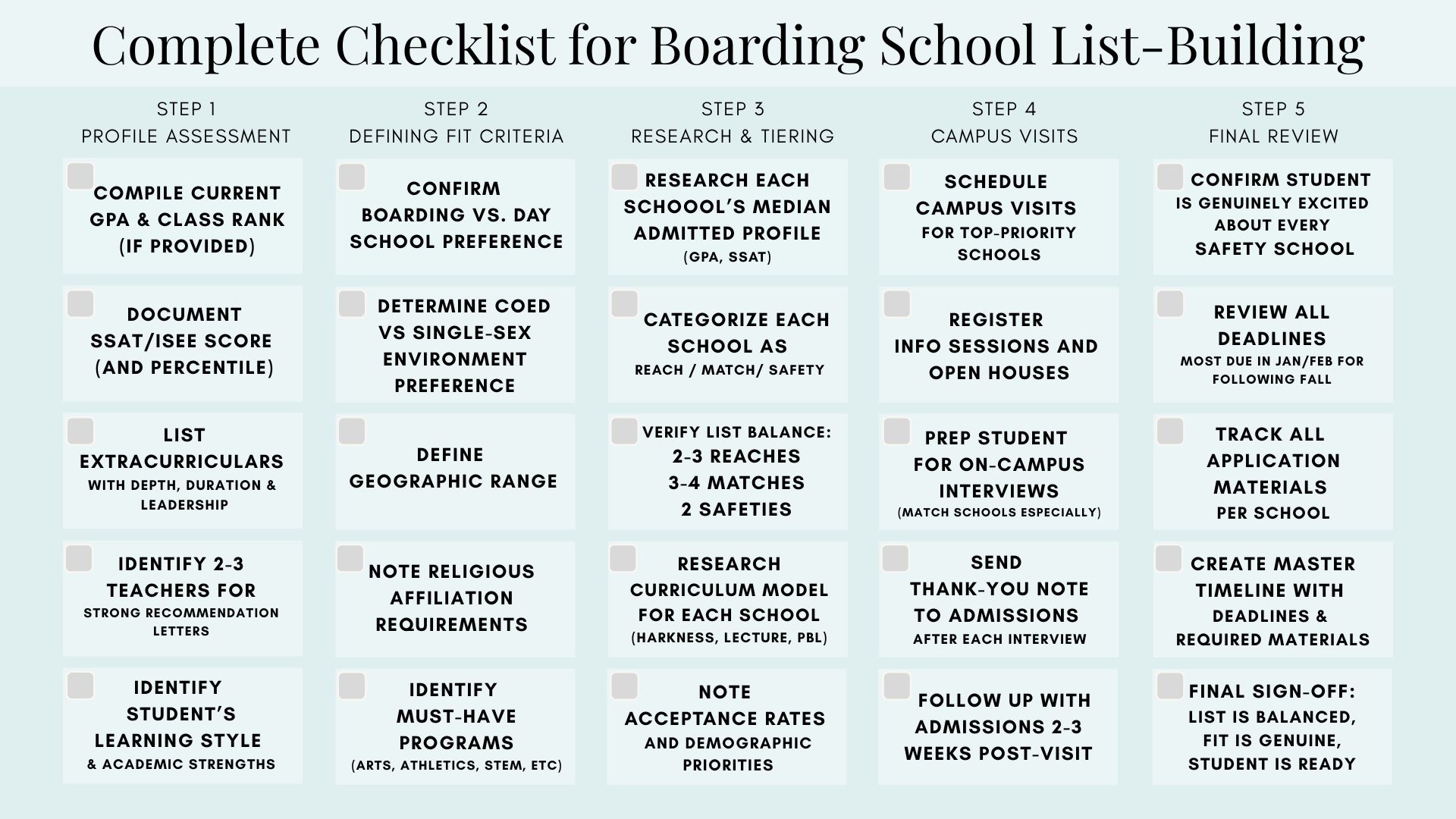
A Complete Checklist: Building a Competitive Boarding School Application List
A complete checklist would have all your bases covered. In the one we’ve made for you below, there is a progression that coincides with your action steps.
Need a Comprehensive Boarding School List? Cardinal Education Can Help!
It’s not just a school list; it’s risk management, opportunity optimization, and strategic design.
Building a solid foundation for your child’s academic trajectory starts with a balanced and strategic roster of possibilities. At Cardinal Education, we understand this can entail complex work, but our boarding school admissions consultants can do this even with their eyes closed.
If you are open to working together, we can curate a list that encourages your child to reach their full potential in a school that fully aligns with their values, goals, ambitions, and dreams.
Schedule a confidential consultation with us today.