
Cardinal Education is an independent educational consulting company. We are not affiliated, associated, authorized, endorsed by, or in any way officially connected with any public or private school.
A complete guide for families, from independent boarding school admissions consultants.
Quick Answer for Busy Parents
Choate Rosemary Hall admits roughly 16% of applicants, though the school publishes neither an acceptance rate nor any minimum GPA or test score. Applications run through Gateway to Prep Schools and are due January 15, with decisions on March 10. Testing is optional. Interviews are online only, capped at one per applicant, and held between September and February. Because the school sets no numerical bar, admission turns on the qualitative parts of the file: essays, recommendations, the parent statement and the interview. Families who start early enough to attend a fall admission event consistently write stronger applications than those who do not.
Why Do Families Choose Choate Rosemary Hall?
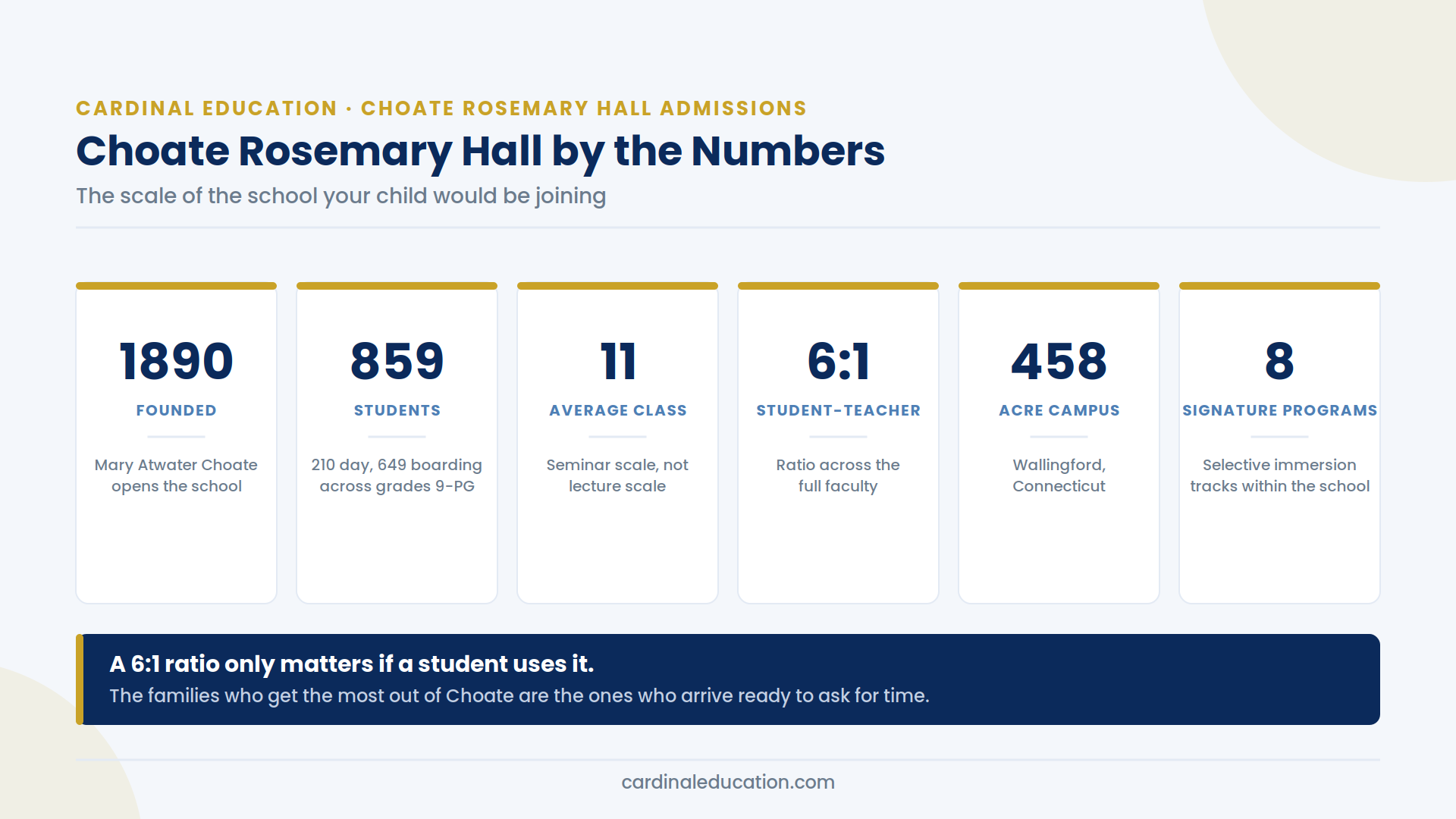
Choate began as two schools. Mary Atwater Choate founded a school for girls in 1890; Judge William Gardner Choate founded a school for boys in 1896. They combined into a single coeducational institution in the 1970s, and the school has spent the century since building a reputation on two things held in deliberate tension: a genuinely demanding curriculum, and character formation inside a residential community. Choate calls this dynamic balance. In practice it means a student is expected to be excellent in the classroom and useful outside it, and neither substitutes for the other.
The campus runs to 458 acres in Wallingford, Connecticut, about fifteen miles north of New Haven. The curriculum spans more than 300 courses across six departments, and eight signature programs let students go far deeper in one direction than a high school ordinarily allows. Families choosing Choate are usually choosing that combination: breadth as the floor, with a real path to specialization on top of it.
Choate Rosemary Hall at a Glance
| Field | Detail |
| Location | 333 Christian Street, Wallingford, Connecticut 06492 |
| Founded | 1890 (Rosemary Hall) and 1896 (The Choate School) |
| Type | Private, coeducational, day and boarding |
| Grades served | 9 through 12, plus a postgraduate year |
| Total enrollment | 859 students | 210 day | 649 boarding |
| Enrollment by grade | 9th: 172 | 10th: 207 | 11th: 235 | 12th: 229 | PG: 16 |
| Average class size | 11 |
| Student-teacher ratio | 6:1 |
| Domestic students of color | 40% |
| International students | 18% |
| College counseling team | 8 counselors |
| SAT middle 50% | ERW 620–750 | Math 610–770 | Total 1220–1510 |
| ACT middle 50% | English 26–35 | Math 26–32 | Reading 27–35 | Science 24–34 | Composite 25–34 |
| Athletics | 80+ interscholastic teams across 20 sports |
| Academic departments | Arts; English; History, Philosophy, Religion and Social Sciences; Languages; Mathematics and Computer Science; Science |
| Motto | Fidelitas et Integritas |
How Hard Is It to Get Into Choate Rosemary Hall?
Independent sources place Choate’s acceptance rate at approximately 16%. We label that an estimate deliberately, because Choate does not publish the figure. The school is explicit that its process is holistic, that it sets no minimum requirements, and that it publishes neither average GPA credentials nor standardized test scores. Some families find that frustrating. It is actually informative: it tells you the committee is not screening on a number, which means the number is not where your child’s application will be won or lost. For broader context, see our analysis of how competitive top private schools really are.
Choate sits in the same selectivity band as Phillips Academy and its fellow Eight Schools Association members. Applicants arrive with strong transcripts as a baseline, so the transcript rarely differentiates. What differentiates is evidence of an actual intellectual life, demonstrated character, and a plausible account of how this particular student will contribute to a residential community.
Top Tips for Getting Into Choate
- Submit the Inquiry Form as early as you can. It is the trigger for interview invitations and event registration.
- Pick a lane. Depth in one area beats competence in five, particularly at a school organized around signature programs.
- Rehearse the online interview format, not just the answers.
- Give recommenders eight weeks and real context about what your child is applying to.
- Read the Statement of Character and the Central Qualities of a Choate Education before drafting anything.
Best Practices for a Strong Choate Application
- Have your child name specific programs, teachers or facilities and explain why. Generic admiration reads as generic.
- Keep the parent statement about your child rather than about your child’s achievements.
- Decide on testing with a diagnostic rather than an instinct.
- Front-load the timeline so nothing important lands in the last week of December.
- Confirm requirements on Choate’s own admission pages, which change between cycles.
Common Questions About Choate’s Selectivity
Does Choate publish an acceptance rate?
No. The roughly 16% figure circulating online comes from third-party aggregators, not from the school. Choate declines to publish minimums, average GPAs or score averages as a matter of policy.
Is it easier to get in as a day student?
Choate describes the pool as competitive whether a student applies as a day or boarding candidate. Only families within commuting distance of Wallingford realistically have the choice, and where the commute is sustainable the admission office has historically suggested considering the day option.
Are some entry points less competitive than others?
Ninth grade is the largest entry point, with 172 students in the current ninth form. Available places in later grades depend on attrition and vary year to year, which generally makes tenth and eleventh grade entry tighter rather than looser.
The Choate Rosemary Hall Admissions Process
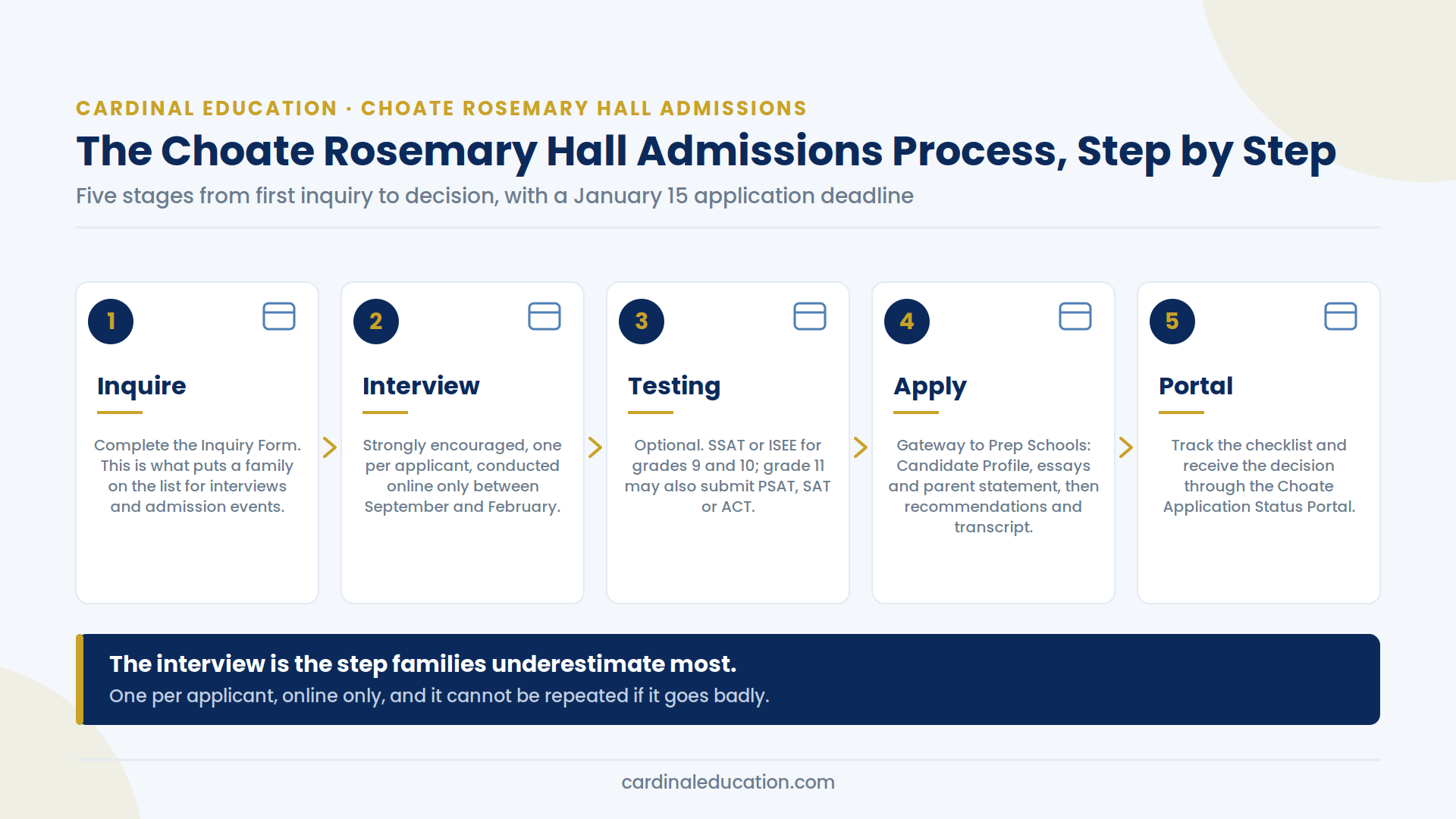
Choate structures the process as a sequence rather than a single submission. Each stage produces information the next one builds on.
- Complete the Inquiry Form. This adds your family to Choate’s mailing list and generates invitations to interviews and admission events.
- Schedule the admission interview. Strongly encouraged, one per applicant, conducted online between September and February.
- Decide on standardized testing and, if submitting, arrange for official scores to be sent directly from the testing agency.
- Register with Gateway to Prep Schools and complete Part 1, the Candidate Profile.
- Complete Part 2: the applicant essays and the parent or guardian statement.
- Complete Part 3: request the Principal or Counselor Recommendation and Transcript Report, plus current English and mathematics teacher recommendations, and any optional recommendations.
- Monitor and complete the file through the Choate Application Status Portal, which also delivers the final decision.
Choate Rosemary Hall Admissions Calendar and Key Dates
| Milestone or Event | Date | Notes |
| Application opens | July 2026 | Inquiry Form first |
| Diversity Round Table Reception | September 15–16, 2026 | Detroit and Chicago |
| Ten School Admission Organization receptions | September 17–20, 2026 | Charlotte, Raleigh, San Francisco, Miami, Palo Alto and Atlanta |
| Regional high school fairs | September 2026 onward | Including Phoenix; Choate updates the calendar through the fall |
| Interview window | September through February | Online only |
| Application status portal opens | Beginning in the fall | Applicants are notified by email |
| Application deadline | January 15 | Gateway application must be submitted by this date |
| Late materials accepted | By February 1 | Still permits an on-time decision |
| Decisions released | March 10 | Through the applicant portal |
If your family is applying to several schools, our overview of boarding school application deadlines will help you see where Choate’s January 15 sits relative to the rest of your list.
Choate Rosemary Hall Application Requirements
The Inquiry Form
Everything starts here. The form collects basic student and family information and areas of programmatic interest. Completing it puts your family on the mailing list and, more practically, is what prompts the interview invitation. Families who skip it and go straight to Gateway routinely find themselves scrambling for an interview slot in January.
Applicant Essays
The essays are the primary place a student stops being a set of numbers. Choate is looking for a voice, not a summary. The most common failure is the achievement inventory: a well-written piece that restates the activities list in prose. The second most common is the essay that has been edited by three adults until nothing fifteen-year-old survives in it. Helping a student find and keep their own writing voice is harder than helping them write well, and it matters more.
The Parent or Guardian Statement
Part 2 also asks parents to write. Choate wants to understand your child’s character and to understand your family: why Choate, what you hope for academically, how you engage with your child’s current school and community. The committee is assessing family fit alongside student fit, and it can tell the difference between a parent who knows their child and a parent who knows their child’s résumé. Our parent statement guide covers what tends to work and what reliably does not.
Recommendations
Choate requires three recommendations and accepts two more. The distinction between them matters, because families often spend their energy on the wrong one.
| Recommendation | Required? | Who Writes It |
| Principal or Counselor Recommendation | Required | A school official, submitted with the Transcript Report |
| English teacher | Required | Current-year teacher |
| Mathematics teacher | Required | Current-year teacher |
| Third teacher recommendation | Optional | A current or previous teacher |
| Personal recommendation | Optional | An adult who knows the student well and can speak to character |
Postgraduate applicants may use a current or previous teacher for the required recommendations. Applicants in grades nine through eleven who cannot secure a current-year teacher should contact the admission office directly rather than substituting quietly. Our guidance on how to ask, and whom, applies squarely here.
Transcripts
Choate asks for current grades alongside the academic record from the previous two years. Students already in grades nine through twelve should also have their counselor submit the school profile sheet where one is available. Because the committee reads for direction rather than a single snapshot, a rising trajectory through progressively harder coursework does real work in a file.
Standardized Testing
Testing is optional at every entry point. If your child does submit, the options vary by grade.
| Applying to | Accepted Tests |
| Grades 9 and 10 | SSAT or ISEE |
| Grade 11 | SSAT, ISEE, PSAT, SAT or ACT |
| Postgraduate | SAT or ACT |
| Non-native English speakers | TOEFL, IELTS or Duolingo, strongly encouraged |
Scores should be sent directly from the testing agency where possible; for the PSAT, SAT and ACT a school counselor may submit verified scores instead. Choate’s codes are 1883 for the SAT and TOEFL, 2392 for the SSAT and 070245 for the ISEE. Note that Choate’s published prose and its own grade-by-grade table differ slightly on which tests tenth graders may submit, so confirm directly with the admission office if your child is applying to tenth grade. On the underlying question of whether to test at all, a diagnostic and some honest analysis will serve you better than a rule of thumb.
The Admission Interview
Interviews last 45 minutes and are conducted entirely online. Choate does not offer in-person interviews on campus or anywhere else, and the school is explicit that this is a deliberate equity decision that also frees families to be fully present during campus visits. The first 20 to 25 minutes are one-on-one with the student; the remaining time is available for a conversation with parents. All interviewers’ assessments carry equal weight, so there is no benefit in trying to secure a particular one. There is one interview per applicant and no second attempt, which is precisely why structured preparation pays here more than almost anywhere else in the process.
Questions Families Ask About Testing and Interviews
If Choate is test-optional, why would we submit?
Because a score can answer a question the rest of the file leaves open, such as whether a student from an unfamiliar curriculum will handle Choate’s pace. If the transcript already answers that question, the score adds little. Our piece on test-optional boarding schools walks through the decision properly.
How should a student prepare for a video interview?
Differently than for an in-person one. Eye contact means looking at a lens, silences feel longer, and energy reads flatter on camera. Practising the format is as important as practising the content of the answers.
What if a required recommendation arrives after January 15?
As long as the Gateway application itself was submitted by January 15 and the outstanding materials arrive no later than February 1, applicants should still expect a decision on March 10.
Student Life at Choate Rosemary Hall
Academics
More than 300 courses sit across six departments, with electives, honors and advanced work throughout. The eight signature programs are the distinctive layer: Advanced Robotics Concentration, Arabic and Middle Eastern Studies, Arts Concentration, Capstone Program, Environmental Immersion Program, Global Engagement Program, the John F. Kennedy ’35 Program in Government and Public Service, and the Science Research Program. Each carries its own eligibility requirements and its own profile, which is sent to colleges as an attachment to the counselor recommendation. Places are limited and admission to a program is separate from admission to the school.
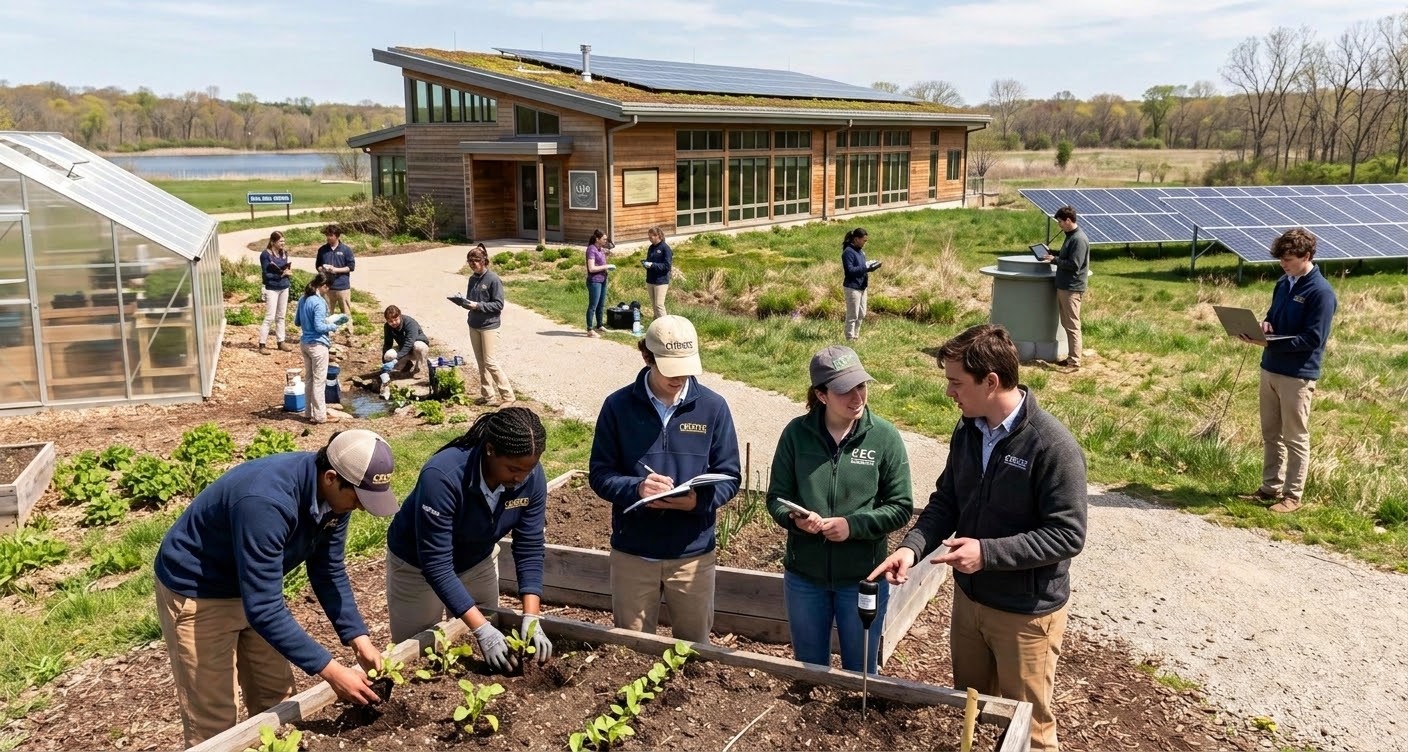
The Kohler Environmental Center anchors the Environmental Immersion Program and was the first residential environmental research center in American secondary education. The Lanphier Center houses mathematics and computer science. Dedicated study hours help new students build the habits the workload assumes.
Activities
More than 100 clubs and organizations run on campus. Named examples include the Robotics Team, the Math Team, The Choate News, the Asian Affinity Space, RISE, CALM, This Is Us, the Mixed Heritage Association, a Thai culture club, and student-led spiritual life organizations including Hillel, the Muslim Student Association, Christian Fellowship, Roman Catholic Fellowship and Buddhist Meditation. Roughly fifteen clubs focus on equity and inclusion. The annual club fair at the start of the year is where most of this actually gets chosen.
Athletics
Choate fields more than 80 interscholastic teams across 20 sports, competing as the Wild Boars in the Founders League and the Eight Schools Association. The programme spans archery, baseball, basketball, crew, cross country, field hockey, football, golf, ice hockey, lacrosse, sailing, soccer, softball, squash, swimming and diving, tennis, track and field, ultimate frisbee, volleyball, water polo and wrestling. For recruited athletes the timeline runs ahead of the general admission calendar, and athletics in admissions works differently enough to warrant separate planning.

Arts
The Paul Mellon Arts Center is the hub for dance, music, theater and visual arts, and the Arts Concentration gives students with serious commitment a structured path through it. Ann and George Colony Hall, opened in 2019, added further performance and gathering space.
Residential Life
Roughly three quarters of students board, across thirty dormitories ranging from large halls to small houses. A faculty member lives in each. Older students serve as prefects, and dedicated residential teams support new students through the transition. This is the part of Choate that admissions is quietly assessing throughout the application, because it is the part that runs twenty-four hours a day.
Choate Rosemary Hall Famous Alumni
- Adlai Stevenson ’18. Governor of Illinois, twice the Democratic nominee for President, and later United States Ambassador to the United Nations.
- John F. Kennedy ’35. The 35th President of the United States, and the namesake of Choate’s signature program in government and public service.
- Edward Albee ’46. Pulitzer Prize-winning playwright, best known for Who’s Afraid of Virginia Woolf?
- Glenn Close ’65. Award-winning stage and screen actor across a career spanning five decades.
- Victoria Nuland ’79. American diplomat who served as Under Secretary of State for Political Affairs.
- Paul Giamatti ’85. Actor known for a long body of critically acclaimed film and television work.
- Angela Ruggiero ’98. Olympic ice hockey medallist and later a member of the International Olympic Committee.
- Hilary Knight ’07. Olympic ice hockey medallist and one of the most decorated players in the American programme.
One Interview. No Retakes.
We rehearse the online format until your child stops sounding rehearsed. That distinction is the whole job.
A Final Word
Choate is unusual among highly selective schools in telling families plainly that it has no numerical bar. That honesty cuts both ways. It removes the comfort of a target to hit, and it puts the weight on the parts of an application that reveal who a student actually is. The families who do well here are the ones who take that seriously a year out rather than a month out.
Where Does Your Child Actually Stand?
We will tell you honestly, including when we think another school is the better fit.
Related Articles:
Choate Rosemary Hall Admissions for International Students: How to Apply and Succeed
Choate Rosemary Hall Admissions: A Complete Guide to the Eight Signature Programs