
When identifying the Best Private Schools for College Placement, families must look beyond superficial rankings to evaluate the actual matriculation patterns of graduates. Learn more in this guide.
In This Guide
Private school college matriculation statistics have become some of the most scrutinized factors for parents considering sending their children to a private school. Although getting admitted to Ivy League schools tends to be the most celebrated outcome, college matriculation is actually a bit more complicated than this.
The best private schools not only admit graduates to a handful of top-tier schools but also consistently get their graduates into a wide array of top-notch colleges that match their academic preparedness, interests, and future objectives. This guide explores which top colleges accept graduates of some of the best private high schools.
Quick Answer for Busy Parents
Top private schools for college placement invariably have graduates who go on to attend selective institutions such as Ivy League schools, Stanford University, MIT, Duke, and the top liberal arts colleges. However, the right-fit college does not simply depend upon the name and ranking of the schools but should be based on the individual student’s academic strengths and interests.
| School | Notable Strength |
| Phillips Exter Academy | Harkness discussion method; top T20 placement rates |
| Phillips Academy Andover | Non Sibi service philosophy: 80%+ to highly selective colleges |
| Harvard-Westlake School | Collegiate-level resources; premier West Coast placement |
| Trinity School | Top-ranked NYC school; legendary Ivy League placement |
| Groton School | Parlor’s mentorship: best student-to-counselor ratio in prep education |
| Choate Rosemary Hall | Signature programs in robotics, government, and the arts |
| The Hotchkiss School | Top 25 nationally; environmental stewardship programs |
| Sidwell Friends School | Quaker values; elite D.C. college placement record |
| Deerfield Academy | Ivy + NESCAC placements; character-driven tradition |
| St. Paul’s School | 24/7 immersive academic environment; deep faculty mentorship |
| The Lawrenceville School | Harkness + House system; consistent Ivy and Top-10 placements |
| The Dalton School | Progressive Dalton Plan; highly self-directed learners |
| Collegiate School | Oldest U.S. school (est. 1628); top Ivy feeder for boys K–12 |
| Milton Academy | “Dare to be true” culture of intellectual risk-taking; NESCAC + Ivy |
| The Brearley School | Most demanding NYC girls’ school; exceptional humanities pipeline |
| Castilleja School | Silicon Valley STEM leader; MIT and Stanford pipeline |
| Lakeside School | Top Pacific NW school; alumni include Bill Gates, tech mentorship |
| Stanford Online High School | Stanford-designed; university-level coursework for gifted students globally |
| College Preparatory School | Low-ego, high-achievement culture; consistent Ivy and top-tier placement |
| The Branson School | Marin County premier; student-led sustainability; elite counseling |
Which Private Schools Have the Strongest College Matriculation Records?
Before we get into the rankings, what exactly is a college matriculation? College matriculation is the final, confirmed enrollment of a student at a specific university after the admissions process is complete. Understanding this metric is essential for families navigating the competitive admissions landscape.
Reputation gets schools on the radar. Results get them on this list. Please note that this ranking is based on Cardinal Education’s professional experience as educational consultants and feedback from hundreds of families we have worked with. It reflects our informed opinion and is intended to provide insight for families exploring private school options. This content is not affiliated with, endorsed by, or officially representative of any of the schools mentioned.
Phillips Exeter Academy | Exeter, NH
Phillips Exeter Academy is a top-ranked boarding and day school in New Hampshire known for its Harkness discussion method, extraordinary T20 college placement rates, and a rigorous curriculum that produces some of America’s most competitive university applicants each year.
Phillips Academy Andover | Andover, MA
Phillips Academy Andover is one of the most prestigious prep schools in the United States, consistently sending over 80 percent of graduates to highly selective universities through its Non Sibi service philosophy, elite faculty, and nationally recognized academic programs.
Harvard-Westlake School | Los Angeles, CA
Harvard-Westlake is the premier college-preparatory day school on the West Coast, offering collegiate-level resources. The school consistently achieves a near 100 percent four-year college matriculation rate and unmatched access to elite university placements for students across Los Angeles and the surrounding region.
Key terms: A “feeder” school is an institution that consistently sends a significant percentage of its graduating class to a specific university or group of universities.
Trinity School | New York, NY
Trinity School in Manhattan is consistently ranked the top private school in New York City, with legendary Ivy League placement rates and a rigorous academic culture spanning kindergarten through grade 12. The school consistently achieves a near 100 percent four-year college matriculation rate, based on its consistent college matriculation record.
Groton School | Groton, MA
Groton School is a highly selective New England boarding school renowned for its intimate Parlors mentorship system, one of the strongest student-to-counselor ratios in American prep education, and a sustained record of placement at Ivy League and top 10 universities.
Choate Rosemary Hall | Wallingford, CT
Choate Rosemary Hall is a leading Connecticut boarding school distinguished by its Signature Programs in robotics, government, and the arts, attracting students who seek deep academic specialization. The school consistently achieves a near 100 percent four-year college matriculation rate, based on consistent data.
The Hotchkiss School | Lakeville, CT
The Hotchkiss School is a fully residential Connecticut prep school ranked consistently in the top 25 nationally by U.S. News, with strong environmental stewardship programs, deep faculty bonds, and a proven record of elite university placement for its graduates.
Sidwell Friends School | Washington, DC
Sidwell Friends School is Washington D.C.’s most distinguished Quaker prep school, known for its reflective academic culture, activist alumni network, and proximity to the capital’s power centers. It consistently maintains a near 100 percent four-year college matriculation rate according to multi-year trends.
Deerfield Academy | Deerfield, MA
Deerfield Academy is a character-driven New England boarding school with a long tradition of placing graduates at Ivy League institutions and NESCAC colleges, built on a culture of shared traditions, face-to-face mentorship, and deep alumni loyalty.
St. Paul’s School | Concord, NH
St. Paul’s School is a fully residential New Hampshire boarding school offering a 24/7 immersive academic environment, extraordinary faculty depth, and a college counseling program that reliably places graduates at the nation’s most selective universities.
The Lawrenceville School | Lawrenceville, NJ
The Lawrenceville School combines the Harkness discussion method with a collaborative House system to create one of the strongest college preparatory environments in the Northeast, with a consistent track record of Ivy League and top 10 university placements from New Jersey.
The Dalton School | New York, NY
The Dalton School in Manhattan applies its signature progressive Dalton Plan to develop highly self-directed students who are among New York City’s top Ivy League college candidates, supported by individualized scheduling and rich elective offerings. The school consistently achieves a near 100 percent four-year college matriculation rate.
Collegiate School | New York, NY
Founded in 1628, Collegiate School is the oldest school in the United States and one of Manhattan’s top feeders to Ivy League universities, providing boys in kindergarten through grade 12 a rigorous, tradition-rich education. The school consistently achieves a near 100 percent four-year college matriculation rate.
Milton Academy | Milton, MA
Milton Academy is a highly regarded K-12 boarding and day school near Boston whose “dare to be true” motto drives a culture of intellectual risk-taking, producing graduates who consistently earn admission to NESCAC colleges, Ivy League universities, and other top-ranked institutions.
The Brearley School | New York, NY
The Brearley School is widely recognized as one of the most academically demanding girls’ schools in the country, with particular strength in the humanities and a formidable Ivy League placement pipeline. Its New York City graduates have historically matriculated to four-year colleges at a rate near 100 percent.
Castilleja School | Palo Alto, CA
Castilleja School is Silicon Valley’s leading all-girls college preparatory school, empowering young women to excel in STEM fields and earn admission to MIT, Stanford, and other top universities. The school holds a Niche A+ rating and has historically sent nearly all of its graduates on to four-year colleges.
Lakeside School | Seattle, WA
Lakeside School is the top-ranked private school in the Pacific Northwest on Niche, famous for alumni including Bill Gates and Paul Allen. Its intellectually elite environment and strong tech-industry mentorship opportunities have historically supported a near 100 percent four-year college matriculation rate.
Stanford Online High School | Redwood City, CA
Stanford Online High School is a fully accredited online prep school designed by Stanford University faculty, serving gifted students globally with university-level coursework and one of the most academically rigorous high school curricula in the country. Graduates have historically gone on to four-year colleges at a rate near 100 percent.
College Preparatory School | Oakland, CA
College Preparatory School in Oakland is one of the Bay Area’s most intellectually distinctive private high schools, known for its low-ego, high-achievement academic culture and consistent placement at Ivy League and other top-tier universities. The school’s four-year college matriculation rate has historically hovered near 100 percent.
The Branson School | Ross, CA
The Branson School is Marin County’s top-ranked private high school, distinguished by its student-led sustainability culture and elite college counseling program. Reflecting its standing as one of Northern California’s premier college preparatory institutions, Branson has historically matriculated nearly all graduates to four-year colleges.
Top Benefits of Reviewing Matriculation Outcomes
- It helps families understand real college placement patterns.
- It provides insight into academic strength and advising quality.
- It helps families compare schools beyond marketing claims and rankings.
Best Practices for Evaluating College Matriculation Data
- Look at multi-year trends instead of a single graduating class.
- Compare matriculation outcomes relative to school size.
- Focus on college fit patterns, not just Ivy League counts.
Common Questions About College Matriculation
Q: Does matriculation data show where students are accepted or where they enroll?
A: It typically reflects where students ultimately enroll after receiving admissions offers.
Q: Is Ivy League placement the best measure of school quality?
A: No, broader matriculation across selective colleges provides a more accurate picture.
Q: Do all top private schools send students to Ivy League universities?
A: Many do, but strong schools also place students in a wide range of elite institutions.
Q: How important is college consulting in matriculation outcomes?
A: It is very important because it shapes application strategy and school selection.
Q: What is the difference between an Ivy League school versus a top-tier liberal arts college?
A: Ivy League schools are large research universities offering extensive resources, whereas top-tier liberal arts colleges emphasize undergraduate teaching and small class sizes.
Related Articles
The Honors College vs. The General University: Which One Should You Choose?
Building the Perfect College List: 5 Myths Juniors Need to Ignore This Month
Understanding Educational Philosophies in American Private Schools
What Should Families Look for When Evaluating College Matriculation Data?
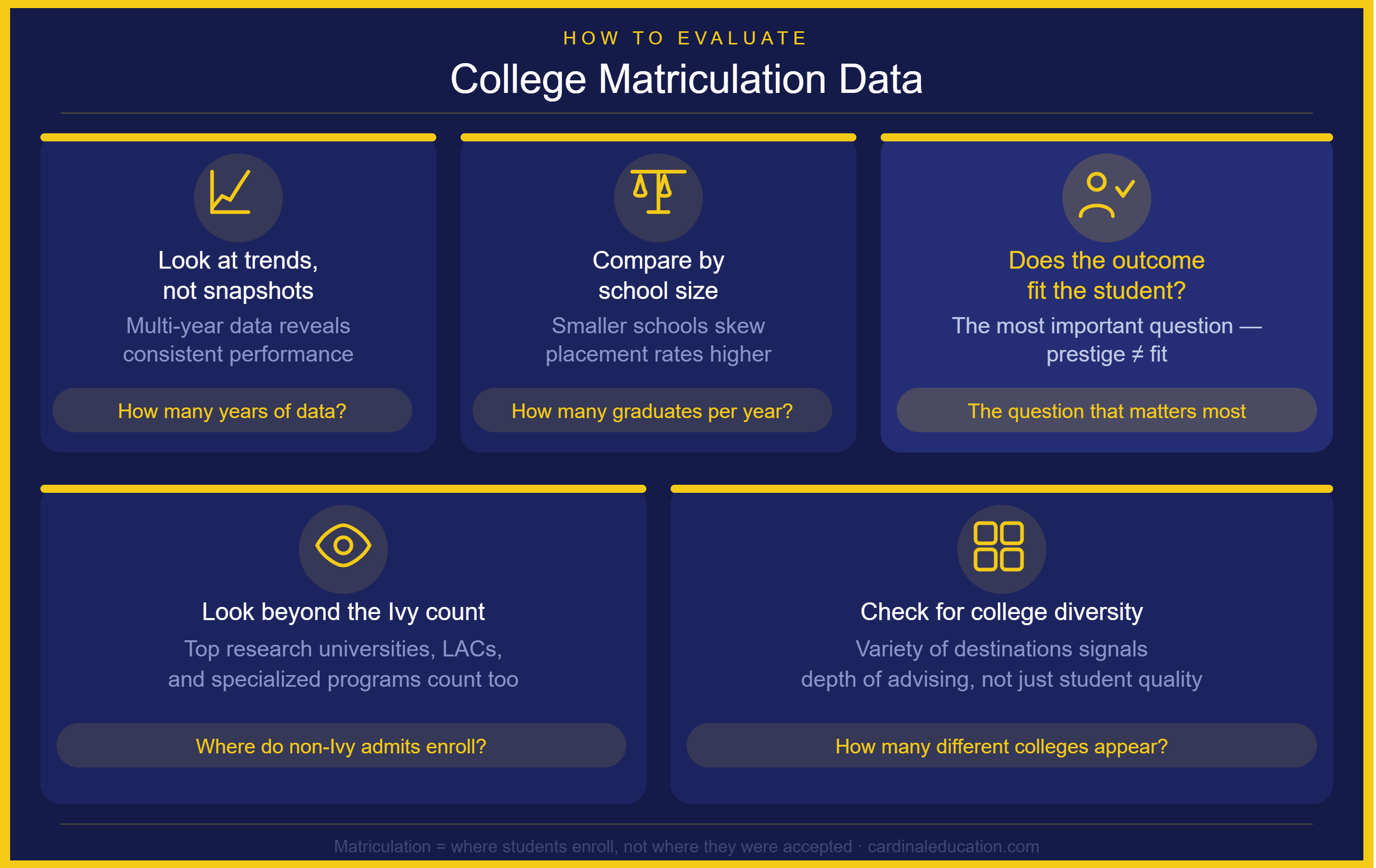
Elite families need to understand that there is much more to matriculation data than meets the eye. Although college matriculation figures look great, especially where prestigious colleges are concerned, there are several factors that could contribute to such numbers, including student selectivity, school size, and even self-selectivity of applicants.
The most meaningful insights come from understanding how schools support students throughout the college admissions process and how consistently they help students identify and gain admission to colleges that match their academic profile and goals.
Why Is It Important to Look Beyond Ivy League Placement Numbers?
The sole consideration of statistics related to Ivy League placements will be misleading in the sense that it does not consider other highly selective colleges where excellent students do equally well. There are many outstanding colleges that give priority to the right fit over elite branding statistics.
A more accurate view of success includes placement into top research universities, liberal arts colleges, and specialized programs that align with student interests and strengths.
How Do School Size and Student Selectivity Affect Matriculation Statistics?
A small school or private school with very selective admissions policies is likely to have an inflated matriculation rate because of the small number of graduates at such institutions. On the same note, schools that accept top students are likely to produce good college figures regardless of programming.
The significance of understanding these factors is that it helps elite families understand the information in context.
Top Tips for Evaluating Matriculation Outcomes
- Compare schools with similar student populations and size.
- Review long-term placement trends instead of annual snapshots.
- Evaluate whether outcomes align with student interests.
Best Practices for Interpreting College Placement Data
- Look for diversity in college destinations.
- Focus on fit and academic alignment, not prestige alone.
- Review how alumni outcomes evolve over time.
Common Questions About Matriculation Evaluation
Q: Should families prioritize Ivy League placement rates?
A: No, broader college placement patterns are more meaningful indicators of success.
Q: Do matriculation lists include all colleges that students attend?
A: They typically highlight major destinations but may not include every institution.
Q: Can matriculation data predict my child’s college outcome?
A: It provides insight but cannot determine individual admissions results.
Q: How early should families consider college pathways?
A: Planning often begins in middle or early high school for best results.
Related Articles
Private School vs Public School: Which is Right for Your College Goals
How to Choose Between Multiple College or Private School Admissions Offers
Evaluating Campus Culture and Fit: How to Choose the Right School Environment
Plan Your Private School to College Pathway With Cardinal Education
Understanding where top students actually enroll is only part of building a strong admissions strategy. Families also need to consider academic preparation, extracurricular development, testing strategy, and long-term positioning to compete effectively in selective admissions pools.
Cardinal Education supports families through private school admissions consulting, academic tutoring, executive function coaching, college admissions strategy, and long-term academic planning. Our work helps students build the academic and personal foundation needed to reach top colleges with confidence and a genuine character.
Our track record speaks for itself; this year alone, 98% of our senior students gained admission to their top-choice colleges.
Reach out today to Cardinal Education to build a strategic pathway from private school to college success.