
Discover what elite families do differently in private school open house visits to secure their spot in top-tier institutions.
Explore
Quick Answers For Busy Parents
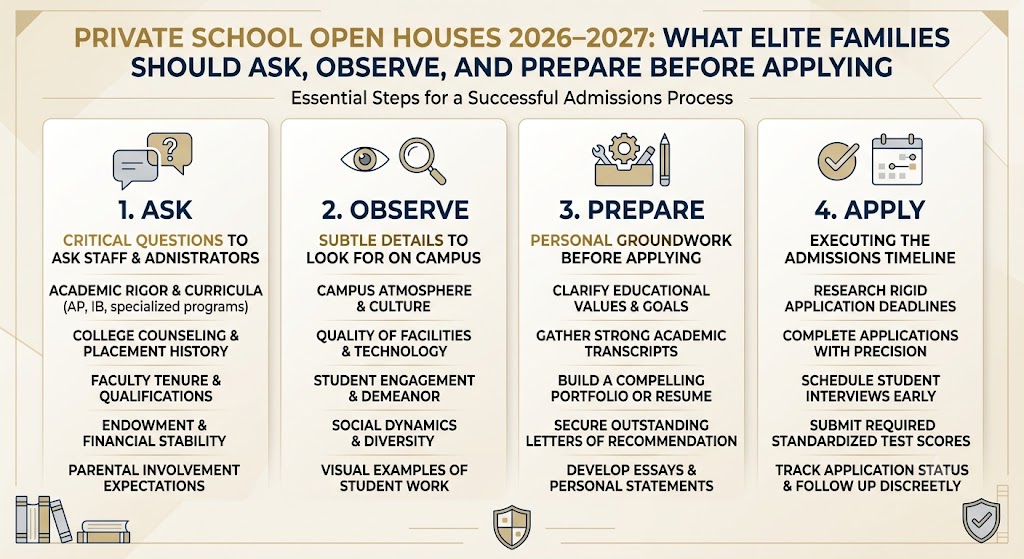
When attending private school open houses, elite families should intentionally ask critical questions about five-year growth priorities and support for exceptionally driven students. They should also keenly observe unspoken details, from classroom setups to authentic campus interactions. Most importantly, they should prepare rigorously by assessing their child’s academic positioning and cultivating strong family advocacy before stepping onto campus.
Beyond the Basics: How Discerning Families Evaluate Open Houses
Exploring a truly exceptional educational environment for your child requires looking beyond the surface. Discerning families move past the external to observe the authentic campus culture, unspoken priorities, and genuine student-faculty dynamics.
What Strategic Questions Should You Ask During Campus Visits?
When visiting open houses, elite families understand that real value is found in the questions they ask, and in the quality of answers they solicit. Asking highly specific questions is essential for uncovering such insights. This ensures the school’s culture genuinely aligns with the families’ goals, ambitions, and expectations. To help you maximize your visit and vet prospective institutions, we’ve curated a list of pertinent questions to guide your evaluation.
| Topic | Questions To Ask | What You’re Really Asking | Why It Matters |
| Endowment | How is the endowment currently allocated to attract top-tier faculty? | Are capital allocations prioritized to attract and retain premium faculty who will teach and mentor my child? | Faculty quality is the most direct driver of academic outcomes.
The allocation of funds reveals whether the school prioritizes it in practice. |
| School Growth | What are the deliberate growth priorities for the next five years? | Does the school have a clear and ambitious vision, or are they maintaining the status quo? | This shows institutional confidence and leadership quality; vague answers are a yellow flag. |
| Early Decision (ED) Applications | What are your ED acceptance rates at Ivy and Tier-1 universities over the last three years? | How effective is the school’s college counseling at getting students into their dream school on the first and most committed try? | ED-specific data over three years reveals consistent, calculated counseling depth at the highest level of application competition. |
| Student Support | How does the school accommodate students competing at an elite level in athletics, arts, or running a business alongside their academics? | Is this school made
for exceptionally driven students—not just academically strong ones, But across all pursuits? |
This reveals whether the school has real capability to support multi-dimensional high achievers, or would it limit what your child can become while enrolled. |
| Board of Trustees | What is the dynamic of the Board of Trustees, and how do parents meaningfully engage beyond standard fundraising? | Who is in charge of the school? Are they effective, and do families have a real seat at the table or just a chair at the gala? | Their transparency directly shapes school culture, stability, and whether families are treated as partners or just donors. |
What Key Details Should You Observe When Touring An Open House?
Academic Rigor and Faculty Caliber
- Observe classroom setups. Are they designed for discussion and critical thinking or passive instruction?
- Notice class sizes. Smaller class sizes show more individualized attention and higher faculty investment.
- Look for evidence of high-level work displayed or exhibited (projects, publications, competition results)
- Ask a faculty member what they’re currently researching or reading. Curiosity is a good sign.
Campus Culture and Cultural Dynamics
- Observe how students interact with each other.
- Notice whether students speak confidently and respectfully to adults and visitors.
- Look for diversity in backgrounds, interests, and personalities, not just demographics.
- Pay attention to student energy. Do they seem engaged or indifferent towards the school?
Concierge-Level College Counseling
- Ask for the number of college counselors who are on staff and their student-to-counselor ratio.
- Look for a dedicated, well-resourced college counseling office.
- Ask when their counseling begins. Does it start in the 9th grade or in junior year?
- Notice how counselors speak about students as individuals or in generalities.
Security, Discretion, and Operations
- Notice how visitors are received at entry. Is there a clear security protocol?
- Observe staff demeanor. Are they composed, discreet, and attentive?
- Look for clean, well-maintained facilities. These reflect institutional pride.
- Pay attention to how the school handles sensitive questions.
Not sure if your child is positioned correctly for these schools?
Schedule a confidential consultation with a Cardinal Education advisor today.
When and How Should Your Child Engage with Admissions?
When assessing prospective schools, the admissions team is also evaluating your family at this level. The focal point is your child. What matters most is that your child comes across as genuinely engaged and curious, not curated or performative. So when and how should your child engage with admission?
Generally, the initial open house is often for you, the parent. Unless the school requests the child’s attendance, it’s best that parents attend alone. When your child does join, encourage them to ask specific and thoughtful questions. Perhaps this would look like, “I heard about your independent robotics study; how much access does the school give to students for in-depth research?”
In line with this, empower your child to answer for themselves. If an admissions officer asks your child a question, resist the urge to answer for them. Students who have the quiet confidence to advocate for themselves is a quality top-tier schools look for. A genuine answer from a 13-year-old, even if it isn’t perfect, is always better than a polished answer from an adult.
Another note worth mentioning is how admission officers of this stature also pay close attention to subtle etiquette. Eye contact, a firm handshake, and how a student treats the administrative staff (not only the Head of Admissions) speak volumes about their character and how they will fit into the school’s culture.
Top Tips For Asking The Right Questions During An Open House
- Skip the brochure stats. Ask how the school handles bespoke scenarios and unexpected challenges.
- Listen for alignment. Try asking the exact same question to a teacher, a student, and an administrator to see if their answers genuinely match up.
- Ask student ambassadors about their most challenging academic moment to get an unfiltered look at the school’s support systems.
- Ask about legacy networks. Gain information on how the school leverages alumni connections to help current students secure elite university placements and real-world mentorships.
- While the fundamental vetting process is universal, competitive markets like the San Francisco Bay Area and California’s private school landscape often demand an earlier, more strategic timeline for families.
Best Practices For Keenly Observing A School During An Open House
- Look beyond the showpieces. Take a discreet look at the everyday spaces (standard classrooms, library corners, and dining halls). These reveal how much the school invests in daily student life.
- Read the bulletin boards. This is a quick pulse-check on student autonomy.
- Notice the other prospective parents in the room. These families represent your child’s potential peer group and your future network. See if their values and general demeanor match yours.
- Check the library’s depth. Glance at the featured book displays. You want to see intellectually rigorous and globally minded material being highlighted.
Common Questions About The Private School Open House Experience
Q: Should both parents attend the initial open house?
A: Yes, attending as a united front allows you to intentionally divide your observations during the tour and compare nuanced notes afterward.
Q: Are we expected to bring our child to the tour?
A: Unless the school explicitly states it is a family event, treat this initial open house strictly as a parent-only vetting opportunity.
Q: What is the appropriate attire for a private school open house?
A: Opt for understated, polished business casual to subtly communicate respect towards the institution’s high standards without appearing flashy.
Q: Do we need to bring anything specific to the event?
A: Bring only a discreet notebook and pen. Less is more.
Related Articles
Navigating Private School Open Houses and Tours
How Admissions Consultants Support Elite Admissions
Elite Schools in California: What Sets Them Apart
Securing the Offer: How Elite Families Prepare and Apply to Private Schools
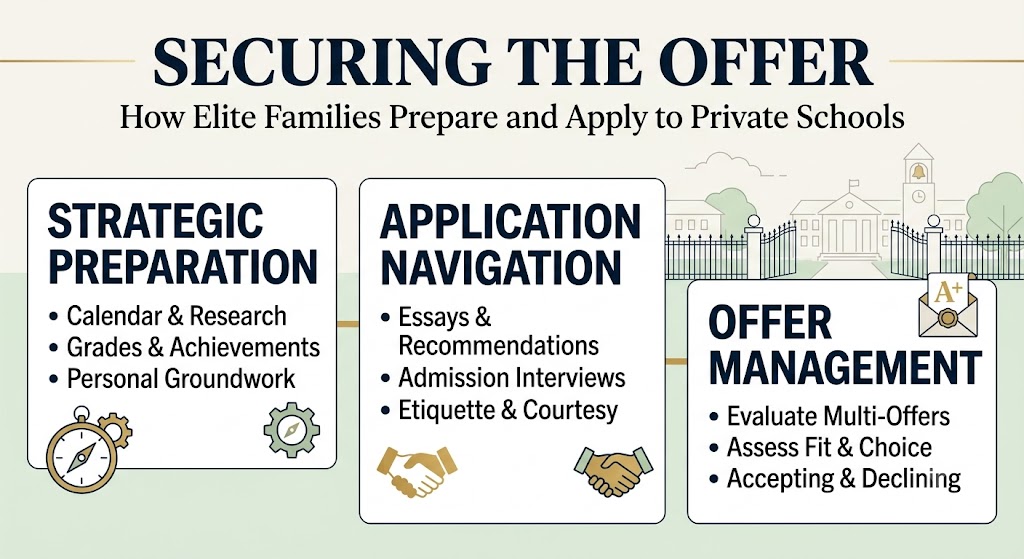
Admission to the most competitive and competent private schools requires more than academic excellence; it seeks a highly strategic approach. Elite families secure offers by elevating basic requirements to craft a cohesive and compelling narrative that aligns with the school’s core values.
What Should You Prepare Before the Private School Application Opens?
Successful private school applications start long before the official portal opening. Here are the essential pillars to consider so you can get ahead of the fall admissions surge.
Pillar 1: Academic & Intellectual Positioning
Objective: Establish a highly optimized standardized testing and academic baseline.
Pitfall: Only starting to identify academic gaps or start SSAT/ISEE test preparation during the fall semester.
Purposeful Action: Initiate test prep in the spring and seek professional consulting for a bespoke tutoring course correction during the summer months. This ensures that any dips in previous grades have been worked through before the fall semester begins.
Pillar 2: Cultivating the Student Narrative
Objective: Shift the student’s profile from generically “well-rounded” to a refined “T-shaped” hybrid: a strong foundation paired with an “angular” impact.
Pitfall: Acquiring a laundry list of affiliations with casual clubs. Admissions puts a premium on curating a well-rounded cohort, rather than admitting a class of well-rounded students.
Purposeful Action: Foster a “T-shaped” student profile over the summer. Maintain strong competence and character across core disciplines, but select one or two genuine passions. Demonstrate highly sustainable commitment, leadership, or community impact in those special interests.
Pillar 3: The Family’s Proactive Preparation
Objective: Articulate the family’s value as culturally suitable additions to the school’s community.
Pitfall: Prioritizing prestige and brand association over the family’s cultural fit, and failing to define a clear value-add for the school’s community.
Purposeful Action: Conduct a digital footprint audit for both parents and the child. Determine your family’s unique value-add (e.g. philanthropic capacity, professional expertise). Solidify your family’s non-negotiables for campus culture.
Pillar 4: Recommender and Advocate Cultivation
Objective: Secure highly personalized, impactful letters of recommendation that validate the student’s narrative.
Pitfall: Delaying recommendation requests until application portals open in September, resulting in rushed or generalized recommendations from overwhelmed teachers.
Purposeful Action: In the spring, identify pivotal mentors, coaches, or faculty members who can speak to your child’s character and resilience in detail. Formally request their advocacy before the current school year ends.
How Should You Navigate Interviews and Admissions Etiquette?
In the midst of all the preparation for paperwork, bear in mind that the interviews are worth just as much as your child’s academic performance. Top-tier private schools assess students and their families at a deeper level through these thoughtful exchanges. Here is how you can approach this critical dialogue:
- Shift your perspective. The interview is less of a “test”, and more of a “dialogue.”
- Quiet observation. Evaluation starts the moment you enter the campus.
- Practice the art of the Follow-Up. Craft a sincere, handwritten thank-you note that shows your genuine interest in the conversation.
- Discretion is crucial. Privacy is deeply valued by these institutions, and they don’t appreciate flaunting. Let your child’s merit and your family’s value speak for themselves.
- Allow your child to take the lead. This shows you are raising him or her to be an independent and resilient student.
How Should You Evaluate Offers and Effectively Manage Multiple Acceptances?
Receiving multiple acceptances is a highly privileged and sought-after position. However, it requires careful and meticulous consideration. In the elite private school community, how you handle acceptances–and rejections–can leave a lasting impression.
Seek Beyond The School Name
An institution’s historical prestige and high-net-worth connections do bring a particular allure. Rather than choose a school based on those external markers alone, seek the one that’s a custom fit for your child’s unique trajectory.
Consolidate Campus Observations
Synthesize your notes from previous open houses and tours. Carefully weigh the distinct advantages each school presented. Finalize your decision once you have determined which school seamlessly aligns with your child’s overarching goals and ambitions.
Address Waitlists With Poise
If your child does get waitlisted, you may send a highly intentional “Letter of Continued Interest” that signals your unwavering commitment to the institution. Detail recent academic or extracurricular achievements and state that they remain your absolute first choice.
Master the Polite Decline
Once you have made your final decision, promptly and graciously decline all other offers. The world of elite education is small; a thoughtful note preserves a positive relationship for the future—whether for younger siblings or broader networking.
Top Tips For Creating A Highly Optimized Academic Profile
- Prioritize rigor over volume.
- Cultivate intellectual vitality.
- Embrace the “T-Shaped” approach.
- Execute proactive course corrections.
Best Practices For A Successful Admissions Interview
- Demonstrate Conversational Agility.
- Showcase Informed Curiosity.
- Present a Unified Family Front.
- Articulate Your Unique Value-Add.
Common Questions About Private School Applications Preparation
Q: When is the ideal time to begin the preparation process?
A: Proactive families begin cultivating the student’s academic and extracurricular narrative 12 to 18 months before the application portals officially open.
Q: How much weight do standardized tests (SSAT/ISEE) actually carry today?
A: They serve as a vital academic baseline, confirming for admissions officers that a student’s transcript accurately reflects their capacity to thrive in a highly rigorous environment.
Q: Is a “well-rounded” extracurricular resume still the gold standard?
A: No; elite admissions committees put a premium on curating a well-rounded cohort, meaning they prefer “T-shaped” students with deep, highly sustainable impact in one or two core passions.
Q: What is the most common mistake families make during the admissions process?
A: Prioritizing prestige and brand association over cultural fit, and failing to define a clear, compelling value-add for the school’s community.
Related Articles
Understanding the Importance of Standardized Testing in Admissions
Private School Admissions: Understanding What Schools Look for in Applicants
Volunteering: Finding Opportunities That Matter In Admissions
A private school open house is more than a campus tour, it’s a two-way vetting process.
Even before the applications open: ask, observe, prepare. The information you gather will not only give you a deeper understanding of the prospective schools you’re evaluating, but it will ultimately inform you of the right decision for your child’s educational trajectory. We recognize the gravity of this investment, and we are here to expertly partner with you through every stage. Securing your child’s future is only a few strategic steps away.
Schedule a confidential consultation with us today.