
How Boarding School Essays Are Different From Day School Essays

In This Guide
Many elite families don’t realize that the admissions process for boarding and day schools differs. And while they are already going through the process, they’d wonder why the application feels different, especially regarding the essays. That’s because the boarding school essay serves a very specific purpose. Beyond grades and awards, the admissions committee wants to understand how well your child will adapt, thrive, and enjoy life on campus.
In this blog, we will break down how a boarding school essay differs from a day school essay, common boarding school mistakes that can weaken an application, how to write a strong essay, and how families can get support throughout the process.
An application essay may sound intimidating, but don’t worry! We, at Cardinal Education, have the best tips on how to brainstorm for a boarding school essay.
Quick Answer for Busy Parents
The number one thing that makes a boarding school essay different from a day school essay is the emphasis on independence, maturity, and readiness for the residential culture. Admissions officers will recognize a strong essay immediately, especially if the student highlights how they can thrive away from home, contribute meaningfully to the residential community, and demonstrate personal and social growth.
What is the Difference between a Boarding School Essay and a Day School Essay?
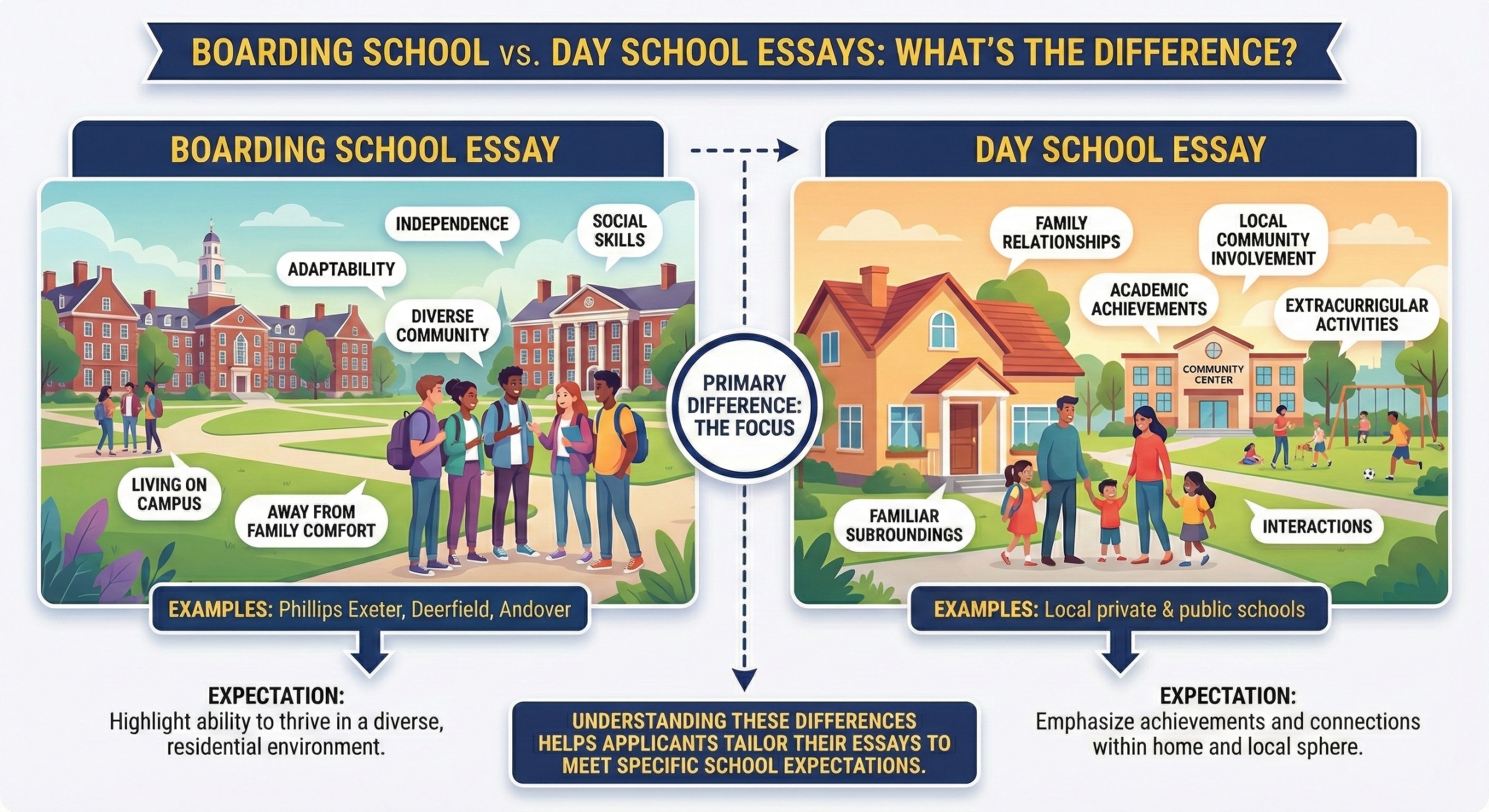
Top boarding schools in the U.S., like Phillips Exeter, Deerfield, and Andover, expect students to highlight high levels of independence, social skills, and adaptability, as they will live on a campus composed of individuals from diverse backgrounds rather than the familiar comfort of living with their families.
On the other hand, a day school essay emphasizes family relationships and interactions as well as local community involvement. Day school students highlight their achievements in both academics and extracurricular activities in a familiar setting. That said, understanding the differences helps applicants modify their essays to meet the school’s expectations.
What is the Focus of a Boarding School Essay?
The goal of a boarding school essay is to help the admissions committee understand whether your child can manage their responsibilities independently, interact with peers, and make meaningful contributions to the school culture. Overall, the focus is on a student’s independence, maturity, and readiness for residential life. These elite boarding schools expect applicants to demonstrate high levels of intrapersonal and interpersonal intelligence essential to thriving in a residential community.
What are the Differences in the Storytelling in Essays for boarding and a Day School?
Storytelling is central to any school application essay. However, if you’re wondering what the difference is between the storytelling for the boarding school and day school essays, look no further. Boarding schools ask students to reflect on their personal experiences, especially those that demonstrate independence. They also want to know more about lessons learned that led to maturity, and they want to see anecdotes that show character development.
While day school essays may still include personal stories, it prioritizes conciseness and academic excellence or engagement in impactful extracurricular activities within the school or the local community.
Top Tips to Ace Your Boarding School Essay
- Focus on highlighting personal anecdotes that demonstrate independence.
- Show, not tell, how your experiences shaped your character and consistently helped you mature.
- Use real-life examples that show problem-solving skills and resilience.
Best Practices to Prepare for Essays in Boarding Schools
- Make sure to visit the school website and familiarize yourself with the school’s culture and mission.
- Practice writing essays that show your authentic voice.
- Research what the student life is like at residential boarding school communities.
Common Questions Families Ask About Prep Schools?
Q: Can my child mention academic achievements in the essay?
A: Absolutely! However, it should be written in a way that is reflective and not boastful. It should also highlight how it led to their growth.
Q: Are boarding school essays the same as day school essays?
A: No, boarding school essays focus on a student’s independence, resilience, and readiness for dorm life. In contrast, day school essays focus on family interactions and daily school-life experiences.
Q: How long should a boarding school essay be?
A: The length of the essay varies by school, but the usual boarding school essay can be around 300 to 650 words.
Related Articles
Boarding School vs. Day School: What’s the Right Fit in 2025?
Boarding School vs. Homeschooling: Academic and Social Differences
Faith-Based vs. Secular Boarding Schools: What’s Right for Your Family?
What are the Common Boarding School Essay Mistakes That Can Weaken an Application?
The top tip in writing a boarding school essay is to avoid focusing too much on achievements and not enough on the student’s character development and their self-directedness. Your child’s academic performance and awards can be highlighted in other application materials. The admission officers want to see how your child deals with challenges, adapts to unfamiliar and uncomfortable situations, and contributes to a community away from the comfort of home.
Another common mistake is overthinking essay ideas, which often leads to disorganized and overly generic essays. Overusing common phrases like “I love learning” weakens an essay. The admissions committee wants to see specificity. Essays should be treated as an opportunity to help your child stand out in the competitive boarding school admissions process.
Lastly, not reinforcing readiness for a boarding school life is a great missed opportunity. Beyond your child’s transcripts and extracurricular activities, the admissions team is also evaluating your child’s readiness to thrive in a residential setting that requires them to be self-directed, resilient, and inclusive.
Why Writing a Boarding School Essay Like a Day School Can Hurt Admissions Chances
Formatting your boarding school essays like a day school essay by focusing too much on grades, achievements, or out-of-school activities fails to show personal growth and readiness for the boarding school experience. To be considered a competitive applicant, the admissions committee must see in your essay how your personal experiences shaped your character and how they ultimately prepared you for a life away from home.
How Overemphasizing Achievements Instead of Fit Weakens the Essay
An essay that is formatted like a resume seems inauthentic. Listing achievements without explaining how they contributed to your child’s personal growth weakens their essay. Additionally, listing awards takes up more words when they could have been used to draw a picture of how the student fits with the boarding school’s culture. As repetitive as it may sound, the alignment of the school values and personal values, as well as the residential setting readiness, strengthens the essay more.
Top Tips to Avoid Weak Boarding School Essays
- Avoid using generic school stories that will not help your child stand out in the admissions process.
- Avoid trying to “sound perfect” rather than being genuine and authentic.
- Make sure not to write the boarding school essay like a day school essay.
Best Practices for Writing a Strong Boarding School Personal Statement
- Make use of authentic experiences that show adaptability and social readiness for boarding school life.
- Highlight experiences that help show the ability to grow from setbacks.
- Ensure that the essay is tailored to each boarding school to reflect their unique values.
Common Questions Parents Ask in Writing a Strong Essay for Boarding School Application
Q: What tone should be used in the essay?
A: The tone for boarding school essays should be reflective and authentic. It should narrate how personal experiences influenced your child’s character growth.
Q: What should my child do to prepare for the boarding school essay requirement?
A: Researching about the school to get a good understanding of the school’s mission and vision is highly recommended.
Q: Should my child mention his or her extracurricular engagements?
A: Yes, especially if it demonstrates independence and leadership, since these are a few of the qualities that the admissions committee looks for.
Related Articles
What The Top Boarding Schools Look For in Today’s Applicants
Comparing Boarding Schools: Ivy-Feeder Schools vs. Well-Rounded Options
Top Boarding Schools Personalizing Education for Gen Z and Gen Alpha
How to Write a Strong Boarding School Application Essay
A competitive boarding school essay goes beyond a list of tangible achievements. The best boarding school essay talks about how your child manages responsibilities without constant hand-holding. This could include working on assignments and submitting projects on time without repeated reminders; advocating for themselves and communicating directly with teachers regarding any concerns or requests; and holding a leadership position.
To begin the writing process, choose a meaningful experience that shows growth, dependability, and self-awareness. Use examples such as facilitating a discussion to ensure responsibilities are clearly assigned to avoid volunteers disagreeing on roles. This shows initiative and leadership beyond the classroom. Demonstrate self-reflection by briefly explaining the situation and sharing what the lesson was and how it shaped character. Make sure the essay captures the student’s authentic voice and own perspective. Finally, to ensure that the essay is of the best quality, review and proofread carefully to avoid errors that could potentially weaken the essay.
Remember, a thoughtful, well-written boarding school essay helps the admissions team to envision the student thriving and engaging meaningfully in the boarding school life.
How to Choose the Best Essay Topic
Select essay topics that frame challenges encountered as a learning curve. Rather than dwelling too much on the struggles, the emphasis should be on learning. What matters most to the admissions officers is not what your child struggled with but how your child responded to it. These top boarding schools want students who are problem solvers and able to bounce back after a setback.
Some of the strongest examples also come from moments where your child experienced a shift in their perspective. This could include examples where your child initially viewed community service as a mere requirement, but after volunteering regularly at a youth shelter, they began to understand the realities of young people in crisis and felt a great sense of responsibility to show up consistently and make meaningful contributions.
The parents can support their child by helping them brainstorm for ideas that they feel genuinely connected to and do not require prompting to be able to talk about in depth.
The parents should help their child choose the best topic that they genuinely feel connected to, which does not require constant prompting to be able to talk about in detail. The goal is to help your child identify specific ideas, not to choose topics for them.
How to Align Your Child’s Goals with a Boarding School’s Mission and Campus Culture
The best way to align your child’s goals with a boarding school’s mission and campus culture is by researching the boarding school’s core values and residential environment expectations. Clearly show how your child’s goals, passions, and learning style match the school’s culture.
For instance, if global citizenship is at the core of the boarding school’s philosophy, include experiences that reflect the qualities, such as open-mindedness and inclusivity, reflective of a global citizen.
Top Benefits of Writing a Strong Boarding School Application Essay
- A strong applicant essay helps the admissions understand a student’s fit with the school.
- It allows students to stand out in the selective boarding school admissions process.
- It demonstrates preparedness for a residential environment.
Best Practices for Writing a Successful Essay for Boarding School Application
- Make sure to focus on one meaningful experience that demonstrates the qualities that these top boarding schools look for.
- After identifying the topics that will be highlighted in the essay, create an outline to ensure that the essay remains structured.
- Avoid using generic statements. Instead, make use of personal experiences and personal reflections.
Common Questions Students Ask When Writing a Boarding School Essay
Q: Can I talk about my failures?
A: Yes, as long as the focus is on the learning and how it helped you grow, and not just on how you struggled.
Q: What should I write about if I think my experiences don’t stand out?
A: Rather than thinking of big moments, think of meaningful ones. Even small everyday moments of growth can be as impactful as major achievements.
Q: Can I use the same essay for multiple boarding school applications?
A: You can adapt it, but each essay should reflect your alignment with the specific boarding school philosophy.
Related Articles
How Can I Help My Student Edit Essays Without Losing Their Original Meaning
Common Boarding School Interview Questions and How to Answer Them
How Boarding Schools Address Homesickness and Build Resilience
Need Help with Your Child’s Boarding School Essay? Cardinal Education Can Guide You
Writing a strong boarding school essay can feel overwhelming, but it doesn’t have to be. At Cardinal Education, we offer comprehensive essay preparation services that help students highlight the qualities that the admissions committee of the top boarding schools looks for.
Beyond essay coaching, we also have a team of academic coaches that helps cultivate excellent study habits, goal setting, and executive functioning skills, which are key qualities that boarding schools value. Our elite boarding school admission consultants guide students and families every step of the way, making the application process less stressful. Contact us today!
Related Articles
Why Choose Getting Into Boarding Schools: 7 Life-Changing Benefits for Students and Families
Why You Should Enroll In A Boarding School
Do You Need an Admissions Consultant for Boarding School Applications?
Frequently Asked Questions
What types of personal experiences work best in a boarding school essay?
The strongest essays for boarding school focus on personal growth, self-awareness, autonomy, and preparedness for the demands of a residential setting. These may include taking on leadership roles, genuine engagements in volunteering work, managing personal challenges, and taking initiative even in unfamiliar settings.
Can a student submit the same essay for a boarding school and a day school application?
In most cases, submitting the same essay for both applications is not recommended. Boarding schools want specificity. The essay should specifically address readiness and enthusiasm for residential life, self-management, adaptability, and community living. Day school essays, on the other hand, focus more on daily school life and academics. While some experiences may overlap, they should be framed differently to ensure a tailor-made fit to the school type. A customized essay is always better than a common essay.
How do boarding school essays influence the overall admission decision?
The essays for your boarding school application can make or break your chances of admission. A strong boarding school essay reveals a snapshot of your profile beyond just your transcript and test scores. The admissions team typically uses essays to assess a student’s character, enthusiasm, and emotional readiness.
How can expert guidance help my child write a stronger boarding school essay?
Receiving expert guidance can help your child develop essays that clearly communicate the qualities of an elite boarding school student. Working with a professional boarding school admissions consultant helps families approach the competitive admissions process with reduced stress and anxiety. Overall, with expert coaching, students are in a better position to present themselves confidently to boarding school admission officers.