
Unsure if boarding or day school is right for your child? Explore the holistic factors elite families must consider and find the ideal environment to thrive.
Explore
Quick Answers For Busy Parents
Elite families consider independence, personal growth and development, self-advocacy, 24/7 college counseling, diverse cultural understanding, and global networks as factors to look for in boarding schools. Conversely, parent-supervised student development, community-based interactions, resources and networks, and structured hours are things to consider for choosing a day school. Ultimately, it’s less about the kind of education model and more about what aligns with your child’s learning style, wants, and needs for them to thrive.
| Feature | Elite Day School | Boarding School |
|---|---|---|
| Primary Environment | Family-centered, home-based | 24/7 immersive residential campus |
| Independence | Gradual, parent-supervised | Accelerated, student-managed |
| Support System | Daily family bond, local community | Peer mentors, dorm parents, 24/7 faculty |
| College Counseling | Highly effective; localized | Deep, institutionalized, 24/7 access |
| Extracurriculars | Varied, often requires outsourcing | Immersive, on-campus, all-inclusive |
| Best For | Students valuing home-life stability | Students seeking 24/7 immersion & resilience |
How to Decide if a Day School or Boarding School Is Right for Your Child?
Choosing between day school and boarding school is one of the most consequential education decisions a family will make. The answer depends less on prestige and legacy than on knowing your child’s learning style, wants, and needs.
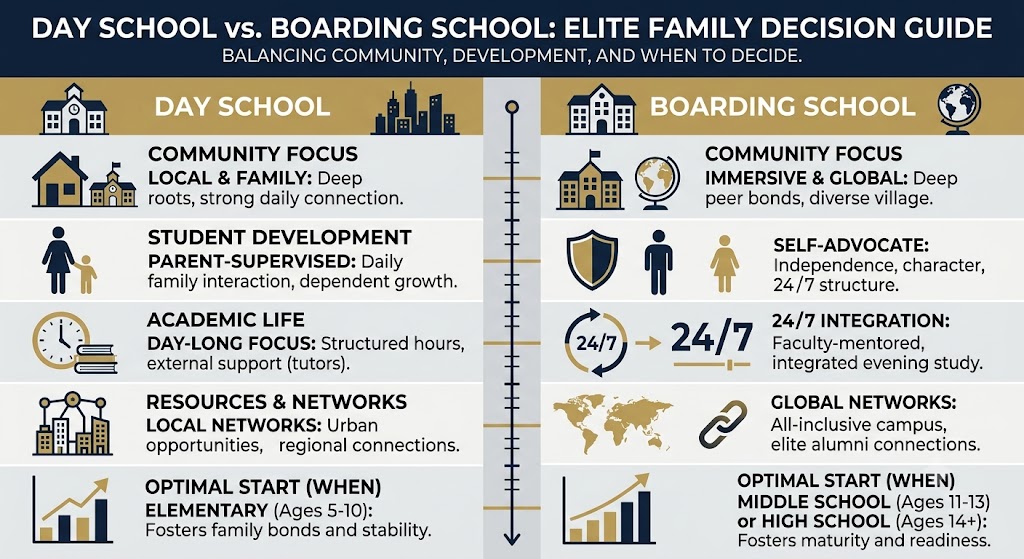
The sections below walk you through the key questions, timing signals, and decision factors that elite families use to find the right fit.
What Are the Questions to Ask When Choosing Between Boarding and Day School?
Families should start by asking how much independence their child is ready for.
- Does the home environment support the kind of focus elite prep demands?
- What does the child actually want and need?
- Does your child thrive with structure and peer immersion?
- Do they need the grounding that comes with coming home each night?
- Is your family prepared for the emotional and financial commitment boarding school requires?
When Should a Family Consider Switching From Day School to Boarding School?
The most common points are in the 8th to 9th grade. This is when the child has outgrown their current school’s academic ceiling or when family circumstances make the residential setting more practical than it once seemed. Family circumstances could include:
- Deep familial matters
- A child’s need for a different environment
- Shifting academic goals
Boarding School 10th-Grade Entry Strategy
Applying for 10th-grade entry at a boarding school is a strategic move because schools actively plan to add spots—often expanding the class size by about 15%—whereas 10th-grade spots at day schools are purely reliant on unpredictable attrition.
Cast a Wider Net. While competitive, these spots exist. scale up applications; if a student plans to apply to three boarding schools, they should consider bumping that number up to seven to maximize their chances of capturing one of those allocated 10th-grade spots.
What Factors Do Wealthy Families Consider When Choosing Boarding vs. Day School?
Beyond academics, high-net-worth families tend to weigh the following:
- The long-term network value of a school’s alumni community.
- The depth of college counseling resources.
- How each school option fits the values, goals, and ambitions of the child.
- Geographic flexibility is also a point of consideration.
Top Tips for Choosing Between Boarding Schools and Day Schools
- Assess independence levels. Boarding schools require strong self-management and advocacy skills, whereas day schools allow for a more gradual development with daily family support.
- Evaluate the family dynamic. Decide whether your family values having the student home every evening or if the child would thrive better immersed in a 24/7 campus community.
- Compare niche resources. Boarding schools often possess the endowment to provide highly specialized academic programs, facilities, and athletic coaching that local day schools might lack.
- Analyze logistical trade-offs. Weigh the daily grind of commutes and high parent-school involvement at a day school against the reality of managing a long-distance relationship during the academic term.
Best Practices in Knowing Timing Signals for Switching Schools
- Watch for academic stagnation. Persistent boredom, a sudden drop in grades, or a lack of intellectual curiosity often indicates the current curriculum has been outgrown.
- Monitor social and cultural fit. Increasing isolation, sudden shifts in friend groups, or a reluctance to go to school can signal an unhealthy peer environment or cultural mismatch.
- Listen to institutional feedback. If teachers or administrators repeatedly indicate they cannot provide the resources or advanced coursework your child needs, it is time to look elsewhere.
- Observe emotional well-being. Consistent, school-specific anxiety or a noticeable loss of enthusiasm for learning is a strong indicator that a change of scenery is required.
Common Questions Wealthy Families Consider When Choosing Schools
Q: How robust is the college counseling pipeline to Ivy League and Tier 1 universities?
A: Elite families want confirmation that the school has strong, direct, and established relationships with top-tier admissions offices to strongly advocate for their child.
Q: What security protocols and privacy measures are in place for high-profile students?
A: Physical safety, anonymity from public scrutiny, and strict data privacy are non-negotiable priorities that must be expertly managed by the administration.
Q: How flexible is the curriculum regarding extended international travel or elite extracurricular commitments?
A: Families frequently require schools to accommodate unique, global schedules or private coaching to offer unusually high levels of the student’s academic standing.
Q: What is the school’s culture around wealth, and how does it manage socioeconomic dynamics?
A: Parents want to ensure the environment either provides a comfortable, relatable peer group or actively grounds students to prevent entitlement.
Need clarity on which school environment will help your child thrive? Contact Cardinal Education today for a confidential consultation to explore your child’s best-fit academic pathway.
Related Articles
What are the Best Boarding Schools in the U.S.?
Navigating Private School Open Houses and Tours
Boarding School vs. Day School: What’s the Right Fit in 2025?
What are the Pros and Cons of Sending My Child to a Boarding School vs. a private school for college prep?
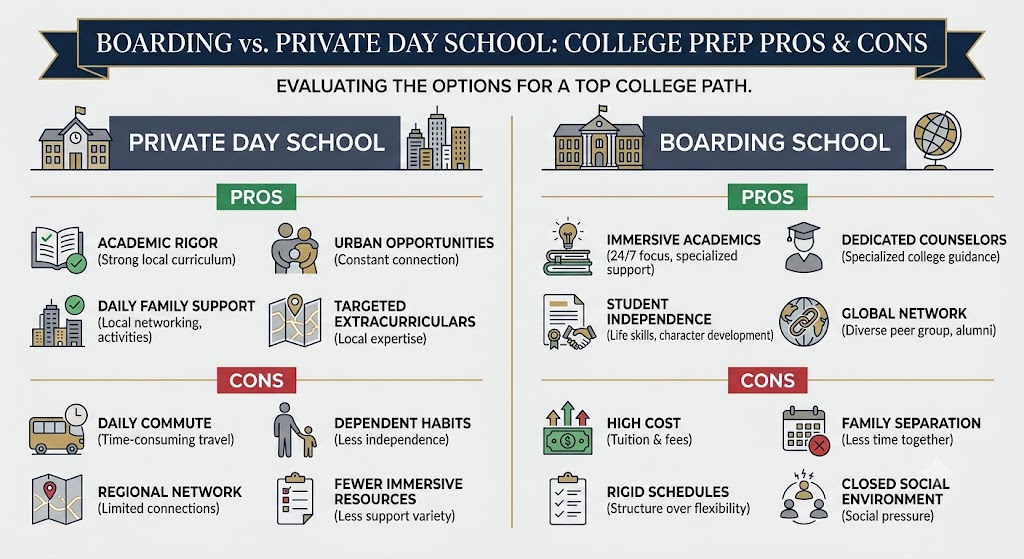
Both boarding and elite day schools can put a student on a path to a top-tier college. But what makes the difference depends on how your child learns, socializes, and grows. Here are the ways you and your family can understand and discern the two categories of schools across academics, college outcomes, and social development.
What Are the Differences Between Their Academic Rigor & Extracurriculars?
Top boarding schools like Exeter, Andover, and Deerfield are structured around an immersive academic culture. The students eat, live, and study alongside their peers. These schools tend to produce unusually high engagement and access to specialized electives, research opportunities, and varsity-level athletics.
Elite day schools can match that rigor in the classroom, but they can’t replicate the depth of residential programming or the sheer volume of extracurricular options a well-resourced boarding school offers.
What Is the Difference in College Acceptance Rates Between Boarding Schools vs. Day Schools?
The most selective boarding schools post acceptance rates to Ivy League and Top-20 schools that rival or exceed those of elite day schools. This is largely because their full-time college counseling framework and national name recognition carry weight with admissions offices.
With this in mind, outcomes vary widely by school. A top-tier day school in a major city often outperforms a mid-tier boarding school. So the comparison is by school rather than by category.
Boarding Schools vs. Day Schools: Differences in Social Development Outcomes
Boarding school students tend to develop independence, self-advocacy, and cross-cultural social fluency earlier. Living alongside their peers from different countries and backgrounds accelerates that growth in ways a commuter school can’t easily duplicate. Day schools, on the other hand, often maintain stronger family bonds and community roots, and may arrive at college with a more stable emotional foundation, though less practiced at navigating life independently without a parental safety net.
The Immersive Faculty Environment
- Deep Faculty Involvement. At a traditional day school, the day ends at 3:30 PM, and both students and teachers disconnect. At a boarding school, teachers often live on or near campus, creating an immersive, familial environment.
- Seamless Integration for Day Students. Day students at boarding schools benefit from the same close relationships with teachers and house parents as boarders. They are often deeply integrated into the boarding infrastructure, sometimes getting their own desks in boarding houses and feeling indistinguishable from actual boarding students.
Top Tips for Comparing and Contrasting Academic Rigor & Extracurriculars in Day Schools & Boarding Schools
- Look beyond the course catalog. Always ask about the availability of bespoke independent study programs, capstone projects, and the actual class sizes of their most advanced seminars.
- Evaluate facility access. Boarding schools often provide 24/7 access to hyper-niche, on-campus facilities (like observatories or elite athletic centers), whereas day schools may require you to outsource to private off-campus coaches.
- Assess faculty availability. Consider that boarding school faculty are typically accessible during evening study halls for immediate help, while day school teachers have distinct, scheduled off-hours.
- Analyze burnout management. Rigor means little without support; investigate how each school actively monitors and protects students from burning out when balancing heavy AP/IB loads with elite extracurriculars.
Best Practices for Making School Choices Based on College Acceptance Rates
- Request multi-year matriculation lists. Do not rely on a single “banner year”; look for a consistent, multi-year track record of placing students into your target Ivy League and Tier 1 universities.
- Focus on percentages, not raw numbers. Always divide the number of elite acceptances by the total size of the graduating class to understand your child’s actual statistical probability of placement.
- Filter out “hooked” applicants. Ask the admissions office what percentage of those top-tier acceptances were driven by recruited athletes, legacies, or institutional VIPs rather than unhooked academic applicants.
- Scrutinize the student-to-college-counselor ratios. High acceptance rates are consistently tied to highly personalized strategies; look for schools with exceptionally low student-to-college-counselor ratios.
Common Questions About Social Development Outcomes Between Boarding Schools and Day Schools
Q: How do boarding schools foster healthy independence without leaving students feeling abandoned?
A: Elite boarding schools scaffold independence by surrounding students with a meticulously structured safety net of dorm parents, faculty advisors, and older peer mentors.
Q: Will sending our child away to boarding school permanently damage our close family dynamic?
A: While you lose daily proximity, many families find that their relationship actually improves because parents transition from being “homework enforcers” to supportive confidants.
Q: Does the “boarding school bubble” leave students ill-equipped to handle the diverse, real world?
A: It is a valid risk; families must actively verify that the school counters this bubble with mandated community engagement, off-campus internships, or robust global travel programs.
Q: How do students manage intense social differences when they live with their peers 24/7?
A: Boarding requires students to master high-level conflict resolution and resilience out of necessity, though this only works if the school has an exceptional pastoral care and counseling team to intervene when necessary.
Related Articles
What Successful Boarding School Applicants Have in Common
Private School Admissions: Understanding What Schools Look for in Applicants
How Parents Can Support the Private School Admissions Process
Expert Insights
- Admissions Timing: The 8th-to-9th-grade transition is widely considered the optimal entry point for boarding school, allowing students to maximize the benefits of a rigorous academic environment and collegiate-style support before high school graduation.
- College Outcomes: Success in admissions is not defined solely by school type; a top-tier day school in a major urban center can be as competitive for Ivy League and top-tier university admissions as a premier boarding school.
- Holistic Value: Choosing the right school goes beyond academic rigor; families should prioritize environments that foster independence, resilience, and long-term success.
How Cardinal Education Helps Families Choose Between Day School and Boarding School
The choice between day school and boarding school transcends academics—it’s holistic.
The mental, emotional, physical, and financial aspects affect not just your child but the whole family. Cardinal Education gives you an in-depth look at both educational models to determine the absolute best fit for your child’s growth.
We support families through boarding school admissions consulting, academic tutoring, executive function coaching, and college admissions strategy, helping students thrive whether they stay local or move to a residential campus. Reach out today to Cardinal Education to build a strategic pathway for your child, whether that starts at a day school or a boarding school.
Schedule a confidential consultation with us today.