
Will AI Get Your College Essay Flagged? What Applicants Need to Know
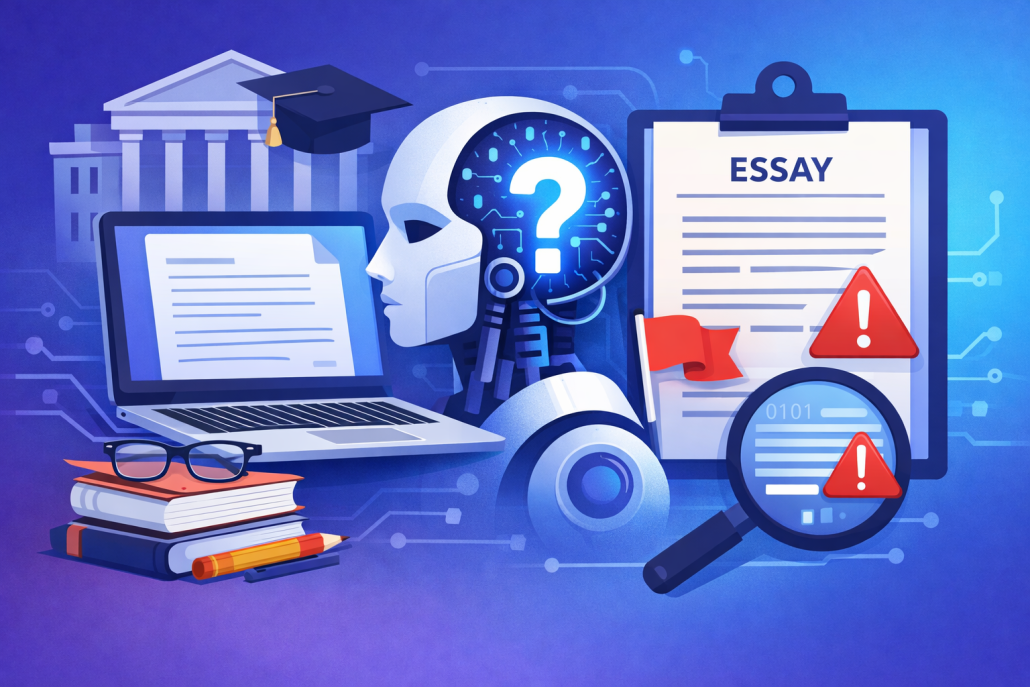
College essays have been a core part of U.S. college admissions for decades—the place where students bare their souls and hope for acceptance. But with AI writing tools now crafting essays in seconds, are we witnessing the slow fade-out of the personal statement? Whether essays evolve or vanish entirely, one thing’s clear: the game is changing
Why Do Colleges Even Want an Essay? A Little History—and How AI Might Break It
The college essay has been around for nearly a century, slowly becoming a key part of American admissions. Back in the day, it was mostly used by elite schools as a way to get beyond test scores and see the person behind the paperwork. Over time, more and more universities adopted the idea. Why? Because a well-written essay can reveal curiosity, resilience, humor, and that elusive thing called “fit.”
Colleges wanted more than perfect grades. They wanted you.
The Role of AI in College Essay
But here’s where it gets tricky. With AI writing tools on the rise, that personal window is getting foggy. If a chatbot can write an essay that sounds smart, moving, and even kind of poetic, how can admissions officers tell what’s real? The whole point of the essay—authenticity, self-reflection, storytelling—starts to crumble when an algorithm can mimic all of it.
In short, what began as a way to humanize applicants might be undone by technology that writes like a human but isn’t one.
How Are Students Using AI in College Essays? Helpful Tool or Academic Shortcut?
AI isn’t just lurking in the background of college applications—it’s actively being invited in. From idea generation to full-on ghostwriting, students are using AI in all kinds of ways. Some of it’s smart. Some of it’s sketchy. Let’s break it down.
1. Brainstorming and Topic Generation
Staring at a blinking cursor is every student’s worst nightmare. So many are turning to AI tools like ChatGPT to kick things off. Prompt it with a vague idea—“write about a challenge I’ve overcome”—and it can spit out potential essay topics in seconds. It’s like having a brainstorming buddy who never gets tired… or distracted by snacks.
Is this bad?
Not at all. Think of it like a whiteboard session. As long as the student is doing the actual reflection and decision-making, this can be a useful jumpstart.
2. Outlining and Structure Help
Once a student picks a topic, AI can help organize their thoughts. “Can you give me a structure for an essay about growing up bilingual?”—boom, instant outline. It’s especially helpful for students who struggle with how to start or what comes next.
Is this bad?
Again, not really. This is more like using a tutor. If it helps students focus and stay organized, it can improve the writing process without taking over.
3. Sentence Polishing and Grammar Checks
AI grammar tools (think Grammarly or Wordtune) have been around for a while, but newer models do more than fix commas—they rewrite entire sentences for clarity or tone. Students might drop in a paragraph and ask AI to make it “sound more mature” or “add a better hook.”
Is this bad?
Only if the edits go too far and erase the student’s personality. A little polish is fine. But if every sentence sounds like it came from a LinkedIn influencer, we have a problem.
4. Full Draft Generation
This is where things get dicey. Some students feed their resume and a prompt into ChatGPT and ask for a full essay. Others even copy essays from friends and ask AI to “make this sound like me.” The result? An essay that sounds smooth but soulless.
Is this bad?
Yeah. Colleges want authenticity. If AI is writing your entire story, it’s not your story anymore. And if everyone’s essay starts to sound the same, admissions officers may stop trusting them altogether.
5. Plagiarism Avoidance and Rewriting Tools
Worried their AI-generated essay might get flagged, students sometimes run it through rewriters to make it “undetectable.” Tools like Quillbot, Spinner, and Paraphraser.ai promise to shuffle words without losing meaning. Spoiler: it often turns decent writing into hot nonsense.
Is this bad?
Yes, and also risky. Many colleges now use AI-detection software. Plus, turning your voice into a scrambled mess rarely makes for a winning essay.
So What’s the Verdict?
AI can be a helpful sidekick—but it shouldn’t be the superhero. Used thoughtfully, it can save time, reduce stress, and spark creativity. But used carelessly, it risks flattening the most important part of your application: you.
Which Colleges Have Banned AI?
Colleges aren’t taking AI-generated essays lightly. Some are clamping down with strict bans, while others are exploring new ways to adapt. Here’s how major universities are handling the rise of AI in college admissions essays.
Strict Bans at the Top
Brown University
Brown has made it clear: no AI help, period. Applicants are expected to submit essays that are entirely their own work. The use of artificial intelligence for any part of the writing process is strictly prohibited under their admissions policies.
Caltech
Caltech allows limited use of AI tools for brainstorming or grammar corrections but draws the line at drafting or outlining. Their admissions guidelines treat AI-generated content the same way they would treat a ghostwritten essay—unethical and unacceptable.
Elite Universities Using AI Detection
Stanford, Yale, MIT
These institutions are investing in AI-detection software to identify essays that might have been written by chatbots. Rather than banning AI outright, they’re focusing on spotting it during the review process and flagging suspicious submissions.
Balanced and Pedagogical Approaches
Harvard, Yale, Penn
While some parts of these universities are cracking down, others are taking an educational approach. They are developing classroom guidelines that explore both the risks and benefits of AI tools. This strategy acknowledges AI as a teaching opportunity rather than a threat.
Public Universities and Liberal Arts Colleges
Many public universities and smaller liberal arts colleges are shifting toward multi-step writing assessments. These include in-class writing samples, draft submissions, and personal interviews to verify authorship. They’re also experimenting with short-answer responses and handwritten components to discourage AI use.
The Two-Lane Approach
The University of Austin and the University of Sydney are testing what’s being called a “two-lane” system. Students must complete certain assignments or exams without any tech, while others allow controlled use of AI tools. The idea is to teach digital responsibility without encouraging full dependence.
Teaching AI Literacy Instead of Policing
Some schools, especially outside the U.S., are choosing to embrace AI by teaching students how to analyze, edit, and critique AI-generated content. Instead of banning the tech, they’re making students think critically about how and when to use it responsibly.
Summary: Big-Name Schools’ AI Essay Policies
| University | AI Essay Policy | Strategy |
| Brown, Caltech | Hard ban on AI | Honor-code enforcement |
| Stanford, Yale, MIT | Use AI-detection tools | Tech-supported verification |
| Harvard, Yale, Penn | AI-integrated guidelines | Pedagogical exploration |
| State & Lib Arts | Multi-step assessment, less tech | Process-based, human-led evaluation |
| University of Austin, Sydney | Device control, two-lane approach | Hybrid exam design |
| Some global colleges | Teach AI editing and critique | Skill-building instead of policing |
Is the College Essay Dead? How AI is Forcing Schools to Change the Game
Let’s be honest—AI isn’t slowing down. It’s getting smarter, smoother, and scarily good at mimicking a thoughtful 17-year-old. At some point, the personal statement might start to feel less like a writing sample and more like a tech arms race. If colleges can’t tell who wrote what, the essay as we know it may be on its way out.
But here’s the twist: colleges still need to understand who they’re admitting. They’re not just looking for grades and accolades—they want personality, values, and perspective. That need won’t vanish with better tech.
So what replaces the essay? Maybe it’s timed, in-person writing. Maybe it’s voice recordings or video submissions. Maybe it’s something we haven’t invented yet. Whatever the format, one thing’s certain: students will still need to show who they are, beyond the bots. Because no matter how clever AI gets, authenticity still matters in a process built on people.
What Could Change About the College Essay?
If the traditional college essay is on shaky ground, what comes next? Schools aren’t likely to ditch personal expression altogether, but how they ask for it could shift dramatically. Here are a few ways the essay might evolve in the age of AI:
1. Timed, In-Person Writing
Colleges might bring back blue books—only now with Wi-Fi blockers. Students could be asked to write essays on-site, with a set prompt and a time limit. It’s not glamorous, but it guarantees the work is real.
2. Handwritten Submissions
Old-school? Totally. But some schools are considering requiring at least one handwritten essay. It’s harder to fake, harder to copy-paste, and very much your own voice—cramped fingers and all.
3. Multi-Step Drafting
Instead of one polished final essay, students might submit outlines, rough drafts, peer edits, and reflections on their writing process. It’s a lot more work, but it shows how the essay evolved—and who actually wrote it.
4. Video or Voice Responses
Think: “Tell us about yourself in two minutes or less.” These unscripted recordings give admissions officers a different kind of window into a student’s personality—and they’re harder to fake with AI (for now, at least).
5. AI-Allowed but Acknowledged
Some schools might say, “Use AI if you want—but tell us how you used it.” This transparency-based model would shift the focus from banning the tech to evaluating how students think critically about it.
Schools are already trying to adapt to AI by rethinking how they assess student writing. Baylor University now requires handwritten essays, while Stanford, MIT, and Yale are testing AI-detection tools. Some public and liberal arts colleges are turning to multi-step drafts and in-class writing to ensure authenticity. Others, like SOAS in London, are replacing traditional essays with creative alternatives. The goal is the same: keep the process personal, even as AI gets smarter.
How Cardinal Education Can Help
At Cardinal Education, we don’t just edit essays—we guide families through the entire college admissions journey. Whether you’re just starting to build your college list or staring down a blinking cursor on your personal statement, our expert team is here to help with every step.
Our services include academic coaching to strengthen classroom performance, test prep for the SAT, ACT, and more, and interview prep so students feel confident when it’s time to sit down face-to-face (or Zoom-to-Zoom). Of course, we also help with essay development, but not in a cookie-cutter way. We work closely with students to shape personal statements that are reflective, compelling, and authentically theirs.
Contact us today and let our experts guide you!
Like what you see here? We are happy to permit you to use our material as long as you link back! Please refer to us as the Cardinal Education Blog.
Related Articles
How Political Expression in Essays Is Impacting College Admissions
2025-2026 Common App Essay Prompts: Breaking Them Down
Common Mistakes Students Make on the Common App (and How to Avoid Them)
How to Help Your Teen Write a Standout Common App Essay in 2025 Admissions
Frequently Asked Questions
Will colleges know if I used AI to write my application essay?
Maybe. Some colleges are using AI-detection tools to flag suspicious essays, but those tools aren’t foolproof. They can mistake fluent writing for AI or miss AI-generated work that’s been lightly edited. So it’s a bit of a gamble. More importantly, admissions officers are human, and they’re very good at sniffing out essays that feel too polished or oddly impersonal. If your essay sounds like a robot or a self-help book, it might raise a red flag. Even if you don’t get “caught,” you’re missing the point. The essay is your chance to be real. If you let AI do all the talking, you’re handing over your voice at the exact moment it matters most.
Is it okay to use AI for brainstorming or grammar help only?
Yes, as long as you’re steering the ship. Using AI to toss around topic ideas or polish your commas is like having a really smart spellcheck that doesn’t judge your procrastination habits. It’s a tool, not a ghostwriter. The key is to stay in charge of the process. If you start with your own experiences and use AI to clean up your phrasing or get past a mental block, that’s fine. Just don’t let it write the thing for you. Colleges want to hear how you think, not how a chatbot rephrases clichés. Use AI like a highlighter, not a pen. Otherwise, you risk sounding like everyone else—and that’s the opposite of standing out.
What happens if a college detects AI-generated content in my essay?
It depends on the school, but the short answer is: nothing good. Some colleges may reject your application outright. Others might flag your file and ask for clarification. Either way, it’s not a vibe you want associated with your name. AI-detection isn’t perfect, but if your essay sets off alarms, you could be facing some very awkward follow-up emails. More importantly, even if you’re not officially caught, admissions officers can usually tell when an essay lacks authenticity. If your essay reads like it came from a synthetic soul, they may simply pass over your application. So yes, AI might help you cheat the process, but it won’t help you win it.
What are ethical ways to use AI in the college application process?
Think of AI as a supercharged brainstorming buddy or a friendly grammar coach, not your ghostwriter. Ethical use means using AI to generate ideas, clarify structure, or fix awkward sentences without outsourcing your actual thoughts. It’s okay to ask AI, “Does this intro sound weird?” or “Can you help me think of essay topics?” It’s not okay to say, “Write me a personal story about resilience” when the only thing you’re resilient about is avoiding the Common App. Keep the soul of the essay yours, even if you let AI help carry the groceries. The best rule? If you’d feel weird telling an admissions officer how much you used AI, you probably went too far.