
- What does Harvard-Westlake look for in a student?
Aside from scholastic achievements, academic records, letters of recommendation, and the writing sample, Harvard-Westlake also assesses students according to their talents, aspirations, character, and leadership qualities. Admissions officers are looking for students who are academically excellent and will contribute and add value to the community. The information gathered during the interview plays a significant role in the admission decision.
- What is Harvard-Westlake’s ranking?
Harvard-Westlake School holds the 1st rank as the best private high school in California and 2nd in California’s best college prep private high schools. It is also among the top 5% of the best high schools for STEM in California.
- What is the Harvard-Westlake acceptance rate?
The Harvard-Westlake Upper School does not disclose its acceptance rate to the public. Even so, according to other information, admissions to this highly regarded school are more likely to be highly challenging and selective.
- Does the Harvard-Westlake School require standardized tests?
No. Harvard-Westlake remains test-optional and does not require standardized test results. However, students may still choose to submit ISEE test scores. We always recommend that applicants take standardized tests and submit the scores. Among the many applicants with the same credentials and achievements, an impressive test score might just be the differentiation needed to gain admission.
How to Get Into Harvard-Westlake: Guide to Admission
With nearly 20 years of experience, we have mastered admissions strategies to get you into top schools.
TALK TO OUR EDUCATIONAL CONSULTANT TODAY! Call Us Toll Free: (888) 521-5243Cardinal Education is an independent educational consulting company. We are not affiliated, associated, authorized, endorsed by, or in any way officially connected with any public or private school.
Quick Answer for Busy Parents
Harvard-Westlake is a prestigious Los Angeles private school (Grades 7–12) known for academic excellence and selectivity. The primary entry points are Grades 7, 9, and 10. A successful application requires an online form, a 40-minute interview, and a mandatory 30-minute timed writing exercise. While ISEE scores are optional, submitting them can provide a competitive edge. Admissions officers look beyond high GPAs for leadership, character, and community fit. Given the low acceptance rates, early preparation is vital. Cardinal Education provides expert guidance through bespoke admissions strategies, interview coaching, test prep, and specialized tutoring to help your child stand out in this rigorous process.
Understanding Harvard-Westlake’s Admissions Process
Harvard-Westlake School is a private, coeducational, college-preparatory school in Los Angeles, California. Gaining admission is highly competitive. Each year, the school receives a large pool of qualified applicants, many of whom perform well academically and participate in meaningful extracurricular activities.
The admissions process is holistic. This means the school looks beyond grades and test scores to understand who a student is, how they think, and how they contribute to a community.
Applicants are evaluated based on:
- • Academic performance
- • Teacher recommendations
- • Personal character and values
- • Extracurricular involvement
- • Interview performance
Because so many students meet the academic threshold, differentiation often comes from how clearly a student presents themselves across every part of the application.
How Competitive Is Harvard-Westlake Admissions?
Harvard-Westlake is widely considered one of the most selective private schools in the United States. While exact acceptance rates are not always publicly disclosed, the level of competition is comparable to top-tier independent schools in major metropolitan areas.
What makes the process particularly challenging is not just the number of applicants, but the consistency of the applicant pool. Many students present strong transcripts, high test scores, and well-rounded activities.
As a result, admissions decisions often come down to:
- • Depth of intellectual engagement
- • Authenticity in presentation
- • Strength of recommendations
- • Performance during the interview
What Harvard-Westlake Looks for in Applicants
Harvard-Westlake is not simply looking for high-achieving students. The admissions committee is focused on identifying students who will actively contribute to the school’s academic and social environment.
Key qualities include:
Intellectual Curiosity
Students who go beyond assigned work, ask thoughtful questions, and show genuine interest in learning tend to stand out.
Character and Integrity
The school values students who demonstrate honesty, humility, and respect for others.
Engagement and Initiative
Rather than doing many activities at a surface level, strong applicants show commitment and growth in a few areas.
Self-Awareness
Students who understand their strengths, challenges, and motivations often present more compelling applications.
GPA, Academic Performance, and Expectations
Strong academic performance is expected of all applicants. Most successful candidates:
- • Consistently earn high grades
- • Take appropriately challenging coursework
- • Demonstrate strong writing and analytical skills
However, academics alone rarely secure admission. Many applicants meet or exceed academic expectations, which is why qualitative factors carry significant weight.
Harvard-Westlake Application
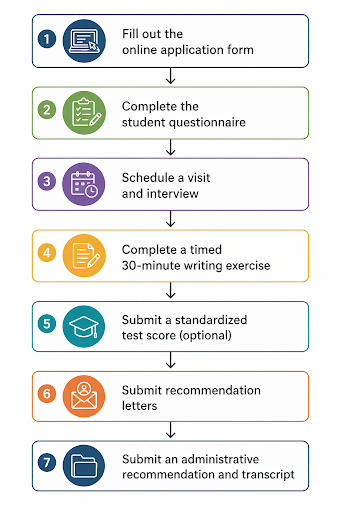
Harvard-Westlake Upper School admissions begin by completing your admissions inquiry form. It is important to remember that the main entry points to Harvard-Westlake are grades 7, 9, and 10. Applications to grades 8 and 12 are scarcely ever accepted. Here are the steps you should follow:
- Fill out the online application form
- Complete the student questionnaire
- Schedule a visit and interview
- Complete a timed 30-minute writing exercise
- Submit a standardized test score (optional)
- Submit recommendation letters
- Submit an administrative recommendation and transcript
Standardized Testing at Harvard-Westlake
Harvard-Westlake has adopted a test-optional approach in recent admissions cycles.
This means:
- • Submitting scores is not required
- • Strong scores can still support an application
- • Other components, such as transcripts and recommendations, become even more important
Families should consider testing as one part of a broader strategy rather than the defining factor. If you plan on submitting scores, only the latest ISEE scores will be accepted.
Harvard-Westlake Admissions Timeline
Understanding the timeline is critical for staying organized and avoiding last-minute stress.
Typical timeline:
Fall (September–October)
- • Begin researching schools
- • Prepare application materials
- • Request teacher recommendations
Late Fall to Early Winter (November–January)
- • Submit applications
- • Complete interviews
- • Finalize all required materials
Spring (March)
- • Admissions decisions are released
Starting early allows students to present a more thoughtful and cohesive application.
The Harvard-Westlake Interview: What to Expect
The interview is one of the most important parts of the admissions process. It provides the school with insight into how a student thinks, communicates, and engages in conversation.
Common themes in interviews include:
- • Academic interests
- • Extracurricular involvement
- • Personal values
- • How a student approaches challenges
Strong interviews feel natural and thoughtful rather than rehearsed. Students who can engage in a genuine, reflective conversation tend to leave a stronger impression. Read more to know how to make a Great Impression During a Private School Interview.
Teacher Recommendations That Stand Out
Teacher recommendations play a significant role in admissions decisions.
Strong recommendations typically highlight:
- • Intellectual engagement in the classroom
- • Work ethic and responsibility
- • Collaboration with peers
- • Growth over time
A detailed, specific recommendation often carries more weight than a generic one, even if both are positive.
Common Mistakes Families Make
Even strong applicants can weaken their chances with avoidable mistakes:
- • Focusing only on grades and test scores
- • Overloading extracurricular activities without depth
- • Submitting generic or unfocused applications
- • Underpreparing for interviews
- • Waiting too long to start the process
Avoiding these pitfalls can significantly improve how an application is received. Read more about Common Mistakes in Private School Applications and How to Avoid Them.
Real Applicant Positioning: What Actually Makes a Difference
In a competitive pool, many applicants look similar on paper. The difference often comes down to how clearly a student’s story is communicated.
Stronger applicants tend to:
- • Show a clear pattern of interests and growth
- • Demonstrate initiative beyond requirements
- • Communicate thoughtfully in interviews
- • Present consistent themes across all materials
The goal is not to appear perfect, but to present a student who is genuine, engaged, and ready to contribute.
How to Build a Strong Harvard-Westlake Application
A successful application is cohesive. Every component should reinforce the same overall narrative.
This includes:
- • Academic choices that reflect curiosity and effort
- • Activities that show commitment and development
- • Recommendations that support the student’s character
- • An interview that brings the student’s personality to life
When these elements align, the application feels clear, complete, and authentic.
Work With Cardinal Education
At Cardinal Education, the focus goes beyond assembling applications. The goal is to help students develop the awareness, confidence, and direction needed to present themselves thoughtfully.
This includes:
- • Clarifying a student’s strengths and interests
- • Guiding long-term academic and personal development
- • Preparing for interviews through real conversation practice
- • Helping students communicate their story in a way that feels natural and compelling
The result is not just a stronger application, but a student who is better prepared for the environment they are applying to.
Common Questions About Harvard-Westlake Admissions
Q: How hard is it to get into Harvard-Westlake?
A: Admission is highly competitive, with many qualified applicants each year. Differentiation comes from personal presentation, not just academics.
Q: Does Harvard-Westlake require standardized tests?
A: The school is test-optional, though strong scores can still support an application.
Q: What grades can students apply for?
A: The main entry points are grades 7, 9, and 10.
Q: What matters most in the application?
A: A combination of academics, character, recommendations, and interview performance.
Related Articles
Private School Admissions: Understanding What Schools Look for in Applicants
How to Create a Winning Private School Application Portfolio
When is the Best Time to Start the Private School Admissions Process?
Famous Harvard-Westlake alumni
Harvard-Westlake graduates have pursued various careers and have become successful in their own respective fields. Some of their notable alumni include:
- Lily Jane Collins – a critically acclaimed actress and a nominee for a Golden Globe Award for Best Actress
- Jake Gyllenhaal – an award-winning actor and stage performer, nominated for the Tony Award for Best Actor in a Play
- Shirley Temple (+) – was Hollywood’s prized child actress, was named US Ambassador to Ghana and Czechoslovakia, and also served as the Chief of Protocol of the United States.
- Jason Collins, a retired professional basketball player who played 13 seasons in the NBA
- Ben Sherwood – writer and journalist, currently the co-chairman of Disney Media Networks and president of Disney ABC Television Group, formerly the president of ABC News
- Jessica Yellin – known as one of the most influential women in Washington- was the Chief White House correspondent for CNN from 2011 to 2013
- Jason Segel – an American actor, comedian, screenwriter, singer-songwriter, author, and producer
- Mark Harmon – an American actor best known for his lead role in NCIS
- Billie Lourd – an American actress widely known for her role in the Fox horror comedy series Scream Queens
- Danica McKellar – an American actress, mathematics writer, and education advocate
Student Life at Harvard-Westlake
Students of Harvard-Westlake are presented with a wide array of ideas and opportunities. There are several community service initiatives for students to participate in, clubs and activities, speech and debate, class retreats, student media and publications, a student government, and a few more projects and programs. The HW community also has a deep-seated commitment to diversity and inclusion. As such, there are multiple opportunities to learn about the diversity of perspectives and experiences at HW, like the “Humans of Harvard-Westlake” project.
Harvard-Westlake Curriculum
The Harvard-Westlake curriculum fosters independent thinking and diversity while uplifting students to explore the world around them and discover themselves. Aside from the core subjects, it has global education programs and experiential learning opportunities that enable students to develop empathy and expand cultural competence. Students can take courses in the Department of Interdisciplinary Studies and Independent Research that expose them to ideas and methods from various or unconventional areas. Additionally, the department provides students with chances for research, in-depth study, and immersion outside of what is typically offered, working in partnership with the other academic departments.
Harvard-Westlake Activities
Harvard-Westlake provides its students with opportunities to get involved in the school community and beyond. There are affinity groups, DEI commitments, Civil Rights Trip, and Pollyanna Conference, among many others! A lot of traditions have existed with the long history of the school. This includes homecoming, Spring Festival, Senior Ceremony, Senior Transition Day, the annual Senior Walk, and a lot more. Harvard-Westlake Upper School also retreats to Big Bear at the end of the year to mark the finale of their high school experience.
Harvard-Westlake Athletics
Harvard-Westlake Athletics promotes B.E.S.T. practices and Principles, which stand for balance, excellence, sportsmanship, and teamwork. The school offers a wide variety of sports, including baseball, basketball, football, bass fishing, golf, water polo, lacrosse, soccer, tennis, swimming, track & field, cross country, volleyball, and wrestling for boys. Girls, on the other hand, are offered bass fishing, beach volleyball, field hockey, basketball, swimming, cross country, golf, soccer, lacrosse, softball, track & field, volleyball, tennis, and water polo.
Harvard-Westlake Arts
In the arts, Harvard-Westlake places value on creativity, collaboration, and self-expression. The school teaches its students essential techniques, encourages exploration and cultural awareness, and believes in every student’s artistic potential. Harvard-Westlake Upper School takes pride in its top-notch resources and facilities, such as its state-of-the-art glass-blowing studio. From dance and music to drama, painting, sculpture, and film, Harvard-Westlake has it all!
Did You Know?
The average number of students per class is 16 and the student-to-faculty ratio is 8:1.

DISCLAIMER
Cardinal Education is an independent educational consulting company. We are not affiliated with or endorsed by any private school, including those mentioned on this website. All school names and trademarks are the property of their respective owners and are used here for descriptive purposes only.