
Is AI Killing Your Child’s Curiosity? How to Keep Kids Exploring in the Age of ChatGPT
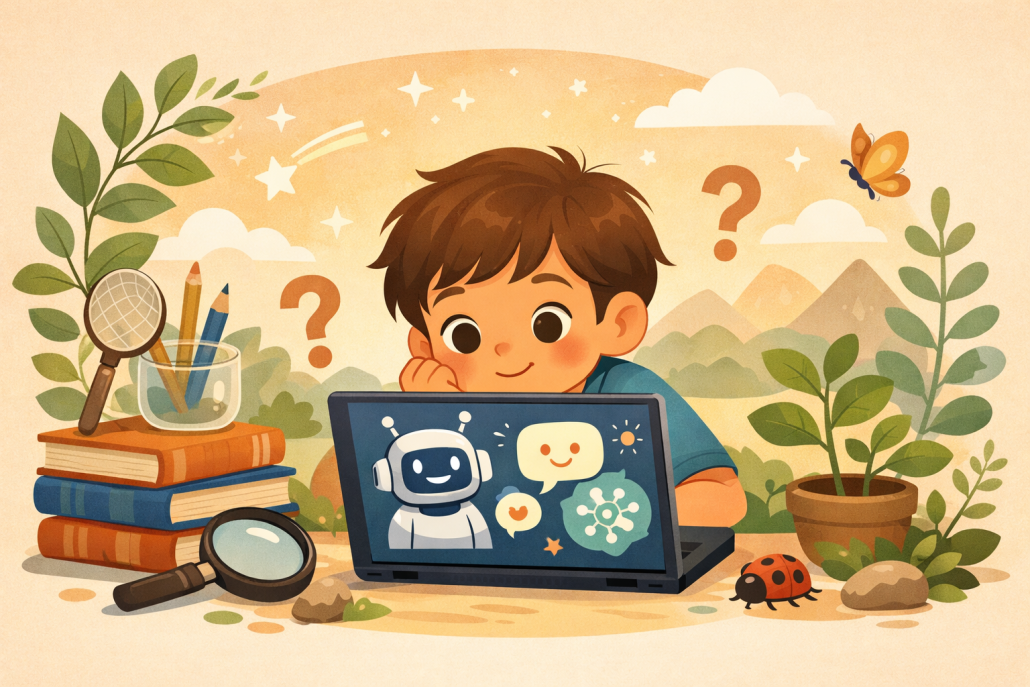
When kids explore, magic happens. Not wand-waving, dragon-slaying magic (though that would be cool), but the kind where a question turns into an idea, and an idea becomes a discovery. Whether it’s figuring out why the sky changes colors or building a robot out of cereal boxes, exploration feeds young minds the kind of nourishment no worksheet ever could.
But here’s the catch. In a world where AI tools like ChatGPT can answer anything in seconds, why bother asking at all? Curiosity used to spark adventures. Now it risks being replaced by a quick scroll and a copy-paste.
Still, exploration hasn’t lost its place. It’s more important than ever. Both in and out of the classroom, we need to make space for wandering thoughts, wild questions, and the joy of not knowing everything. The world may be automated, but wonder is still wonderfully human.
Why Do Students Stop Asking Questions? (And How AI Changes the Game)
Curiosity might be the engine of learning, but let’s be real—it’s not always firing on all cylinders. Today’s students face a unique mix of old-school pressures and new-age shortcuts that can quietly smother their sense of wonder. Let’s break it down.
Traditional Obstacles: The Classic Classroom Curiosity Crushers
Long before AI showed up, students were already bumping into obstacles that made exploration feel like a luxury instead of a learning essential. Think jam-packed school days where every minute is accounted for: math at 8, reading at 9, science squeezed in before lunch, and maybe, just maybe, a rushed art project at the end of the day if time allows. There’s barely room to take a deep breath, let alone chase a weird and wonderful question like “Do plants sleep?”
Then there’s the testing culture. With standardized tests looming large, teachers are often under pressure to “teach to the test,” leaving little time for open-ended inquiry. A curious student who wants to veer off course and ask why frogs can freeze and come back to life might get a polite “Let’s stick to the lesson plan.” Over time, kids get the message: questions are cool, but only if they’re multiple choice.
And let’s not forget classroom culture. In schools where grades are king, students often fear making mistakes. Why risk asking a question that might sound silly? Why try something new if it might fail? The result: creativity takes a back seat to compliance. Students start playing it safe, giving the “right” answers instead of the thoughtful ones. Exploration becomes a side dish, not the main course.
The AI Challenge: How AI Tools Can Discourage Deep Exploration
Now fast-forward to today, where AI tools are just a click away. Need a summary of the causes of the Civil War? Done in three seconds. Struggling to write a paragraph on photosynthesis? AI will happily do it for you, with citations and a bow on top.
While this technology can be helpful—especially for kids with learning differences or time constraints—it also introduces a tricky new temptation. Why explore when you can just ask? Why experiment when you can generate an answer instantly?
Take a middle schooler trying to write a science fair report. They might have started by researching, jotting down notes, even doing a little trial and error. Now? They might just plug their topic into an AI generator and copy-paste the results. Fast? Sure. But where’s the messy process of discovery? Where’s the learning?
Or imagine a high schooler wrestling with a creative writing prompt. Instead of dreaming up characters or plot twists, they turn to AI for a story that checks all the boxes. Technically, it works. But it robs them of the joy of building something from scratch, of surprising themselves along the way.
AI isn’t the villain here. It’s a tool. But like all powerful tools, it requires guidance. Without it, students risk becoming spectators in their own education—watching the answers roll in without ever getting their hands dirty.
How to Encourage Exploration in the Classroom
So how do we reignite that spark of curiosity when the school day feels more like a checklist than an adventure? It starts with creating classroom environments where questions matter more than answers and where kids feel safe taking intellectual detours. Here’s how to make exploration part of the daily routine.
Project-Based and Inquiry-Based Learning
Instead of drilling students with facts they’ll forget by next week, project-based learning invites them to dive into big questions and solve real-world problems. Think: “How can we reduce plastic waste in our school?” or “What would a Mars colony need to survive?” Suddenly, students aren’t just absorbing content; they’re applying it, testing it, and collaborating to make something new.
Inquiry-based learning takes it one step further. Students start with a question they care about and follow the trail wherever it leads. A fifth grader fascinated by bees might end up designing pollinator gardens, interviewing a local beekeeper, or running experiments on flower preference. The result? Engagement, ownership, and a whole lot of learning they’ll actually remember.
Open-Ended Discussions, Socratic Seminars, and Maker Spaces
Want to encourage deeper thinking? Open the floor. Socratic seminars and open-ended discussions give students a chance to ask their own questions and wrestle with ideas without the pressure of getting it “right.” Whether they’re debating a theme in Of Mice and Men or wondering aloud whether AI should be allowed to write novels, they’re practicing the fine art of thinking out loud.
And let’s not sleep on maker spaces. Give kids a pile of cardboard, some circuits, and a mission to build something that solves a problem, and you’ll see innovation come alive. These hands-on zones give students permission to tinker, fail, adjust, and try again, exactly the kind of learning that sticks.
Why Celebrating the Learning Process Over Outcomes Boosts Exploration
Here’s the secret sauce: praise the journey. Instead of only handing out gold stars for the correct answer, celebrate curiosity, risk-taking, and perseverance. If a student tries three different ways to solve a problem before finding what works, that’s a win. If a group prototypes a bridge that immediately collapses but learns from it, that’s success.
When we reward the process, not just the polished result, we show students that exploration is valuable in its own right. That’s how you build thinkers, not just test-takers.
3 Simple Ways Parents Can Boost Curiosity at Home
Learning doesn’t stop when the bell rings. In fact, some of the richest, most exciting discoveries happen outside of school walls, when there’s time to wonder, to build, to get messy. The world is basically one giant classroom, and here’s how to help kids make the most of it.
-
Choosing Curiosity-Boosting Extracurricular Activities
If your child loves asking random questions like “How do airplanes stay in the air?” or “Can jellyfish live forever?”, lean into it. Science fairs, book clubs, coding camps, and art studios are gold mines for curious minds. These aren’t just resume boosters. They’re playgrounds for passion.
A kid who joins a robotics club might end up staying late just to figure out why the robot veers left instead of right. A book club can spark heated debates about character choices. And coding camps? They’re basically puzzle palaces for kids who like solving things just for the fun of it.
-
Why “I’m Bored” is Actually the Best Thing Your Child Can Say
Here’s a radical idea: boredom is not the enemy. In fact, it’s one of curiosity’s best friends. When kids have unstructured time, their brains do this incredible thing: they start looking for something to do. And more often than not, they stumble into something interesting.
Maybe it’s building an elaborate blanket fort, inventing a new board game, or making a short film with their dog as the lead. That kind of creative play builds problem-solving skills, independence, and imagination. Plus, it’s way more satisfying than scrolling through a screen.
-
Lead by Example: Practical Ways for Parents to Model Curiosity at Home
You don’t need a lab coat or a teaching degree to foster exploration. Parents can model inquisitiveness in everyday life. Go on a nature walk and wonder out loud why some leaves are fuzzy. Watch a documentary together and pause it every few minutes to ask, “What do you think about that?” Start a family tradition of trying one new food, activity, or question each week.
Even little things, like letting your child help fix a leaky faucet or plan the garden, can turn into opportunities for learning. When kids see adults asking questions, trying new things, and getting excited about the unknown, they learn that curiosity isn’t just for school. It’s a way of life.
Is ChatGPT Helping or Hurting Your Child’s Education?
AI isn’t the enemy of education, but it can be the enemy of exploration if we’re not careful. When used thoughtfully, AI tools can support creativity and accelerate learning. But without balance, students risk becoming answer-seekers instead of deep thinkers. Here’s how to keep curiosity alive in the age of instant everything.
1. Use AI Tools to Spark Ideas, Not Do the Work
AI can be a fantastic starting point, but it shouldn’t be the destination. Encourage students to use tools like ChatGPT, Grammarly, or AI-based search engines to brainstorm or get unstuck. For example, a student struggling to write a short story might ask AI for three plot ideas based on a mystery theme. Great! But from there, they should develop the characters, build the conflict, and write the actual story on their own.
In math, AI can explain a difficult concept, like the difference between permutations and combinations. But once a student grasps it, they should still work through problems independently to solidify their understanding. When AI becomes the assistant instead of the author, students stay engaged in the process.
2. Teach Students to Ask Better Questions with AI
The quality of a student’s learning often depends on the quality of their questions. Instead of Googling “What is gravity?” they could ask, “How would gravity change if Earth were twice as big?” or “How does gravity affect time near a black hole?”
These are the kinds of questions that lead to rabbit holes worth exploring. Educators can model this by turning simple topics into big conversations. For instance, during a lesson on ecosystems, instead of just defining terms, ask: “What would happen if bees went extinct tomorrow?”
AI is at its best when it helps students dig deeper. Equip them with the skill of inquiry, and they’ll use AI to investigate the world, not just breeze through it.
3. Encourage Student Reflection After Using AI
After a student uses AI, don’t just move on; pause. Ask them: “What surprised you?” “What did you learn that you didn’t expect?” “What do you still want to explore?”
These reflection moments turn quick interactions into long-lasting understanding. For example, after using AI to summarize a historical event, students could write or talk about how their view of that event changed. Did the AI miss any perspectives? Was anything oversimplified?
Reflection also helps students distinguish between information and insight. It trains them to slow down, process what they’ve learned, and make connections to bigger ideas.
4. Combine Hands-On Learning with Technology
AI lives in the cloud, but curiosity thrives in the real world. Students need to engage their senses, not just their screens. That’s why it’s essential to pair digital tools with hands-on, messy, tactile learning.
Think: building a prototype of an invention after researching similar ideas online. Or creating a diorama to illustrate a novel’s setting instead of just writing a summary. Even something as simple as keeping a paper sketchbook alongside a digital design program can help students visualize, iterate, and take ownership of their learning.
Don’t underestimate the power of scissors, glue, paint, or popsicle sticks. They build problem-solving muscles that AI just can’t touch.
5. Promote Deep Learning by Slowing Things Down
In our instant-everything culture, slowing down is revolutionary. But deep learning doesn’t happen in a rush. Give students time to explore topics that fascinate them, even if it doesn’t fit neatly into a lesson plan.
For example, let a student spend a week building a Rube Goldberg machine after they learn about energy transfer. Or allow a whole class period for students to debate a philosophical question raised during a reading assignment. These experiences might not check every box on a rubric, but they build intellectual curiosity, patience, and persistence.
Slower doesn’t mean less productive. It often means more meaningful.
Key Takeaway: How to Foster Student Curiosity in the Age of AI
Fostering curiosity in students is still entirely possible, even in a world where answers are just a few keystrokes away. The key is to treat AI as a helpful tool, not a replacement for hands-on discovery and thoughtful questioning. When we create environments that celebrate the learning process, make room for experimentation, and encourage students to ask better questions, we invite curiosity to flourish.
Exploration doesn’t always look polished. It might show up as a half-finished science experiment, a question that leads nowhere, or a project that changes direction three times. But these are signs of real thinking. With the right balance of digital support and real-world learning, we can raise students who are not only informed but also deeply engaged and excited to understand the world around them.
Need Help? Cardinal Education Can Lend a Hand!
Exploration is powerful, but let’s be honest—it can also be overwhelming, especially when students are aiming for competitive programs, prestigious camps, or high-level academic challenges. That’s where we come in! Here at Cardinal Education, we understand what students go through, so we offer help by working with you and giving you the necessary skills to achieve success in admissions. With academic coaching and test prep, we ensure students are in their best shape to tackle any tasks!
Contact us today and let our experts guide you!
Like what you see here? We are happy to permit you to use our material as long as you link back! Please refer to us as the Cardinal Education Blog.
Frequently Asked Questions
- Why is student curiosity important in learning?
Because curiosity is the engine that keeps the brain running. When students are curious, they’re not just memorizing for a test—they’re hunting for answers, making connections, and actually enjoying the process. It’s the difference between dragging your feet through school and sprinting toward the next big idea. Curious kids ask “why,” “what if,” and “how come,” which leads to real understanding and long-term learning. Without curiosity, school feels like one big chore list. With it, it becomes a treasure hunt. So if you want kids to grow into problem-solvers, innovators, and lifelong learners, feed that curiosity like it’s hungry. Because it is. And it’s got a serious appetite for wonder.
- What are the best ways to promote curiosity at home?
Start by letting your kid ask a million questions—even the weird ones like, “Do fish get thirsty?” Create a home where it’s okay not to know everything and even better to go find out. Try new foods, explore local museums, or build a volcano in the kitchen. Read books together and take nature walks without a plan. Ask “what do you think?” more than “what’s the answer?” Show your own curiosity too. Wonder out loud, make guesses, and Google things as a team. Kids mirror what they see. If your household treats learning like a scavenger hunt instead of a pop quiz, curiosity will thrive. Just be prepared for an endless stream of “why” questions.
- How does AI affect student learning and curiosity?
AI is like a super smart assistant who always has the answer. Helpful? Yes. A little too helpful? Also yes. When students get used to instant responses, they might skip the messy, magical part of learning—the wondering, the testing, the “aha!” moments. Curiosity needs time and struggle to grow, and AI can make things feel too easy. That said, it’s not all bad. AI can support learning if used wisely. It’s not curiosity’s enemy, but it can accidentally become its crutch. The key is teaching students how to use AI as a tool, not a cheat code. Because while AI can explain gravity, it can’t replicate the thrill of discovering something for yourself.
- Can AI be used to encourage student exploration?
Yes, but only if it’s treated like a co-pilot, not the captain. AI can help students brainstorm ideas, clarify confusing topics, and offer new perspectives. It’s great at generating possibilities, especially when students feel stuck or uninspired. Want help thinking of science project ideas? Need a list of plot twists for a short story? AI can jumpstart the process. But from there, students need to take the wheel. True exploration happens when they follow their own questions, make decisions, and try things out. So yes, AI can encourage exploration—as long as it doesn’t steal the joy of figuring things out along the way. Curiosity is still human-powered. Let AI play backup, not lead guitar.