Cardinal Education completely transformed our approach. We were so stressed about the Middle School transition, but their guidance on the parent statement and interview prep made all the difference. Our daughter is now thriving at Eton!
How To Get Into Eton School in Seattle: Best Guide for Prospective Families
Admission tips from the best boarding school admissions consultants in Seattle.
TALK TO OUR EDUCATIONAL CONSULTANT TODAY! Call Us Toll Free: (888) 521-5243Cardinal Education is an independent educational consulting company. We are not affiliated, associated, authorized, endorsed by, or in any way officially connected with any public or private school.
For families relocating to the Greater Seattle area (or those already established in tech hubs like Bellevue, Redmond, and Medina), securing a seat at a premier independent school is almost always a top priority. And that’s why you’re here.
You are likely navigating the complex, often opaque world of independent school admissions. At a school like Eton, you might be wondering: How early do we need to prepare? Does a Montessori background matter? What are the admissions committees actually looking for beyond a strong transcript? Luckily for you, our admissions consultants understand the anxieties and the high stakes involved in these decisions. We have guided countless families through this exact labyrinth.
This comprehensive guide is designed to help you with the admissions process for Eton School. We will walk you through the nuances of their admissions criteria, the culture of the campus, and the strategic steps you need to take to position your child (and your family) for success.
Quick Answer for Busy Parents
Getting into Eton School requires a holistic demonstration of a child’s innate curiosity, a family’s alignment with Montessori and experiential learning philosophies, and an academic foundation that shows readiness for rigorous middle school coursework.
For families focused on getting into Eton School in Seattle, the primary objective is to prove that your educational values perfectly mirror the school’s mission of educating the whole child. Admissions committees are looking for students who are adaptable, intrinsically motivated, and capable of thriving in a deeply collaborative environment.
Ultimately, securing admission means successfully articulating your child’s unique narrative through compelling parent statements, exceptional teacher recommendations, and a confident, authentic presence during campus visits and student evaluations.
Why Families Choose Eton School
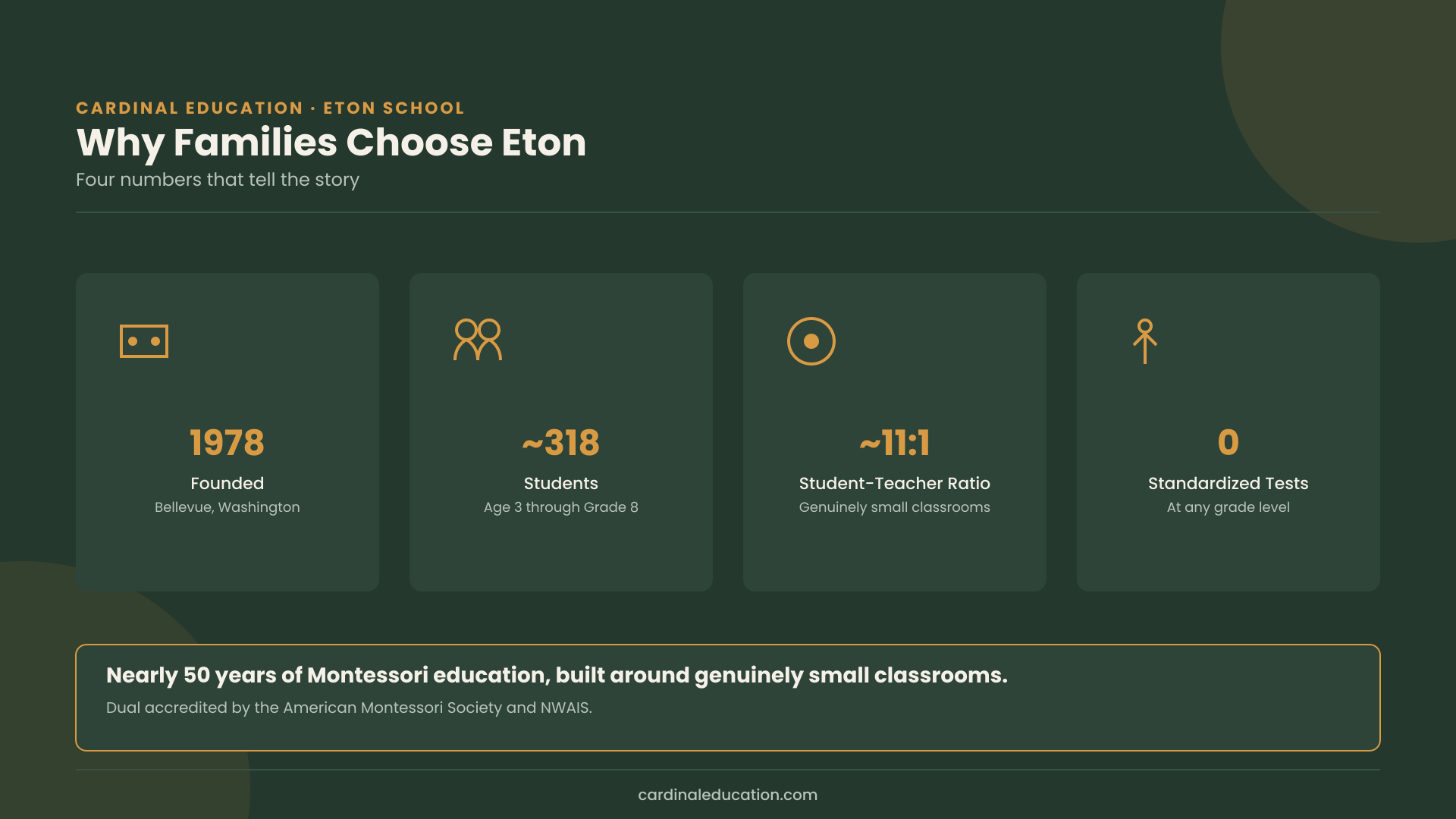
Eton School, nestled in the vibrant Bellevue community just outside Seattle, offers a truly distinctive educational trajectory spanning from Pre-Kindergarten through Grade 8. At its core, the school is deeply rooted in Montessori philosophy for its younger learners, gradually transitioning into a highly robust, project-based curriculum in the Upper Elementary and Middle School years. Families are consistently drawn to this model because it respects the developmental stages of the child while simultaneously demanding academic excellence. The mission is clear: to inspire creative, confident thinkers who have a deeply ingrained sense of global citizenship.
Beyond the philosophy, families choose Eton for its tangible outcomes. In a region dominated by rapidly evolving technology and innovation, parents want their children to possess soft skills—adaptability, emotional intelligence, and collaborative problem-solving—just as much as hard academic skills. Eton delivers on this by prioritizing STEAM initiatives, intensive foreign language instruction (particularly Spanish), and global awareness programs. Furthermore, the school’s intimate size ensures that no child falls through the cracks; every student is known, valued, and challenged appropriately. It is a nurturing incubator that reliably feeds into the most prestigious independent high schools in the Pacific Northwest, making it a highly coveted foundational step for ambitious families.
How Hard is it to Get Into Eton School?
Admission to Eton School is highly competitive, particularly at the primary entry points: Pre-Kindergarten (ages 3-4), Lower Elementary (Grades 1-3), and Middle School (Grades 6-8). Because the school intentionally maintains small class sizes to preserve its low student-to-teacher ratio, the number of available seats each year is inherently limited. The difficulty of admission fluctuates depending on the grade level and the attrition rate of the current student body. For instance, entering at the Middle School level requires a strong academic track record and a clear demonstration of readiness for complex, independent project work, making it a rigorous transition for students coming from traditional public schools.
Eton’s evaluation process is profoundly holistic. They do not rely on a single data point to make their decisions. For early childhood and lower elementary applicants, the emphasis is heavily placed on behavioral readiness, social-emotional development, and the family’s understanding of Montessori principles. For older students, the admissions committee scrutinizes transcripts, teacher recommendations, and standardized testing (if applicable) to ensure the applicant can handle the academic pacing. They are assessing not just the child, but the family as a whole; they want active, engaged parents who will contribute positively to the school community.
Navigating this competitive landscape requires strategy. You must anticipate the school’s priorities and meticulously craft an application that speaks directly to their core values. It is a nuanced dance of showcasing your child’s brilliance without appearing overbearing and demonstrating your family’s resources without appearing entitled.
Top Tips for Eton School Admissions
- • Emphasize Intrinsically Motivated Learning: In all application materials, highlight instances where your child pursued knowledge independently, reflecting the Montessori ethos.
- • Demonstrate Community Engagement: Show how your family values diversity, global citizenship, and active community participation.
- • Prepare for Behavioral Evaluations: For younger children, arrange playdates and structured activities beforehand to ensure they are comfortable interacting with new peers and adults during assessment days.
Best Practices for Prospective Families
- • Align Your Educational Philosophy: Read deeply about Eton’s specific blend of Montessori and project-based learning. Your parent statements must reflect a genuine understanding of this model.
- • Cultivate Relationships Early: Attend open houses, speaker series, and community events long before the application is due. Familiarity breeds favorable consideration.
- • Curate Exceptional Recommendations: Guide your current teachers on what Eton values (collaboration, curiosity) so their letters highlight these specific traits.
Common Questions About Getting Into Eton School
- • Does my child need prior Montessori experience? While highly beneficial for early elementary entry, it is not strictly required, provided the child demonstrates adaptability and a love for self-directed learning.
- • What are the primary entry points? Pre-Kindergarten, Grade 1, Grade 4, and Grade 6 are the most common entry points with the highest number of open seats.
- • Do they offer financial aid? Yes, Eton School is committed to socioeconomic diversity and offers a robust, need-based tuition assistance program.
- • How important is the parent interview? It is critical. The school is assessing if you will be a supportive, collaborative partner in your child’s educational journey.
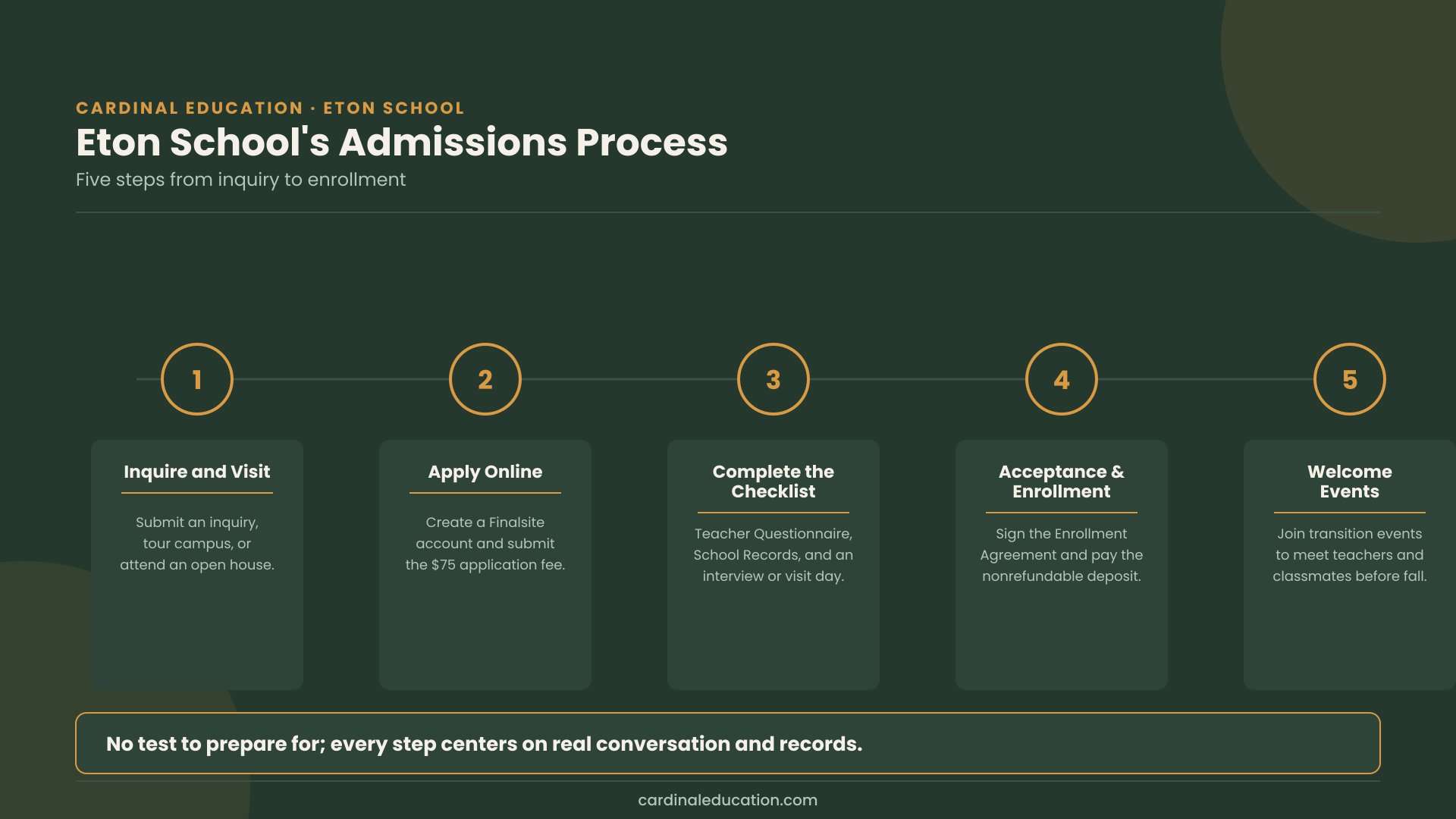
The Eton School Admissions Process

- Submit an Inquiry: Complete the online inquiry form to enter the school’s system and begin receiving specific dates for tours and open houses.
- Attend an Open House or Campus Tour: Mandatory for understanding the campus culture and meeting faculty.
- Submit the Application: Complete the formal online application, including the application fee, by the mid-January deadline.
- Delegate Teacher Evaluations: Request confidential recommendation forms from your child’s current teachers to be sent directly to Eton.
- Submit Academic Records: Provide official transcripts and progress reports from the past two academic years.
- Schedule a Student Visit/Assessment: Depending on the grade, students will participate in a play-based assessment or a full classroom visit.
- Attend the Parent Interview: A formal conversation with the admissions team to discuss educational goals and family alignment.
Eton School Admission Requirements
Here is exactly what you need to prepare for Eton.
Parent Statement
The parent statement is arguably the most critical component of the application for younger applicants, and it remains heavily weighted through Middle School. Eton’s admissions committee uses this document to gauge your family’s alignment with their philosophy. They want to know what you value in education, how you handle academic setbacks, and what kind of community member you intend to be.
How to write a parent statement:
Avoid reciting your child’s resume or speaking in generic platitudes about “loving to learn.” Instead, use vivid, specific anecdotes. Describe a time your child solved a complex problem at home, or how they interact with siblings during a conflict. If you need assistance translating your family’s unique narrative into a compelling, admissions-ready essay, utilizing Cardinal Education Parent Statement Consulting is highly recommended. We help you strike the perfect balance between proud advocacy and humble self-awareness, ensuring your family’s ethos resonates powerfully with the committee.
Teacher Recommendations
Eton requires confidential evaluations from your child’s current teachers. For younger students, this focuses on social-emotional development, the ability to follow multi-step directions, and peer interactions. For older students, the focus shifts to academic resilience, classroom participation, and leadership qualities.
How to get strong recommendation letters:
You cannot write the letter for the teacher, but you can heavily influence its quality. Schedule a polite, brief meeting with your child’s current teachers months in advance. Express your interest in Eton School and casually mention the specific traits Eton values—such as self-directed learning and empathy. Provide the teacher with a concise “brag sheet” detailing your child’s recent milestones or projects that they might have forgotten. Make the process as frictionless as possible for the teacher, ensuring they have ample time before the deadline.
Transcript
Your child’s academic record provides a historical map of their learning journey. Eton looks for a consistent trajectory of growth. While straight As are excellent, they are also looking at teacher comments regarding work habits, behavior, and participation. A single low grade is rarely a dealbreaker if the overall narrative points toward a dedicated, curious student.
How to improve grades:
If your child’s transcript has weak spots, proactive remediation is essential before application season. Admissions committees respect a narrative of overcoming challenges. If your child struggles with organization or time management, addressing their executive functioning through Cardinal Education Academic Coaching can dramatically improve both their grades and their confidence, ensuring their transcript reflects their true potential by the time Eton reviews it.
Personal Statement
For applicants entering the Middle School program (Grades 6-8), a student questionnaire or personal statement is often required. This is the student’s opportunity to speak directly to the admissions committee in their own voice. Eton is looking for authenticity, maturity, and a clear indication of what the student will add to the campus community.
Crafting a compelling personal statement:
The biggest mistake middle schoolers make is trying to sound like miniature adults. The essay should sound like a bright, engaged 11- or 12-year-old wrote it. Encourage your child to write about a niche passion, a time they failed and recovered, or a peculiar hobby that brings them joy. The essay must go through multiple drafting phases. Brainstorming should be expansive, focusing on finding a unique angle, while the editing phase should refine the prose without scrubbing away the child’s authentic tone.
Standardized Test Scores
Depending on the specific grade level and the current year’s admissions policies, standardized testing may be required or highly recommended for older applicants. Tests like the ISEE or SSAT provide the admissions committee with a standardized benchmark to compare applicants from wildly different academic backgrounds.
How to prepare:
Do not send your child into a standardized test cold. The format, pacing, and penalty structures of these exams are entirely foreign to most elementary and middle school students. Strategic preparation is non-negotiable. To understand how to optimize your child’s performance and reduce test anxiety, reviewing the Best Study Strategies for the SSAT and ISEE is a vital first step. Cardinal Education Test Prep provides bespoke tutoring that transforms these daunting exams into manageable, conquerable puzzles.
Admissions Interviews
The interview phase is a pivotal moment in the Eton admissions process. For parents, it is a formal dialogue regarding educational philosophy. For students (particularly Middle School applicants), it is a chance to demonstrate social grace, intellectual curiosity, and conversational maturity. Depending on logistical considerations, these may be conducted via Zoom or in person on campus.
How to prepare for admissions interviews:
Preparation is the antidote to anxiety. For the parent interview, you and your spouse must be on the same page. Practice answering common questions: “Why Eton?” “How do you handle homework struggles?”, and “Describe your child’s weaknesses.”
For the student, preparation is equally critical. They must practice making eye contact, offering a firm handshake (or polite greeting), and expanding on their answers beyond simple “yes” or “no” responses. If your child is scheduled for a full shadow day, our Interview Prep can teach them the subtle nuances of classroom etiquette, how to engage with current students naturally, and how to leave a lasting, positive impression on the faculty without appearing overly rehearsed.
Campus Tours and Open Houses
Open houses and campus tours are not just informational sessions for you; they are the beginning of your family’s evaluation. Eton tracks demonstrated interest. Your presence, your demeanor, and the quality of the questions you ask all become part of your unofficial admissions file.
Tours typically involve a presentation by the Head of School, followed by guided walks through the classrooms (often led by parent ambassadors or older students). Registration for these events opens early in the fall and fills up incredibly quickly. You must be proactive in securing a spot. Treat the tour as an informal interview. Dress appropriately (business casual), arrive early, and silence your devices. Take mental notes of specific programs or classroom dynamics that you can later weave into your parent statement or interview, proving that you paid attention and are genuinely invested in their specific model.
Top Tips for Admissions Interviews & Events
- • Ask Insightful Questions: Do not ask questions that can be answered by looking at the school’s website. Ask about how teachers differentiate instruction or how they measure character development.
- • Divide and Conquer: If both parents attend a tour, split up during the mingling portions to interact with as many faculty members and parent ambassadors as possible.
- • Send Thank You Notes: Within 24 hours of an interview or a highly personalized tour, send a brief, sincere email thanking the admissions staff for their time.
Best Practices for the Interview & Visiting Campus
- • Be Authentic: Admissions directors have finely tuned radar for inauthenticity. Speak honestly about your child’s quirks and areas for growth.
- • Monitor Your Child’s Behavior: During open houses, allow your child to speak for themselves. Do not answer questions directed at them.
- • Stay Positive: Never speak negatively about your child’s current school or teachers during the interview process. Focus entirely on why Eton is the right forward step.
Common Questions About Interviews & Events
- • Should we bring our child to the Open House? Check the specific event details. Some are designated as “Parents Only,” while others welcome students.
- • What should my child wear to the shadow day? Neat, comfortable clothing that allows them to move freely but looks polished. Avoid overly casual attire like sweatpants or graphic tees.
- • Will we be interviewed on the same day as the tour? Typically, no. The formal interview is scheduled separately after the application is submitted.
- • How long does the parent interview last? You should expect the conversation to run between 30 to 45 minutes.
What is Student Life Like at Eton School?
Student life at Eton School is intentionally designed to blur the lines between learning and living. It is a highly dynamic, joyful, and bustling environment. Walk down the halls, and you will not see rows of desks facing a chalkboard. Instead, you will see students sprawled on rugs collaborating on maps, small groups debating in corners, and teachers acting as facilitators rather than lecturers. The “feel” of the campus is one of purposeful freedom.
Because it is a Pre-K through Grade 8 school, the culture is deeply nurturing. Older students frequently interact with younger ones, acting as reading buddies and mentors, which fosters a profound sense of responsibility and campus unity. The environment is devoid of the intense, cutthroat social pressures found in larger high schools; instead, it is a safe space for early adolescents to take intellectual risks, make mistakes, and discover their true identities before stepping onto a larger, more competitive stage.
Eton School Curriculum Overview
The curriculum at Eton is a masterful blend of exploratory learning and rigorous academic standards. In the early years, the Montessori method reigns supreme, focusing on sensorial learning, practical life skills, and early literacy through tactile materials. As students transition into Upper Elementary and Middle School, the curriculum pivots toward a project-based approach. STEAM integration is heavy, with students utilizing maker spaces to build prototypes and solve real-world problems. Language arts focus heavily on critical reading and expansive, analytical writing. A standout feature is the immersive Spanish language program, which begins in the early years and culminates in high-level fluency expectations by graduation.
Athletics at Eton School
Eton School believes in the development of the physical self alongside the intellect. While they do not have the massive athletic complexes of high schools, they offer a robust, inclusive athletic program designed to teach sportsmanship, teamwork, and healthy habits.
| Season | Middle School Sports Offered |
| Fall | Co-ed Cross Country, Co-ed Soccer |
| Winter | Boys Basketball, Girls Basketball |
| Spring | Co-ed Track & Field, Co-ed Ultimate Frisbee |
Arts and Music at Eton School
Creativity is not an elective at Eton; it is central to the curriculum. The school boasts a vibrant visual and performing arts program. Students engage in everything from ceramics and painting to digital media design. The music program introduces students to vocal performance, rhythm instruments, and eventually, more complex ensemble work. Annual theater productions and art showcases are highlights of the school calendar, providing every student with an opportunity to perform or exhibit their work, building immense public speaking and presentation confidence.
Clubs and Organizations at Eton School
Student life is enriched by a variety of clubs that cater to niche interests, allowing students to explore passions outside the core curriculum. From the Robotics and Chess Club to the Student Council and Environmental Action groups, there is a space for every child to lead. The administration highly encourages students to propose and found their own clubs if they see a gap in the offerings.
If your child is looking to build a compelling narrative for future high school applications, maximizing these internal extracurriculars during the school year and complementing them with a Cardinal Education Summer Program Strategy ensures a highly competitive, well-rounded profile.
Top Tips for Student Life & Programs
- • Encourage Broad Exploration: Middle school is the time to try everything. Encourage your child to join a club or sport they have never tried before.
- • Leverage Mentorship: Have your child seek out older students or faculty advisors to help them navigate complex projects.
- • Prioritize Balance: With so many offerings, it is easy to overschedule. Ensure your child has enough downtime to decompress.
Best Practices for Student Success
- • Embrace the Growth Mindset: Teach your child that failure on a project is just data for the next iteration. This is the core of the STEAM philosophy.
- • Communicate with Advisors: Maintain an open, collaborative dialogue with your child’s homeroom teacher or advisor throughout the year.
- • Support Language Immersion: If possible, expose your child to Spanish media or cultural events at home to reinforce the school’s language initiatives.
Common Questions About Student Programs
- • Is athletic participation mandatory? While physical education is part of the curriculum, after-school team sports are optional but highly encouraged.
- • Do they have a gifted program? The project-based nature of the curriculum inherently allows for advanced differentiation, meaning gifted students are constantly challenged without needing a separate track.
- • Are there overnight field trips? Yes, Middle School students participate in outdoor education retreats and overnight trips that focus on leadership and environmental science.
- • How is technology integrated? Technology is viewed as a tool, not a crutch. Students are taught digital citizenship and use laptops for research and design, but screen time is carefully monitored.
Eton School Famous Alumni
When evaluating the “alumni” of a Pre-K through Grade 8 institution, the metric of success is vastly different from a university or a high school. Eton School does not produce immediate Oscar winners or Fortune 500 CEOs upon graduation. Instead, Eton’s “famous alumni” are the remarkable, highly sought-after young adults who go on to dominate the student bodies of the region’s most elite independent high schools.
Graduates of Eton consistently matriculate to powerhouse institutions such as Lakeside School, The Overlake School, Seattle Academy (SAAS), and University Prep. Admissions directors at these high schools actively seek out Eton graduates because they are known to be self-starters, exceptional writers, and fearless collaborators. An Eton education is the foundational bedrock; their alumni go on to attend Ivy League universities, build tech startups in Silicon Valley, and lead non-profits globally. The true legacy of an Eton alumnus is their lifelong intellectual curiosity and their unparalleled preparation for the rigors of elite secondary education.
Work With Cardinal Education
Gaining admission to a prestigious institution like Eton School requires a masterful, highly customized strategy. The landscape of Seattle private school admissions is fierce, and families who leave things to chance often find themselves on waitlists.
At Cardinal Education, our Senior Educational Consultants possess unparalleled insight into the specific desires of admissions committees. Learn how our personalized admissions consulting can help your family secure a coveted seat at your dream school. Contact us today!
Related Articles
How Eton School Prepares Students for Seattle’s Elite Private High Schools
A Parent’s Guide to Acing the Eton School Interview and Assessment Day
Did You Know?
Eton School was founded in 1978 and has spent decades perfecting its unique blend of Montessori and project-based learning.
Fun Fact
The school places such a high premium on global citizenship that Middle School students frequently engage in complex model UN-style debates, tackling real-world international crises right in the classroom!
Frequently Asked Questions
When is the ideal time to apply to Eton School?
The ideal time to begin the application process is in the late summer or early fall the year prior to your desired entry. This gives you ample time to register for tours, prepare your child for any necessary testing, and thoughtfully draft your parent statements before the mid-January deadlines.
How does Eton support students with learning differences?
Eton School is incredibly nurturing, but it is not a specialized therapeutic school. They can accommodate mild learning differences (such as mild ADHD or dyslexia) provided the student can access the standard curriculum with minimal pull-out support. It is crucial to be transparent during the admissions process to ensure a good fit.
Can international families apply to Eton School?
Yes, Eton welcomes a diverse, global student body. However, because they do not offer an ESL (English as a Second Language) program, applicants must demonstrate a proficient level of English fluency to ensure they can fully participate in the collaborative, discussion-based curriculum.
What is the community like for parents?
The parent community at Eton is highly active, deeply invested, and welcoming. Parents are frequently on campus volunteering for events, organizing cultural celebrations, and participating in the Parent Council. The school expects parents to be true partners in the educational experience.
DISCLAIMER
Cardinal Education is an independent educational consulting company. We are not affiliated with or endorsed by any private school, including those mentioned on this website. All school names and trademarks are the property of their respective owners and are used here for descriptive purposes only.
SITEMAP
OUR OFFICES
Burlingame Office
100 El Camino Real,
Suite 101
Burlingame, CA 94010
(888) 521-5243
info@cardinaleducation.com
Woodside Office
2920 Woodside Rd,
Suite D
Woodside, CA 94062
(888) 521-5243
info@cardinaleducation.com
Beverly Hills, LA Office
9350 Wilshire Blvd,
Suite 203
Beverly Hills, CA 90212
(310) 904-6055
info@cardinaleducation.com
Bellevue, WA Office
2265 116th Ave Northeast,
Suite 110,
Bellevue, WA 98004
(425) 998-9164
info@cardinaleducation.com
New York, NY Office
26 Broadway,
Suite 934,
New York, NY 10004
(212) 516-1132
info@cardinaleducation.com