
We knew applying to St. Paul’s would be challenging, and we weren’t entirely sure how to approach the process. Cardinal Education helped our daughter stay organized, think through her essays, and prepare for the interview without making the experience feel overwhelming. Having that guidance made the process much more manageable for our family, and she felt well prepared going into each step.
How to Get Into St. Paul’s School: Best Guide to Admissions
Admission tips from the best boarding school admissions consultants in New Hampshire.
TALK TO OUR EDUCATIONAL CONSULTANT TODAY! Call Us Toll Free: (888) 521-5243Cardinal Education is an independent educational consulting company. We are not affiliated, associated, authorized, endorsed by, or in any way officially connected with any public or private school.
Quick Answer for Busy Parents
Elite families who seek admission to St. Paul’s School must not only be academically excellent but also intellectually curious and aligned with the school’s commitment to developing morally upright learners dedicated to the service of the greater good.
To be considered competitive in this highly competitive process, students must present a compelling narrative that reinforces a strong fit with St. Paul School. A student’s ability to highlight their unique strengths, initiative, and commitment to enriching the school community plays a critical role in securing admission.
Why Do Families Choose St. Paul’s School?
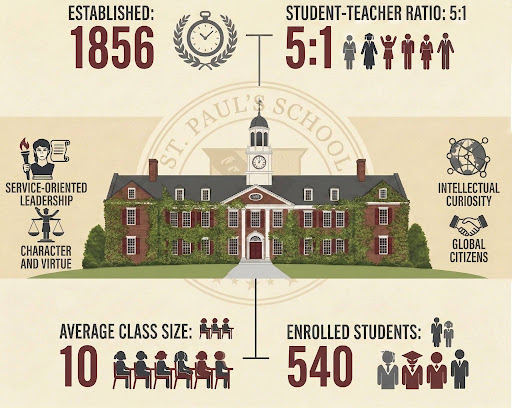
St. Paul’s School was founded by George Cheyne Shattuck in 1856, modeled after England’s greater boarding schools. Before becoming coeducational in 1971 and later becoming one of the top independent prep schools in New Hampshire, St. Paul was primarily an Episcopal boarding school for boys dedicated to producing academically excellent, honorable, and service-oriented individuals.
Located in New Hampshire, St. Paul’s School has become one of the most prestigious boarding schools in the United States, recognized for its rigorous academics, distinguished alumni, and strong emphasis on intellectual curiosity, high purpose, and community accountability.
Families choose St. Paul’s School for its transformative education that encourages not only academic excellence but also character formation, openness, empathy, and service-oriented leadership, equipping learners with the skills essential to their functioning as global citizens.
How Hard Is It to Get Into St. Paul’s School?
With an acceptance rate of around 16%, St. Paul’s School ranks among the highly competitive boarding schools in the United States alongside Groton and Phillips Andover, which makes it extremely difficult to get admitted to despite its multiple entry points.
Having said that, St. Paul’s primary entry point is in 9th grade, with the most seats available, which makes it competitive, as many applicants would try to get in during this year. While the school accepts applications for higher grades, such as 10th grade, these spots are often limited, contributing to the school’s overall selectiveness. As one of the country’s most selective boarding schools, St. Paul’s School attracts a large number of well-rounded applicants, which makes the applicant pool extremely competitive.
Furthermore, St. Paul’s testing policy varies by grade level. 9th-grade applicants are required to submit an SSAT or ISEE score. 10th-grade applicants are expected to submit the SSAT or PSAT. 11th-grade applicants, on the other hand, are required to submit an SSAT, PSAT, SAT, or ACT score. Additionally, students whose mother tongue is not English are required to submit TOEFL, IELTS, or the Duolingo English Test. However, students who are enrolled in a school where English is the primary medium of instruction for three or more years are exempt from this requirement.
Taking into consideration how competitive the St. Paul’s School admission is, ambitious families may benefit by working with a highly regarded boarding school admissions consultant experienced in the St. Paul’s admission process. Consultants can provide invaluable guidance in crafting a compelling narrative for the application.
Top Tips For Families Who Want to Get Into St. Paul’s School
- • Begin admission preparation early to give your child the foundation for academic growth.
- • Pursue advanced courses to demonstrate academic initiative.
- • Engage in meaningful extracurricular activities way before the start of any applications, as this would frame you as a well-rounded applicant.
Best Practices for Students Applying to St. Paul’s
- • Highlight leadership roles, community and volunteering involvements, and academic performance in the application.
- • Share authentic anecdotes in essays and other short responses to reflect character, growth, and self-awareness.
- • Prepare for interviews by speaking naturally about your academic goals, interests, and what excites you about St. Paul’s.
Common Questions Parents Ask About St. Paul’s School Admissions
Q: What is the acceptance rate at St. Paul’s?
A: St. Paul’s School is one of the top boarding schools in the country and has an acceptance rate of around 16%, easily making it one of the most competitive schools to get into.
Q: What role do interviews or conversations play in the admissions process?
A: Interviews and conversations help the admissions get to know your child better beyond just their transcript and test scores. It would also help them assess whether your child’s authentic voice is reflected in their application.
Q: How important are extracurricular activities and leadership?
A: Extracurricular involvement plays a vital role in shaping your child. It will help the admissions committee determine whether your child is a well-rounded student who can enrich the school community.
The St. Paul’s School Admission Process
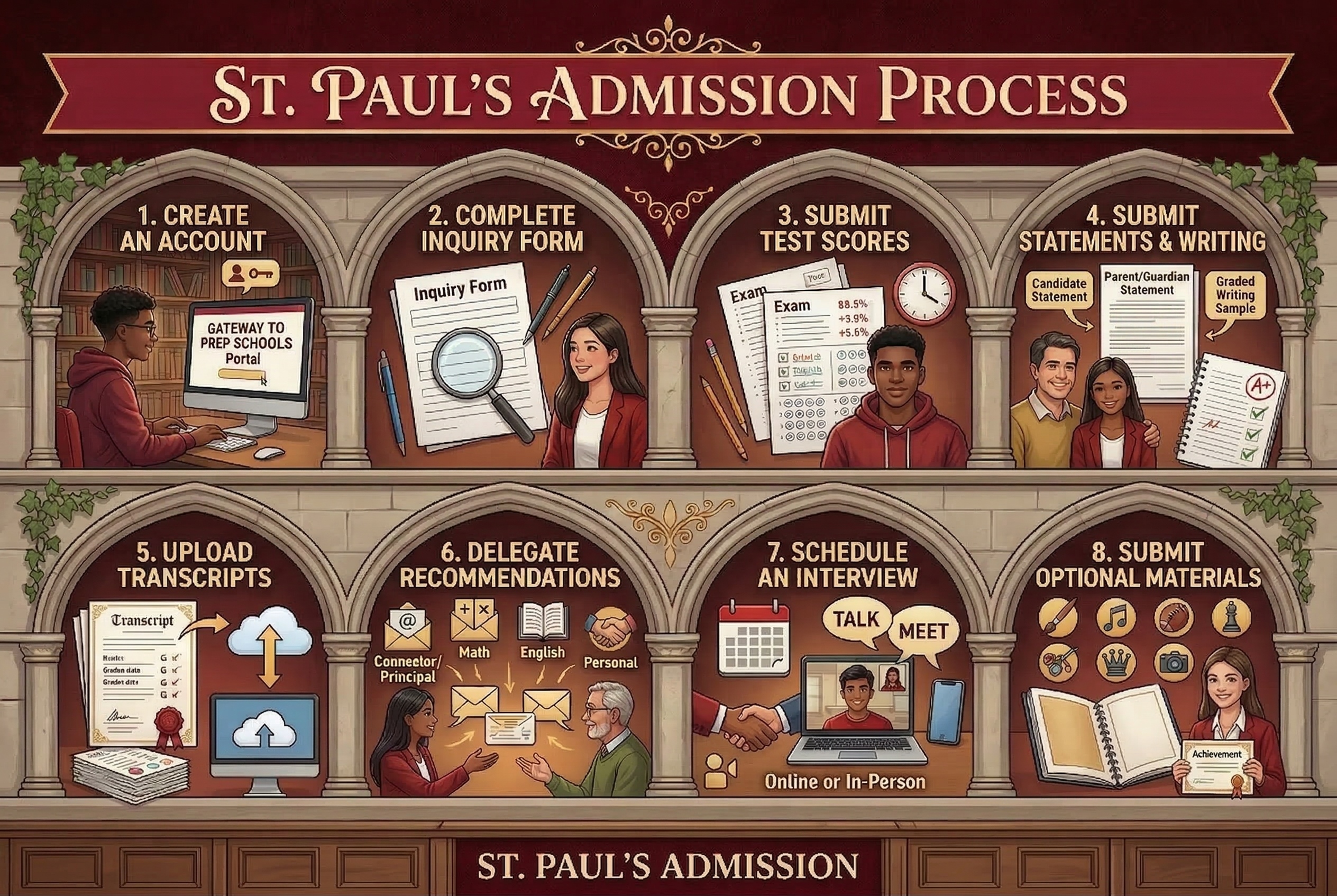
Creating an account on Gateway to Prep Schools is the first step in the St. Paul’s School admission process. You may apply, register for admission events, receive notifications from St. Paul’s, and monitor your application progress. The steps you should take are as follows:
- Create an account on Gateway to Prep Schools
- Complete the Inquiry Form
- Submit the standardized test scores
- Submit the student’s graded writing sample, candidate statement, and parent/guardian statement
- Upload school transcripts
- Delegate counselor/principal, math & English recommendations, personal recommendation
- Schedule an Interview
- Submit optional supplementary materials
For more details and to begin your application, visit St. Paul’s School Admissions.
St. Paul’s School Admission Requirements
The admission to St. Paul’s School is composed of multiple requirements specifically designed to help the admissions team get to know your child beyond their transcript and test scores. In this section, we will be identifying the key components of the application and what families should know to help them prepare for the selective admissions process.
Inquiry Forms
The first step in the application process is completing St. Paul’s inquiry form. This helps ensure that you are in the school’s database, so you can receive information on the admission and upcoming school events.
Standardized Testing
All applicants are required to submit standardized test scores, depending on the grade level they are applying for. All tests must be taken within one year of the application deadline. For a comprehensive list of the required testing information to be submitted for each grade level, as well as the test codes, kindly visit St. Paul’s Application Process page.
Admission testing is an integral part of St. Paul’s application process. These test scores will be used by the admissions team to evaluate your child’s fit with the academically demanding environment of the school. To ensure your child is prepared for the rigors of the SSAT or ISEE, schedule a proctored diagnostic test to identify knowledge gaps and establish a baseline score.
Graded Writing Sample
As part of the St. Paul’s School application, students are required to submit a graded writing sample that they have submitted to the school this academic year. The sample should include the teacher’s comments or feedback. The applicants are encouraged to choose a sample that they feel most proud of. Additionally, the applicants must also complete the accompanying form describing what the assignment was and identifying the course.
Candidate Statement
The candidate statement is an important part of the St. Paul’s application process. Through this requirement, the students are given a chance to show a genuine interest in the school using their own voice. Just like any other elite boarding school in the U.S., St. Paul’s encourages the students to identify anecdotes that speak for their character rather than provide a listicle of accomplishments, which makes the essay seem like a resume rather than a compelling narration of personal experiences and achievements that helped shape their character.
How to write a compelling candidate statement
To help the admissions officers get a full view of the applicant as a whole person, crafting a well-written and thoughtful candidate essay is crucial. When choosing what to write about or which areas of the students’ profiles to highlight, the key thing to remember is to remain authentic rather than trying to appear on par with professional writers. Crafting a narrative that stands out requires a unique perspective; learn more about developing an authentic writing voice to help your child resonate with admissions officers.
Parent Statement
Another vital application requirement that parents or guardians need to accomplish is the parent statement. The question varies by school, but parents are usually asked to talk about their child and talk about their character, achievements, and other personal information. You will also be asked why your family is interested in St. Paul’s for your child and about your involvement in your child’s current school, as well as the local community. Remember that the admissions are not only evaluating your child’s fit with the school; they are also evaluating the family’s fit.
How to write an effective parent essay
To write an effective parent essay, the guardian or parents must carefully consider how to frame and convey their child in a way that avoids coming across as too proud. When choosing what to write, focus on your child’s strengths and characteristics. Reference personal examples that bolster your claim. Describe how the school’s teaching approach aligns perfectly with your child’s learning style. Detail how the family’s values also align with the core principles of the school. A persuasive parent statement balances pride with objective insight. Explore our expert guide on how to write a compelling boarding school parent essay for further strategies and examples.
Transcript
St. Paul’s School specifically requires the applicants to submit grades from the current year as well as the official transcript from the previous two years. The school looks for consistency and an upward trajectory in core subjects.
How to improve grades?
Your child’s transcript will demonstrate their readiness for St. Paul’s academically rigorous curriculum. But what if your grades are not as competitive as those of the other applicants? Start your top boarding school admissions consulting early!
Our subject tutors will work with your child closely to improve their foundational knowledge and study habits, ultimately helping your child achieve the grades that meet the admission requirements. We provide high-impact tutoring for a variety of courses. However, we also acknowledge that executive functioning plays a big role in building habits that truly guarantee long-term success, which our academic coaches are excellent at.
Recommendation Letters & Supplemental Materials
In terms of recommendation letters, St. Paul’s specifically requires a personal recommendation and a recommendation letter from your child’s current principal or counselor, as well as from your child’s current math and English teachers. Additionally, a special interest recommendation may also be submitted as optional material.
How to get the best letter of recommendation
To secure the best letter of recommendation, it is important for your child to establish a genuine relationship with the teachers. Your child’s leadership in the school community is as important as academic performance. For the LoR to be of true value, the teachers, principal, or school counselor must be able to talk about how your child plays a big role in the school community in terms of their leadership and how they model good behavior and excellent academic performance for their peers.
Admission Interviews
Similar to private school admissions in the Bay Area, elite boarding schools in the country may include separate interviews with the students and their parents as part of the admissions process. The format of the interview may be virtual or in person. The applicants may only schedule the interview once part one of the Gateway to Prep School application is completed.
Regardless of how the interview is structured format-wise, it is important to remain authentic in reinforcing both the family’s and the child’s strong fit and value alignment with the school.
Indeed, taking an interview is nerve-racking, but worry not! Confidence is key. Our interview preparation helps students and parents articulate their values effectively during the St. Paul’s interview. Our process involves introducing you to common interview questions and how to structure your answer in a way that is both reflective of your values and also appealing to the St. Paul’s School admissions committee.
Optional Supplementary Material
Aside from excellent academic performance, central to the best boarding school’s mission is to produce a well-rounded individual—intellectually curious and driven to pursue and enrich their creative interests. To support this mission, St. Paul’s School encourages student athletes or any students deeply immersed in the creative realm, including ballet dancers, musicians, artists, or actors, to submit supplementary material that showcases their talents.
If you want to know what specific material can be submitted for each creative discipline, kindly check out the SPS Admission Page.
Top Tips for Navigating St. Paul’s School Admission Requirements
- • Start your application process by completing the Admissions Inquiry Form.
- • Always review the school website to confirm the application requirements and process.
- • Work with an expert boarding school consultant for a less stressful and more informed approach to St. Paul’s competitive admission process.
Best Practices to Achieve a Strong St. Paul’s School Application
- • Ensure that all requirements are submitted before the deadline.
- • Choose a letter of recommendation writer who knows your child well and can speak positively about your child for better admission chances.
- • Thoughtfully prepare for interviews by reviewing unique offerings by the school and getting a great understanding of the school’s philosophy and how it matches your family’s values.
Common Questions Families Ask About the Admission Process
Q: Is St. Paul’s School accepting international students?
A: Absolutely! St. Paul’s School has a “house system” where students and the faculty from diverse backgrounds live together. Students from around the world are open to apply.
Q: Does the school require an in-person campus visit?
A: An in-person visit is not strictly required, but it is encouraged. However, virtual tours and information sessions are available to accommodate applicants who are not able to visit the campus during the application season.
Q: Are English proficiency tests required for international applicants?
A: Yes. For applicants whose mother tongue is not English, proficiency tests such as IELTS, TOEFL, or Duolingo are required.
What is Student Life Like at St. Paul’s School?
The student life at St. Paul’s is an exciting mix of rigorous academics, extracurricular activities, and a close-knit residential community that fosters a community that genuinely feels like a home away from home.
Academic Culture at St. Paul’s
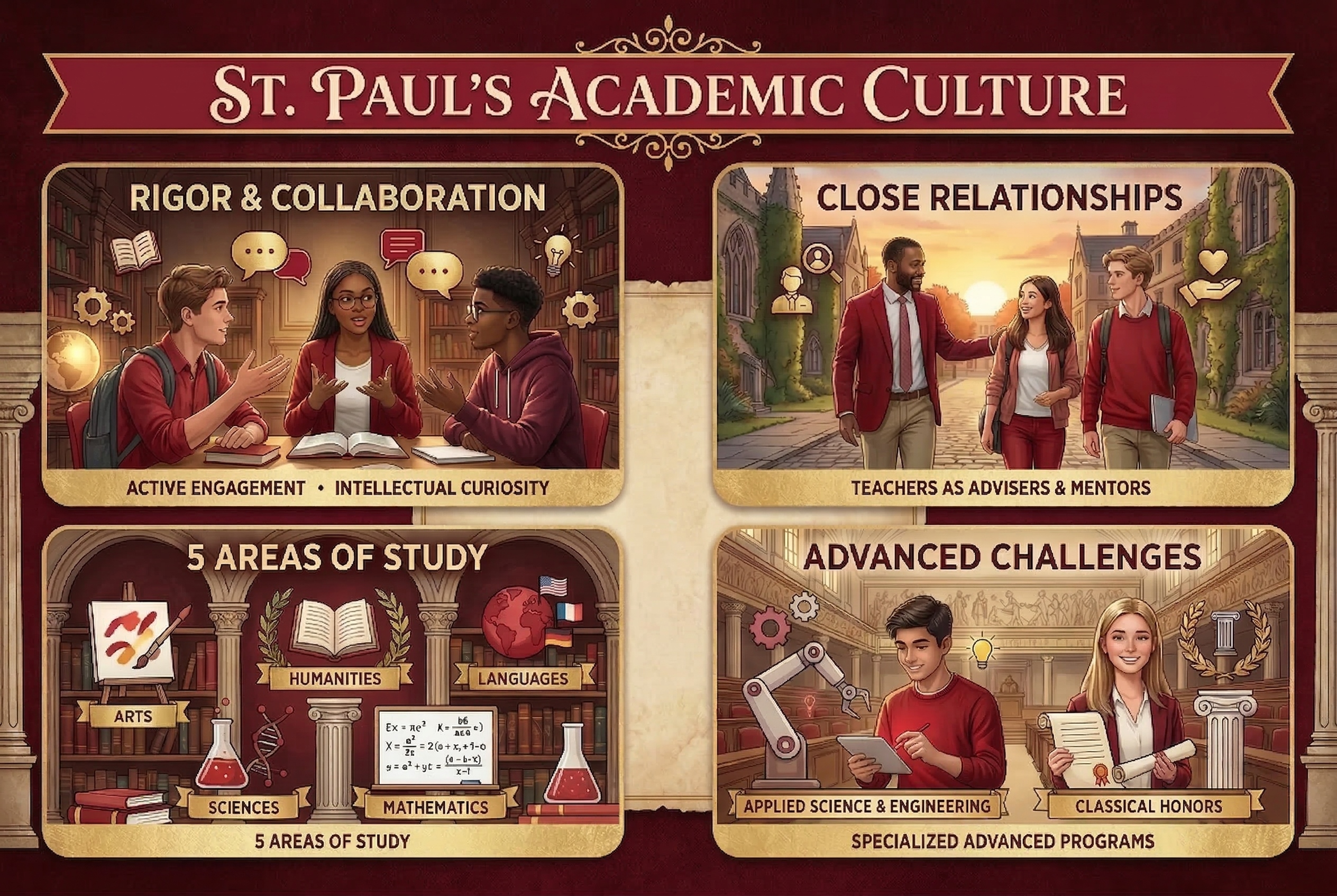
The academic culture at St. Paul’s is generally described as rigorous and collaborative. Centered on intellectual curiosity, active engagement with ideas, and collaboration, the school encourages students to explore a wide area of subjects of interest while pursuing excellence. Teachers are not only instructors but also advisers, coaches, and mentors who live within the community, creating close relationships that support both academic growth and personal development.
St. Paul’s School offers five areas of study, along with more than 30 electives in humanities, 62 art courses, four science laboratories, and two ancient languages taught. This wide range of academic offerings provides students with numerous opportunities to explore their interests while striving for excellence. On top of the core curriculum, students can further challenge themselves through advanced programs such as Next Level Learning for Applied Science and Engineering and Classical Honors. These programs allow highly motivated students to pursue deeper, specialized study in their chosen fields.
St. Paul’s five areas of study are as follows:
- • Arts
- • Humanities
- • Languages
- • Mathematics
- • Sciences
As one of the top-tier boarding schools in the country, St. Paul’s School has a 360-degree approach to education, emphasizing the importance of social, emotional, intellectual, and spiritual growth.
Residential Community and Campus Culture
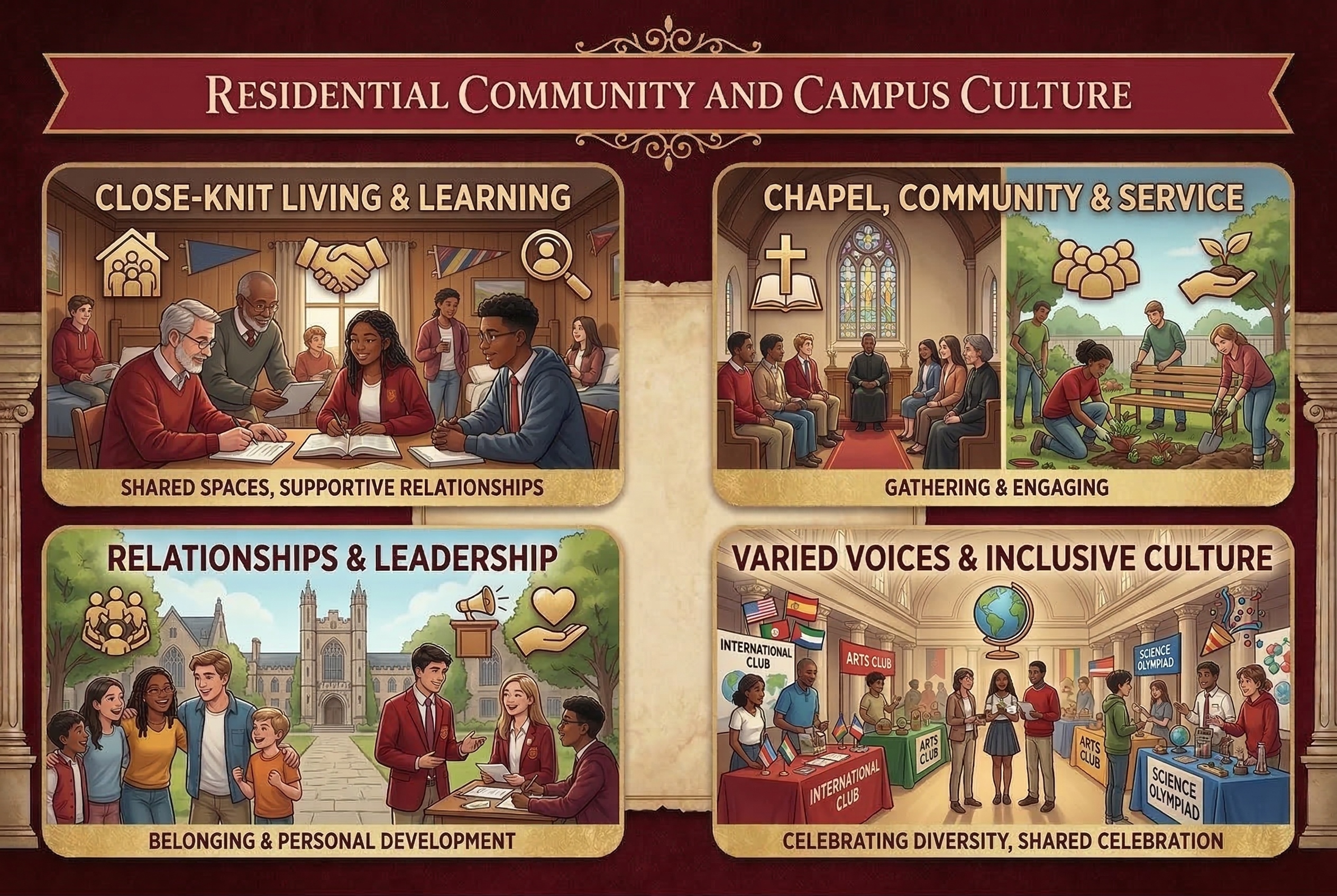
Life in a residential community where students bring varied experiences and viewpoints can be demanding at times, but it is never without excitement or learning.
The residential community and campus culture at St. Paul’s School are built around a fully boarding experience where students and faculty live and learn together on campus. Because the school is entirely residential, teachers, advisers, and students share the same environment, creating a close-knit community where support and mentorship are always nearby. Friendships often become very strong, and many students describe the campus as feeling like an extended family rather than simply a school.
Campus culture also emphasizes shared values, inclusivity, and community connection. Students and faculty gather regularly for Chapel services, participate in clubs and social events, and engage in service and community programs both on and off campus.
At St. Paul’s School, the culture is close-knit, supportive, and values-driven. Living together on campus helps students establish strong relationships, develop leadership and empathy, and experience a true sense of belonging.
Activities at St. Paul’s School
Committed to producing multifaceted individuals, St. Paul’s School has more than 70 clubs and societies. Long-standing organizations like the Debate Team, The Pelican, and the Missionary Society coexist with creative groups such as Funkdefied, GAINS for girls in STEM, and Sparkle for Hope. Students also contribute to literary and artistic publications like Horae Scholasticae, providing a platform for creative expression.

Life outside the classroom at St. Paul’s is vibrant and diverse, with plenty of opportunities for students to pursue passions, build leadership skills, contribute to community projects, and connect with peers through shared interests.
For a comprehensive list of clubs and societies, please visit St. Paul’s Clubs & Activities.
The St. Paul’s School Famous Alumni
St. Paul’s School has a long-standing tradition of academic excellence and a strong influence across fields such as business, science and academia, politics and public service, journalism, arts, literature, and entertainment. Its graduates have gone on to achieve distinction in a wide variety of professional arenas, reflecting the school’s emphasis on scholarship, leadership, and character. Some of St. Paul’s notable alumni include:
- • Lorene Cary (Class of 1974). Acclaimed novelist, memoirist, and educator best known for Black Ice, a memoir reflecting on her experiences as one of the first Black female students at St. Paul’s School. Her work explores themes of identity, history, and social justice.
- • Garry Trudeau (Class of 1966). Pulitzer Prize–winning cartoonist and creator of the long-running comic strip Doonesbury. Trudeau is known for his sharp political satire and cultural commentary, making him one of the most influential editorial cartoonists in the United States.
- • John Kerry (Class of 1962). Former U.S. Secretary of State, U.S. Senator from Massachusetts, and the Democratic nominee for President in 2004. Kerry has had a long career in American politics and diplomacy, including leadership in international climate negotiations.
- • Robert Mueller (Class of 1962). Director of the Federal Bureau of Investigation from 2001 to 2013 and later Special Counsel for the U.S. Department of Justice. Mueller is widely respected for his leadership in federal law enforcement and his role in major national investigations.
- • Hobey Baker (Class of 1910). Legendary amateur hockey player and World War I fighter pilot. Baker is considered one of the greatest early figures in American hockey, and the prestigious Hobey Baker Award, given annually to the top NCAA men’s hockey player, is named in his honor.
These alumni reflect St. Paul’s School’s enduring tradition of preparing students to lead and make meaningful contributions in public service, the arts, literature, and athletics.
Related Articles
Best Guide to St. Paul’s School’s Selective Admission Process
The St. Paul’s School Alumni: Where Are They Now?
Did You Know?
The school’s literary magazine, Horae Scholasticae, is one of the oldest continuously published high school literary magazines in the United States, showcasing student poetry, essays, and artwork.
Fun Fact
Winter is considered one of the most magical seasons on campus. When snow covers the grounds and the ponds freeze, students often gather to skate outdoors, an experience many say makes St. Paul’s feel more like a classic New England college campus than a typical high school.
Frequently Asked Questions
How much is the tuition fee at St. Paul’s School?
St. Paul’s School believes that investing in your child’s education is investing in the future. The tuition fee for boarding students at St. Paul’s School is estimated to be around $76,650, inclusive of the tuition, room and board, mandatory fees, and estimated personal expenses.
Does St. Paul’s School offer a summer program?
Yes. St. Paul’s School offers a five-week-long Advanced Studies Program with more than 15 major courses. The session for the year 2026 will run from January 21 to July 26. The ASP provides students with an opportunity to explore thought-provoking courses and connect with like-minded people. The program is more than just an academic exploration; it’s also qual parts real-life preparation and fun.
What is St. Paul’s acceptance rate?
St. Paul’s School has an acceptance rate of approximately 16%, making it one of the more selective boarding schools in the country. The admission is highly selective, with the applicants evaluated based on their academic performance, extracurricular involvement, teacher recommendations, interviews, and alignment with the boarding school’s values.
Can international students apply to St. Paul’s?
Absolutely, international students are encouraged to apply and are an important part of St. Paul’s diverse campus community. Applicants from outside the United States follow the same admissions process and are required to submit the same requirements, with the addition of the TOEFL English proficiency test.

DISCLAIMER
Cardinal Education is an independent educational consulting company. We are not affiliated with or endorsed by any private school, including those mentioned on this website. All school names and trademarks are the property of their respective owners and are used here for descriptive purposes only.