
Choate Rosemary Hall Admissions Consulting for Asian American Families
Independent Counsel for Asian American Students Applying to a Connecticut Boarding School Where 18% of the Community Arrives From Abroad
Cardinal Education is an independent educational consulting company. We are not affiliated, associated, authorized, endorsed by, or in any way officially connected with any private or public school, including Choate Rosemary Hall.
As Seen On




















About the School
Why Choate Rosemary Hall Admissions Look Different for Asian American Applicants
There is a problem specific to this school, and it is worth naming plainly. Choate enrolls 859 students in Wallingford, Connecticut, and 18% of them are international. A large share of that international cohort comes from Asia. An Asian American applicant from New Jersey or Northern California is therefore competing inside a pool where the committee is already reading many files that look superficially adjacent to hers, and where the easy story about her, the strong math student who plays an instrument, has been told several hundred times by January.
The answer is not to hide anything. It is to be specific enough that no one can confuse your child with anyone else. Choate makes this unusually possible, because the school publishes no minimum GPA and no target score, which means the differentiating work has to happen in the parts of the file a family can actually control.
Choate at a Glance
Where
333 Christian Street, Wallingford, Connecticut, on 458 acres about 15 miles from New Haven
Who
859 students in grades 9 through 12 plus a postgraduate year (649 boarding, 210 day)
Domestic Students of Color
40%
International Students
18%
Average Class Size
11 students
Student-Teacher Ratio
6:1
Courses Offered
More than 300
Signature Programs
8
Cycle
Opens July 2026, closes January 15, decisions March 10
Testing
Optional at every entry point
Counseling
A team of 8 college counselors
The Numbers Behind the Community
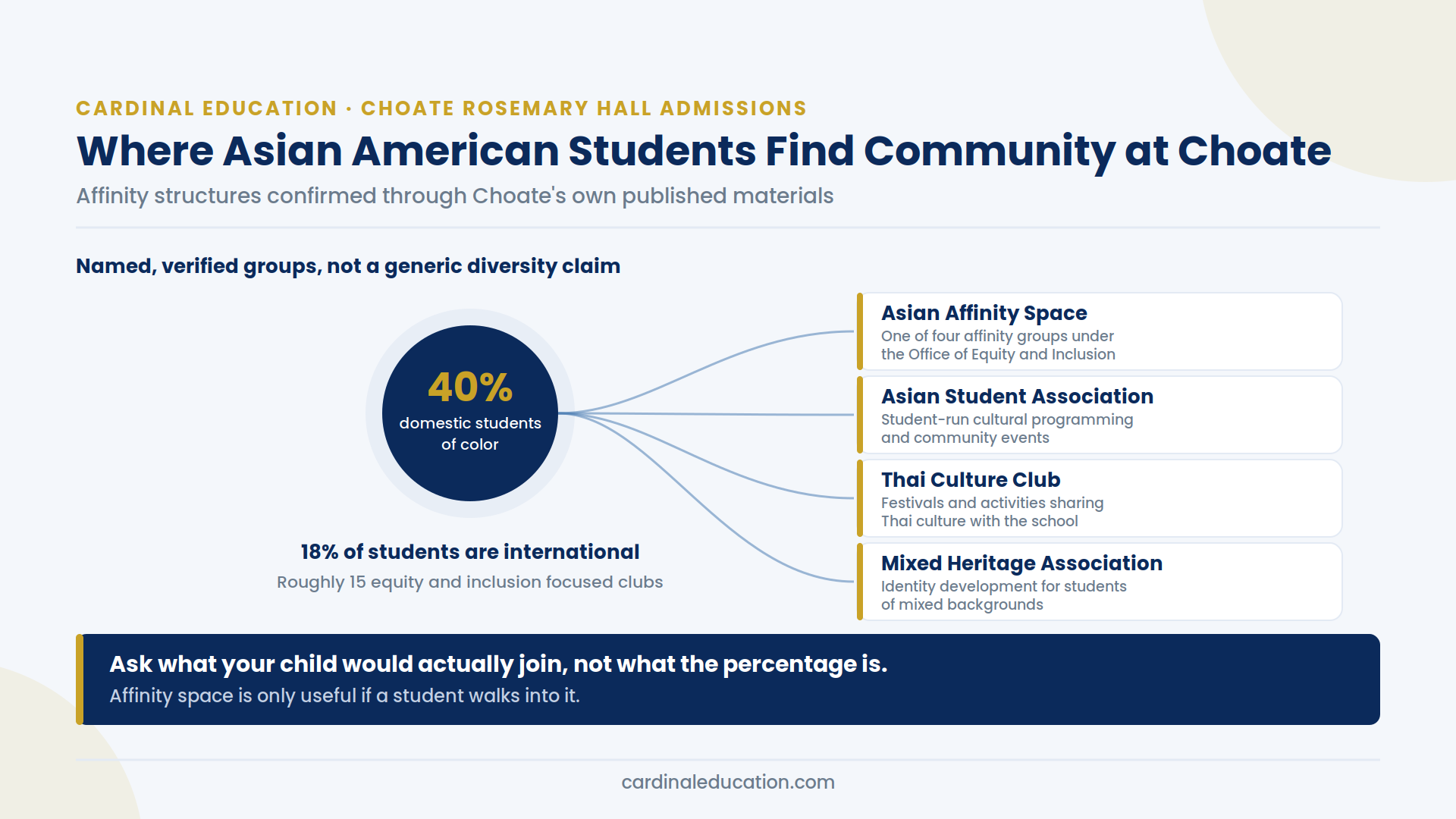
Choate does not publish a standalone Asian American enrollment figure. Anyone quoting one to you has inferred it. What the school does publish, and what is actually more useful, is the structure of affinity life on campus.
Domestic Students of Color
40% of enrollment
International Students
18% of enrollment
Affinity Groups Under the Office of Equity and Inclusion
Four, including the Asian Affinity Space
Equity and Inclusion Focused Student Clubs
Roughly fifteen
Student-Led Spiritual Life Organizations
Five, including Buddhist Meditation and the Muslim Student Association
Office of Multicultural Affairs Established
1989
Our main Choate page carries the full academic snapshot, including SAT and ACT middle-50% ranges and the per-grade enrollment breakdown. Choate Rosemary Hall Admissions Consulting
Named Affinity Spaces, Verified
We list these because vague reassurance about diversity helps nobody choose a school. Each of the following appears in Choate’s own published materials.
- Asian Affinity Space (AAS). One of four affinity groups overseen by the Office of Equity and Inclusion, alongside RISE, CALM and This Is Us. Its stated purpose is to create an environment that celebrates the range of Asian cultures, traditions and experiences, and to provide a platform for dialogue and support.
- Asian Student Association. Student-run cultural programming and community events.
- Thai Culture Club. Founded to promote Thai culture and values across the school and to give Thai students a place to connect, including festivals and cultural activities.
- Mixed Heritage Association. Focused on the identity development of students of mixed background, which matters to a meaningful and growing share of Asian American families.
- Buddhist Meditation. One of five student-led spiritual life organizations overseen by the Spiritual Life team.
- Campus-Wide Observance. Lunar New Year and Diwali celebrations are organized by affinity groups, and International Education Week runs each October.
The useful question on a campus visit is not how many of these exist. It is which one your child would walk into unprompted in October of ninth grade.
Dates and Events Worth Putting in the Calendar
Application Opens
July 2026 (Start with the Inquiry Form; it drives interview invitations)
Diversity Round Table Reception
September 15–16, 2026 (Detroit and Chicago)
Ten School Admission Organization Receptions
September 17–20, 2026 (Includes San Francisco and Palo Alto, relevant to many Bay Area families)
Interview Window
September through February (Online only; one interview per applicant, no exceptions)
Application Deadline
January 15 (Gateway application must be in by this date)
Supporting Materials Grace Window
By February 1 (Late recommendations or scores still permit an on-time decision)
Decisions
March 10 (Released through the Choate Application Status Portal)
Families who attend a regional reception before applying tend to write better essays, simply because they have something concrete to write about. Our guide to what to ask and observe at an open house is worth reading first.
Working Through the Application
Top Tips for Applying
- Build the file around one genuine depth rather than five competent surfaces. Choate’s signature programs reward students who arrived already committed to something.
- Name the program. A student who can explain why the Science Research Program rather than the Advanced Robotics Concentration has demonstrated more than a student who admires the school in general.
- Do not let the parent statement flatten your child into a résumé. It is the one place a family can add dimension the transcript cannot.
- Prepare for an online interview specifically. Camera framing, pacing and the awkwardness of silence over video are learnable and most applicants do not practise them.
- Choose a personal recommender who has seen your child outside an academic frame.
Best Practices for Families
- Read Choate’s Statement of Character before drafting. It is the clearest available description of what the committee rewards.
- Separate your child’s story from the international applicant narrative if your family has been in the United States for generations. They are different files and should read differently.
- Have a real conversation about boarding before applying, not after an acceptance arrives.
- Decide on testing with evidence. A diagnostic answers the question; anxiety does not.
- Verify every requirement against Choate’s own admission pages, which update through the fall.
Application Requirements
-
01What Gateway Actually Asks For
Choate uses Gateway to Prep Schools in three parts. Part 1 is the Candidate Profile. Part 2 is the applicant essays plus the parent or guardian statement. Part 3 collects the Principal or Counselor Recommendation and Transcript Report, along with recommendations from the current English and mathematics teachers. Two further recommendations are optional: a third teacher, current or previous, and a personal recommendation from an adult who can speak to character. For students whose academic record is strong but whose narrative is thin, that personal recommendation often does more work than anything else in the file.
-
02Transcripts and Course Rigor
Choate asks for current grades and the record from the previous two years. Because the school reads for trajectory and for the difficulty of what a student chose, course selection deserves attention a year before anyone opens an application. Where the foundation needs strengthening, that is a coaching problem rather than a tutoring one, and we treat it as such.
-
03Testing, and Whether to Submit
Ninth and tenth grade applicants may submit SSAT or ISEE scores. Eleventh grade applicants may also submit PSAT, SAT or ACT. Postgraduate applicants submit SAT or ACT. Students who are not native English speakers, or who have not spent two years in an English-medium school, are strongly encouraged to send TOEFL, IELTS or Duolingo results. For many Asian American families the reflex is to submit, on the theory that a strong score can only help. Sometimes that is right. Sometimes a very good score simply confirms what the transcript already said and spends attention that a different part of the file needed. The decision deserves analysis, not reflex.
-
04The Interview
Forty-five minutes, online, once. The first 20 to 25 minutes are the student alone with the interviewer, and the balance is available to parents. Choate weighs every interviewer’s read equally, so there is no advantage in angling for a particular person. The single most common failure we see is a well-prepared student answering in complete, careful, slightly rehearsed paragraphs. Choate is looking for a person, and polish is not the same as authenticity.
How Cardinal Education Helps
Our position on this is not complicated. Asian American applicants to schools like Choate are frequently over-prepared and under-differentiated, and the fix is not more activities. It is finding the one thing your child would keep doing if no admissions committee existed and building the file honestly around it. We work through personal statement development, interview coaching, executive function support where the workload is the real obstacle, and candid conversation about fit. Families who want the general Choate overview, including athletics, academics, and full admissions details, should start with Choate Rosemary Hall school profile.
Frequently Asked Questions
How many Asian American students attend Choate Rosemary Hall?
Does being Asian American make Choate Rosemary Hall admissions harder?
Is there an Asian affinity group at Choate?
Should an Asian American applicant submit test scores to a test-optional school?
How does Choate support students during the transition to boarding?
How does Choate compare to other New England boarding schools?
Considering Choate Rosemary Hall for Your Family?
Your child does not need to be more impressive. They need to be more legible. Tell us where your child actually is and we will tell you what we think, including when the answer is no.