
Cardinal Education is an independent educational consulting company. We are not affiliated, associated, authorized, endorsed by, or in any way officially connected with any public or private school.
Everything Bay Area families need to know about applying to Menlo School in Atherton, from the required STAR Assessment to the March decision date.
Speak with an Admissions Expert
Quick Answer for Busy Parents
Menlo School admits students primarily into 6th and 9th grade, taking roughly 72 new sixth graders and 82 new ninth graders each year. Applications open September 1, 2026 through Ravenna and close January 5, 2027 for family-submitted materials. Every applicant must take Menlo’s own STAR Assessment in the fall, and outside test scores are not accepted from local families. Interviews are required. Decisions arrive March 12, 2027. The strongest applications come from students who can speak specifically and honestly about what they are curious about, because Menlo reads for engagement rather than for a perfect transcript.
Why Do Families Choose Menlo School?
Menlo School opened in 1915 as the William Warren School and has spent the century since becoming one of the Peninsula’s defining independent schools. Today it is a coeducational, college-preparatory day school serving roughly 845 students in grades 6 through 12 on a single campus at 50 Valparaiso Avenue in Atherton, under Head of School Than Healy.
The school’s stated purpose is to inspire students to lead lives of meaning, impact, and joy, and it repeats a second idea just as often: that learning is a journey that should be enjoyed. In a region where academic pressure can curdle into something corrosive, that emphasis is not marketing. It shows up in how Menlo structures its program, with a broad elective catalog, an interdisciplinary scholars pathway, and a project term that pulls students out of the regular schedule entirely.
Niche currently ranks Menlo among the top private high schools in California, at #17 statewide, with an overall grade of A+. Menlo is accredited by the Western Association of Schools and Colleges and belongs to the National and California Associations of Independent Schools.
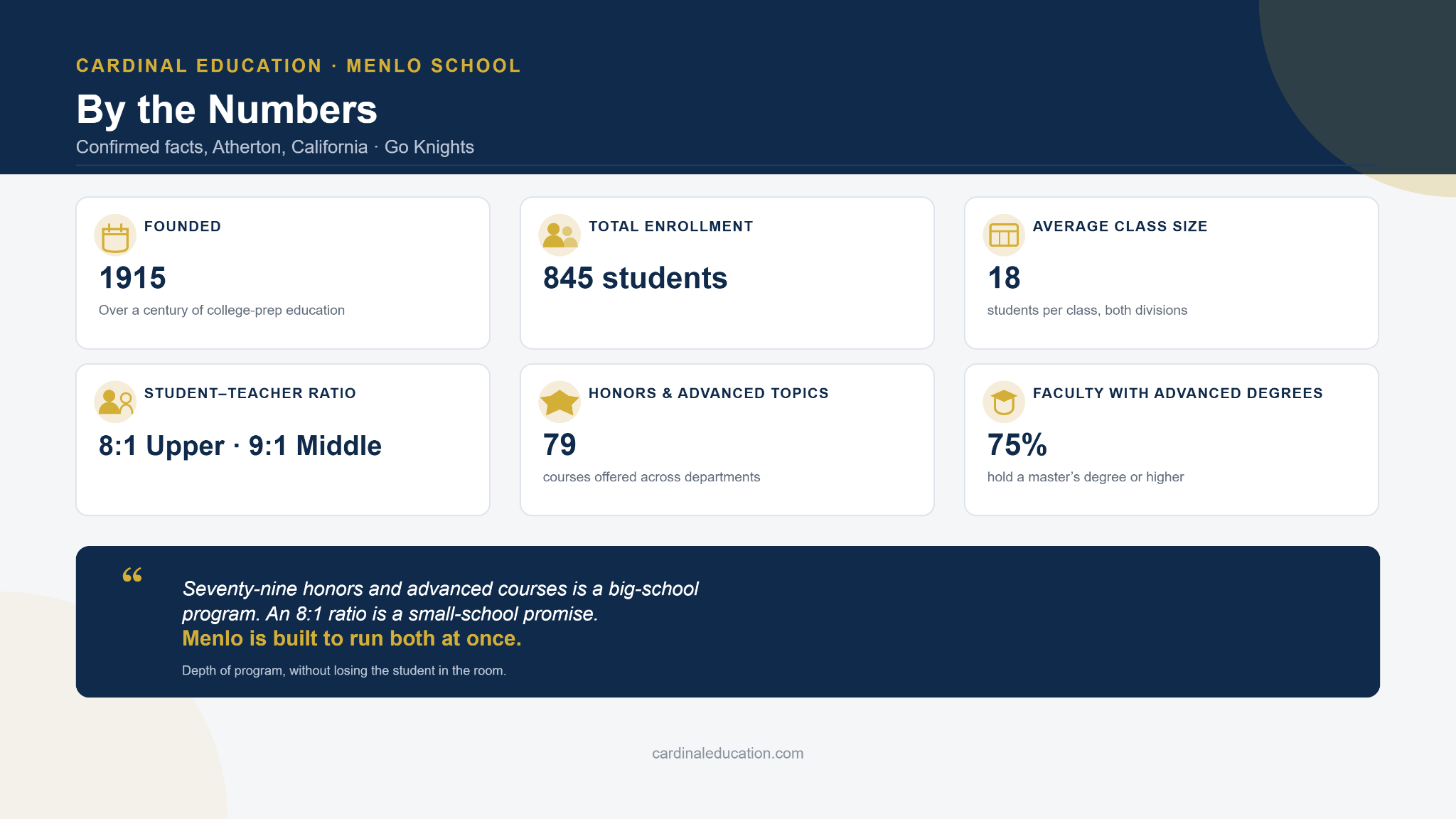
Menlo School Academic Snapshot
| Measure | Middle School (6–8) | Upper School (9–12) |
| Enrollment | 226 | 619 |
| Student-teacher ratio | 9:1 | 8:1 |
| Average class size | 18 | 18 |
| Faculty with advanced degrees | 75% | 75% |
| Advanced coursework | Foundational sequences feeding Upper School honors tracks | 79 Honors and Advanced Topics courses |
| Departments | Creative Arts; Design Engineering + Computer Science; English; Human Skills; Learning Seminar; Mathematics; Science; Social Sciences; World Language | Applied Science & Engineering; Computer Science; Creative Arts; English; History & Social Sciences; Mathematics; Science; World Language |
Menlo reports that 60% of its students identify as students of color, and that applicants arrive from more than 35 different sending schools in each division. Free bus service runs on four routes, with an additional shuttle to and from the Menlo Park Caltrain station.
How Hard Is It to Get Into Menlo School?
Menlo does not publish an acceptance rate, and we would rather give you the numbers the school actually stands behind than a figure lifted from an aggregator. Here is what Menlo does say: roughly 72 new students enter sixth grade each year and roughly 82 enter ninth grade. The typical Upper School graduating class is about 155 students, with about half continuing up from Menlo’s own Middle School. Applications for any grade other than 6 or 9 are considered on a space-available basis, and for the current cycle Menlo is accepting transfer applications into 10th grade only, with no mid-year transfers considered at all.
That structure tells you more than a percentage would. The ninth grade class has roughly 82 open seats for the entire Peninsula, and Menlo has been explicit that qualified siblings are turned away every year because of how competitive the pool is. What it looks for is not a formula. The school says plainly that it wants students who love learning, have strong academic skills, are kind and inclusive, and will actually engage with the program beyond the classroom. Families comparing options often look at Menlo alongside The Harker School, Crystal Springs Uplands, Castilleja, and The Nueva School, though the testing requirements differ meaningfully between them.
Top Tips for Applying to Menlo
- Target 6th or 9th grade. These are the real entry points, and everything else depends on space that may not exist.
- Build the STAR preparation into your summer. The assessment happens in the fall, months before the January deadline.
- Give your child something specific to say about why Menlo. Generic enthusiasm is the most common weakness we see in interviews.
- Ask recommenders early, in September, and give them material to work with.
- Protect current-year grades. Menlo reviews the year in progress alongside last year’s transcript.
Best Practices for Families
- Register the moment applications open on September 1, because every event has limited space.
- Attend a Parent Information Session before your child’s visit, so your own questions get answered separately from theirs.
- Read Menlo’s description of the student it wants and assess fit honestly, including whether the pace suits your child.
- Plan the commute early using the bus routes and Caltrain shuttle.
- Let your child speak for themselves in the Kira video. Over-coaching is visible.
Common Questions About Menlo’s Selectivity
What GPA does Menlo School require?
Menlo publishes no minimum GPA. Strong performance in core academic subjects is the practical expectation, but the school reads holistically and weighs trajectory. A student whose grades have climbed steadily reads better than one who peaked two years ago.
Does applying with a sibling at Menlo help?
Siblings are carefully considered, and Menlo says it values keeping families together. It also says directly that qualified affiliated students are not offered admission every year because of the competitiveness of the pool and space constraints. Treat sibling status as a factor, not an advantage to rely on.
Does attending an admissions event improve my child’s chances?
Menlo states that events are optional except where noted, and that attendance is not required to be admitted. The real benefit is indirect: a child who has walked the campus and spoken with students has concrete material for the interview, and vague answers are what sink otherwise strong applicants.
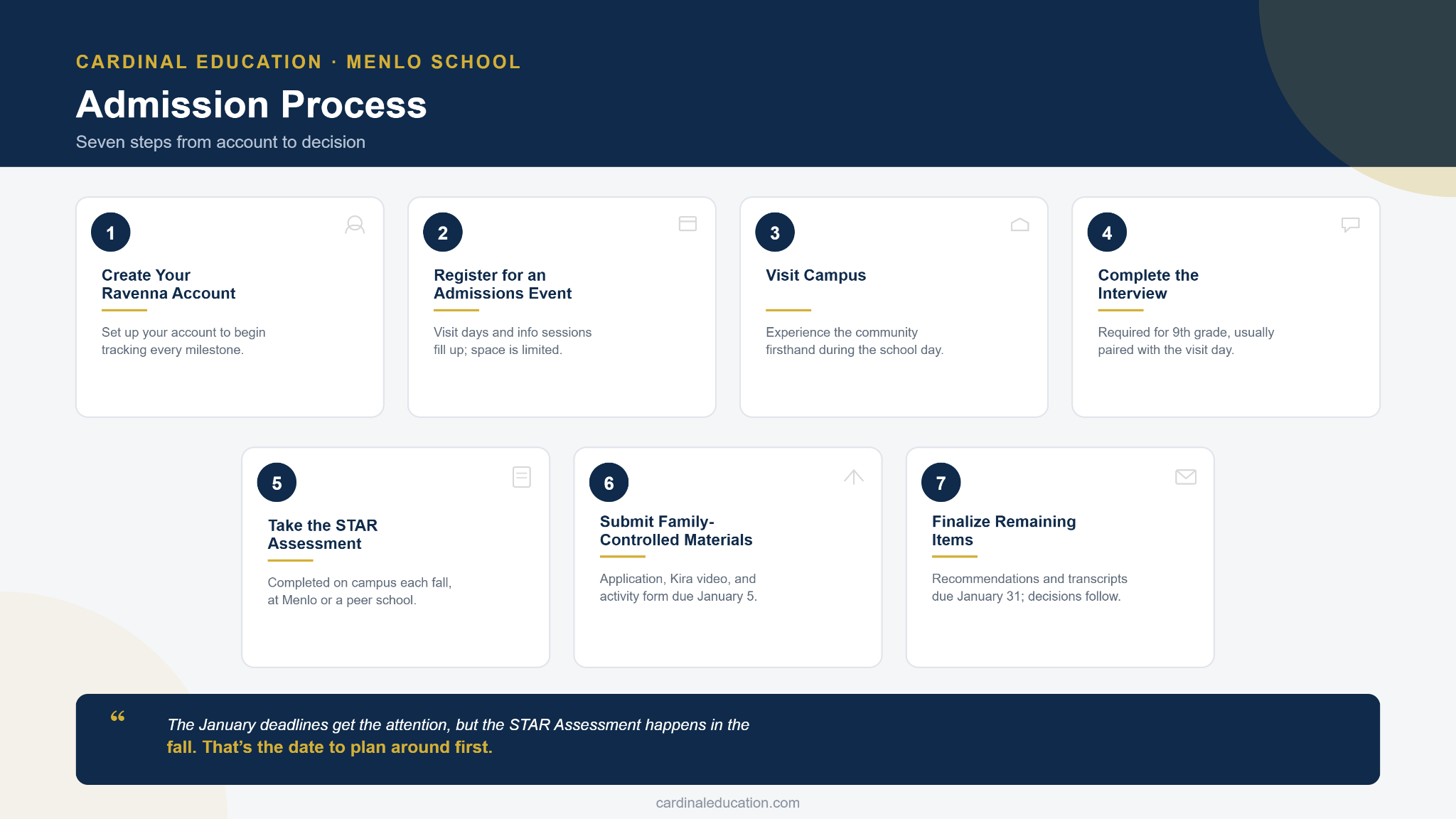
The Menlo School Admission Process, Step by Step
- Inquire and create a Ravenna account. Complete the student and family profile, select Menlo School from the school directory, and click Apply. Ravenna is where every event registration and application item lives.
- Get to know Menlo. Register for Parent Information Sessions, Preview Days, or other admissions events. Registration is required for all of them and space is limited.
- Complete the Student Visit Experience. Prospective students visit during the school day. Sixth grade visits include a group activity, lunch, and a small-group interview; ninth grade visits include a campus tour, classroom time, and lunch with current students.
- Sit for the student interview. Required. Appointments run October through January and are usually attached to the visit day. Upper School interviews are one-on-one and last 20 to 25 minutes.
- Take the STAR Assessment and writing sample. Required, in fall 2026, at Menlo or a peer school that administers it.
- Submit the application. Family-controlled materials are due January 5, 2027. School-submitted materials, meaning transcripts and recommendation forms, are due January 31, 2027.
- Await decisions. Menlo publishes admissions decisions on Ravenna after 4:00 pm on March 12, 2027, with enrollment contracts and deposits due before noon on March 19.
Menlo School Admissions Calendar and Key Dates
| Date | Milestone | Notes |
| September 1, 2026 | Applications and event registration open | Everything runs through Ravenna |
| October 2026 – January 2027 | Admissions events | Preview Days, Information Sessions, Student Visits and Interviews, STAR Assessments |
| January 5, 2027 | Family-controlled materials due | Includes the Kira video, the interview, and the STAR Assessment |
| January 31, 2027 | School-submitted materials due | Recommendation forms and transcripts |
| March 12, 2027, after 4:00 pm | Decisions published | Posted to Ravenna with notification emails |
| March 19, 2027, before 12:00 pm | Enrollment contracts and deposits due | Noon deadline is firm |
Menlo runs several admissions events. Visit the school website for updates.
| Event | Required? | What to Expect |
| Parent Information Session | Optional | Online or in person, covering academics, athletics, arts, and culture. In-person sessions include an optional tour. No pre-application steps needed. |
| Preview Day: Meet Menlo | Optional | Weekend event with students, teachers, and administrators. Requires a completed pre-application form and paid fee. |
| Middle School Student Visit and Interview | Required for 6th grade | Group activity, lunch, and small-group interview. Rolling dates late September through mid-October and in December; none in November. |
| Upper School Student Visit | Optional | Campus tour, academic experience, and lunch with current students. |
| Upper School Interview | Required for 9th grade | One-on-one, 20 to 25 minutes, virtual or in person. Casual dress, conversational format. |
| STAR Assessment and Writing Sample | Required | On campus in fall 2026, or at a peer school offering the assessment. |
Menlo School Application Requirements
Standardized Testing: The STAR Assessment
This is the requirement that most often surprises families, and it deserves the most attention. Menlo requires its own STAR Assessment, administered on campus during fall 2026 or at one of the peer schools that offers it, together with a proctored writing sample. Other standardized test results will not be accepted in place of it from local applicants. If your family is applying across several Peninsula schools, you are running two testing tracks on two calendars.
| Applicant Situation | Testing Requirement |
| Living within the nine Bay Area counties | Menlo STAR Assessment and writing sample, taken in person. No substitutions. |
| Living outside the nine Bay Area counties and unable to attend in person | SSAT or ISEE scores accepted instead |
| International applicant whose school does not teach primarily in English | TOEFL scores required in addition to the applicable assessment |
The Kira Family Video Questionnaire
Your family records video responses to a set of prompts and submits them through the Kira platform. You will need a laptop or desktop with a working camera and microphone. The single most useful thing you can do here is resist scripting it. Admissions readers watch a great many of these, and the difference between a family talking and a family reciting is obvious within seconds.
Recommendation Letters
Menlo requires three recommendations, and the specific recommenders differ by division.
| Middle School Applicants (Grades 6–8) | Upper School Applicants (Grades 9–12) |
| Principal or counselor recommendation | Principal or counselor recommendation |
| Current-year teacher recommendation | Current English teacher recommendation |
| Previous-year teacher recommendation | Current math teacher recommendation |
Ask in September. Then give each recommender a short written note listing two or three specific projects or moments from their class that mattered to your child. Teachers write far better letters when they are reminded of something concrete, and a letter that names a particular lab or essay does more than one that calls your child hardworking.
Transcripts and the Activity and Interest Form
Menlo reviews the previous full academic year and the current year in progress, which means fall grades in the application year matter. The Activity and Interest Form asks your child to describe how they spend time outside the classroom. Menlo has said openly that it looks for students who will take advantage of a big-school program, so sustained commitment to two or three things reads better than a long list of brief involvements.
The Interview
Interviews are a required step, not a courtesy. Sixth grade applicants are interviewed in small groups as part of their visit day. Ninth grade applicants have a one-on-one conversation of 20 to 25 minutes with a member of the admissions team or faculty, either virtually or on campus. Menlo describes the tone as relaxed and the dress as casual, and both are true. Neither means the conversation is not evaluative. Your child should arrive able to talk about something they genuinely care about and should have questions of their own.
Ready to Build a Menlo Strategy?
The STAR Assessment lands in the fall, which means the real preparation window opens the summer before. We help families use it well.
Common Questions About Testing and Interviews
When exactly is the STAR Assessment given?
Menlo administers it during the fall of the application year, ahead of the January 5 deadline. Specific session dates for the 2026-2027 season had not been published at the time of writing and are released through Ravenna.
What should my child wear to the Menlo interview?
Menlo explicitly says dress is casual and the format is conversational. Comfortable and neat is the right target. What matters far more is whether your child can hold a real conversation with an adult who is genuinely curious about them.
Can the Upper School interview be done virtually?
Yes. Menlo offers both virtual and in-person appointments for Upper School interviews and tells families to choose whichever works better. Middle School interviews happen on campus as part of the required visit day.
Student Life at Menlo School
Academics
Menlo’s Upper School runs eight academic departments and offers 79 Honors and Advanced Topics courses, taught by a faculty that is 75% advanced-degree holders. Beyond the standard sequences, several signature programs define the experience: Menlo IP, the interdisciplinary and personalized scholars program, through which students design project-based work in areas including Arts and Letters, Civic Leadership, Community Engagement, and Global Scholars; MTerm, an immersive project term; the Catalyst Semester; a Global Learning program; a 9th Grade Seminar; and a structured internship program. The Middle School is organized around what Menlo calls its Habits of Heart and Mind, with a distinct department structure that includes Human Skills, a Learning Seminar, and Design Engineering with Computer Science.
Academic support is layered rather than remedial. Menlo runs faculty-led help sessions, a math and science learning lab, a writing center, one-on-one study skills coaching, and Student Success Plans for students with diagnosed learning differences.
Activities and Traditions
Student clubs at Menlo are genuinely student-led and range from Robotics, Model UN, and Debate to Book Club, Drama Club, Cooking Club, K-Pop Club, and the Climate Coalition. Affinity spaces run in parallel for students, parents, and faculty, and include the Asian Affinity Alliance, the South Asian Affinity Group, Society of the Pacific, Black Student Union, Latinos Unidos, Mixed at Menlo, the Middle East and North Africa Affinity Group, the Jewish Affinity Group, United Menlo Muslim Alliance, Rainbow Club, and the Gender and Sexuality Alliance. Grade-level retreats, all-school assemblies, and community engagement programming round out the calendar, and the Advocacy program pairs every student with a faculty advocate who follows them through the year.
Athletics
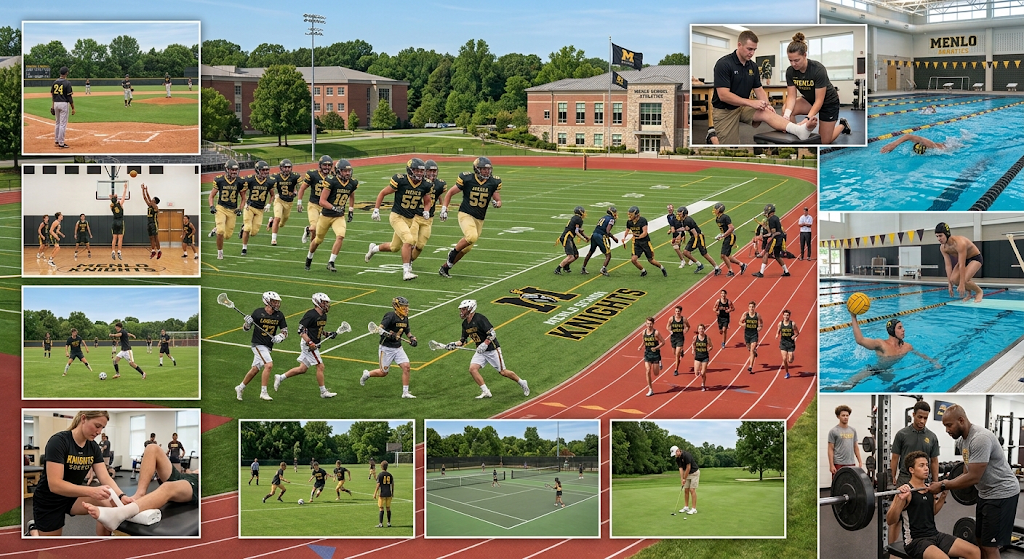
The Menlo Knights field 40 interscholastic teams across 13 sports: baseball, basketball, cross country, flag football, football, golf, lacrosse, soccer, swimming and diving, tennis, track and field, volleyball, and water polo. Programs run at varsity, junior varsity, and freshman levels in the Upper School, with a separate Middle School slate. Menlo pairs its athletics program with performance and wellness and sports medicine support, and maintains an alumni athletes network for students pursuing college recruitment.
Arts
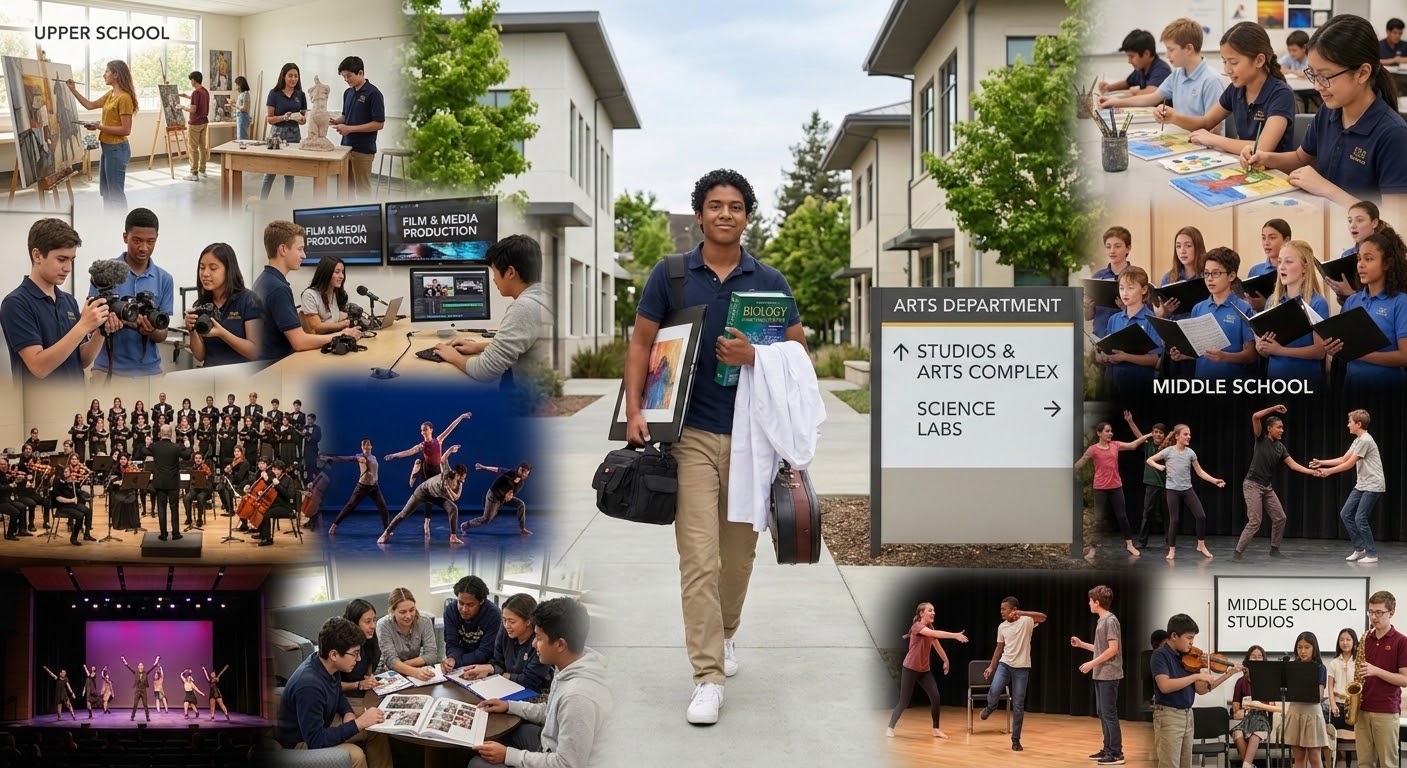
The Upper School arts program covers studio art, photography, moviemaking and media production, vocal music, instrumental music, dance, drama, and yearbook. The Middle School introduces visual art, chorus, dance, drama, and music. Arts are treated as a full academic department rather than an add-on, which is part of why students routinely carry an arts course alongside a heavy science load.
Summer Programs
Menlo runs summer programming through its Student Life office, including athletics camps and clinics offered through the athletics department.
Notable Menlo School Alumni
Menlo’s alumni community spans technology, film, science, motorsport, and music.
- Nick Woodman ’93: Founder and CEO of GoPro, the action camera company. Menlo has hosted him on campus for student panels on action-sports careers.
- Robby Krieger: Guitarist and songwriter for The Doors, and co-writer of several of the band’s best-known songs.
- Chris Paine: Filmmaker and director known for documentaries on technology, sustainability, and the future of transportation.
- Maria Fadiman: Ethnobotanist and a National Geographic Society Emerging Explorer, recognized for research on human-plant relationships in tropical ecosystems.
- Jon Beekhuis: Former professional race car driver and now a pit reporter and analyst for NBC Sports motorsports coverage.
Choosing Cardinal Education was one of the best decisions we made. Their personalized approach really helped our daughter find her inner strengths and build her confidence.
— Parent from Atherton
Preparing for Menlo, Honestly
Menlo tells families exactly what it wants: students who love learning, who are kind, and who will use everything a small school with a big program can offer. That is not something a family assembles in the fall of the application year. Our work is to help your child get there genuinely, and to tell you plainly if we think another school would serve them better.
Talk to a Menlo Admissions Consultant
From summer STAR preparation to March decisions, we work alongside Peninsula families through the whole cycle.
Related Articles
- Notable Menlo School Alumni and Where They Are Today
- Best Guide to Menlo School’s Selective Admissions Process