
In this blog, we will look at ways parents can leverage the parent statement to reveal their child’s hidden strengths, personality, and growth in a way that strengthens a school application. While transcripts and test scores provide a good indication of academic performance, it is the parent statement that provides much-needed context about who your child is outside the classroom.
Here you will discover what schools are actually looking for, how you can emphasize your child’s strengths without sounding like a marketing brochure, and above all, the mistakes you should avoid when crafting an impressive parent statement.
In This Guide
Quick Answer for Busy Parents
A strong parent statement should highlight your child’s growth, personality, and character using concrete examples. The admissions committee is not looking for perfect writing. They want an honest and accurate representation of who your kid is, apart from being a student.
The most effective parent statements reveal how students behave and respond to challenges. And with a selective admissions process, many elite families also choose to work with admissions experts, especially when preparing competitive school applications.
What Do Admissions Committees Want to Learn From the Parent Statement?
The admission committees use the parent statements to gain a better understanding of the personality and values of the applicant, as well as their development over time. While the recommendation letters and transcripts give insight into a student’s academic achievements, the parent statement provides information about the behavior of a child in the real world and development on an emotional, social, and intellectual level. Such information allows competitive admissions to judge a child’s compatibility with the greater school culture.
What Personal Qualities Do Admissions Officers Look for Beyond Academics and Test Scores?
Admissions officers look for traits such as curiosity, resilience, independence, empathy, and motivation. These qualities help schools understand how a student will adapt to academic rigor and community life.
Instead of listing traits, strong parent statements show them through real examples. Families who want to strengthen how these traits are communicated sometimes work with academic coaching or executive function support to help students demonstrate stronger independence and consistency in their academic habits.
How Does the Parent Statement Add Context to a Student’s Overall Application?
A parent statement ties together the entire application through its ability to give insight into the “why” behind a student’s behavior, development, and interests. This narrative context can be critical when evaluating applications at institutions that emphasize fit in addition to academic merit.
The structured approach of college application consulting or private school admissions counseling can help parents achieve a consistent narrative context throughout the application.
Top Tips for Writing a Parent Statement That Highlights Your Child’s Personality, Growth, and Strengths
- Focus on 1–2 key character traits supported by real examples.
- Show growth over time instead of listing achievements.
- Use specific situations from home or school life.
Best Practices for Crafting a Strong Parent Statement That Adds Depth and Authenticity
- Use storytelling instead of general descriptions.
- Balance strengths with realistic observations.
- Edit for tone and authenticity rather than perfection.
Common Questions Parents Ask About Writing a Strong Parent Statement
Q: What should I include in a parent statement?
A: Include specific examples that show your child’s personality, strengths, and growth.
Q: How long should a parent statement be?
A: Most parent statements are typically 250–500 words.
Q: What tone should I use in a parent statement?
A: Use a natural, honest, and reflective tone.
Q: How do I choose what to write about my child?
A: Choose moments that best show your child’s character and growth.
Related Articles
What Holistic Admissions Really Means for Today’s Applicants
How Schools Use the Character Skills Snapshot
Understanding Educational Philosophies in American Private Schools
How Can Parents Highlight Their Child’s Strengths Without Sounding Overly Promotional?
One of the biggest challenges parents face is describing their child honestly without sounding exaggerated. Admissions officers value authenticity over perfection.
The most effective parent statements use real-life examples that naturally demonstrate strengths such as leadership, kindness, or perseverance. Families often find that support in reading and writing development programs can help refine how stories are communicated, ensuring clarity while preserving authenticity.
How Do You Describe Your Child’s Personality, Motivation, and Growth Authentically?
Authentic descriptions come from real behavior, not labels. Instead of saying a child is “hardworking,” explain situations where they showed persistence or overcame challenges. Motivation should be shown through actions and choices rather than abstract statements.
Growth is especially powerful when it shows how a child has changed over time in response to experiences, feedback, or academic challenges.
To truly demonstrate the “Show, Don’t Tell” principle, consider the difference between a vague description and a specific, educational example:
- Vague/Generic: “My child is hardworking and resilient.” (Fails to provide context)
- Specific/Educational: “When my son struggled with his Honors Biology midterm, he didn’t give up. Instead, he created a color-coded study system and sought one-on-one help from his teacher every morning for three weeks, ultimately raising his grade by 15 points by the final.” (Highlights the process, ownership, and growth over time).
What Stories and Examples Best Showcase Leadership, Resilience, or Kindness?
Leadership can be shown through teamwork, mentoring, or initiative in group settings. Resilience often appears when a child overcomes academic setbacks or adjusts to change. Kindness is best illustrated through peer relationships and everyday interactions. These stories give admissions officers a clearer picture of how a student will contribute to a school community beyond academics.
Top Benefits of Writing a Strong Parent Statement
- Strengthens overall application narrative.
- Provides insight beyond grades and test scores.
- Makes the student’s application more memorable.
Best Practices for Writing a Parent Statement That Highlights Strengths Without Overstatement
- Use specific examples instead of general praise.
- Avoid exaggerated or emotional language.
- Ensure alignment with the rest of the application.
Common Questions Families Ask About Highlighting Strengths in Parent Statements
Q: How do I avoid sounding like I am exaggerating my child’s abilities?
A: Focus on specific, real examples instead of general praise or labels.
Q: What types of examples are most effective for admissions committees?
A: Examples that show character, growth, and how your child responds to real situations.
Q: How personal should the examples be?
A: They should be personal enough to show genuine insight but still appropriate for admissions.
Q: Can school and home examples be combined effectively?
A: Yes, combining both provides a more complete picture of your child’s character.
Related Articles
How to Write a Standout Personal Statement for Private School Applications
Top Parent Statement Examples for Private School (What Works and Why)
How School Culture Impacts Student Success
What Common Parent Statement Mistakes Can Hurt a School Application?
Even well-meaning parents can weaken an application by using vague language, excessive praise, or overly formal writing. Admissions officers quickly recognize when statements lack specificity or authenticity.
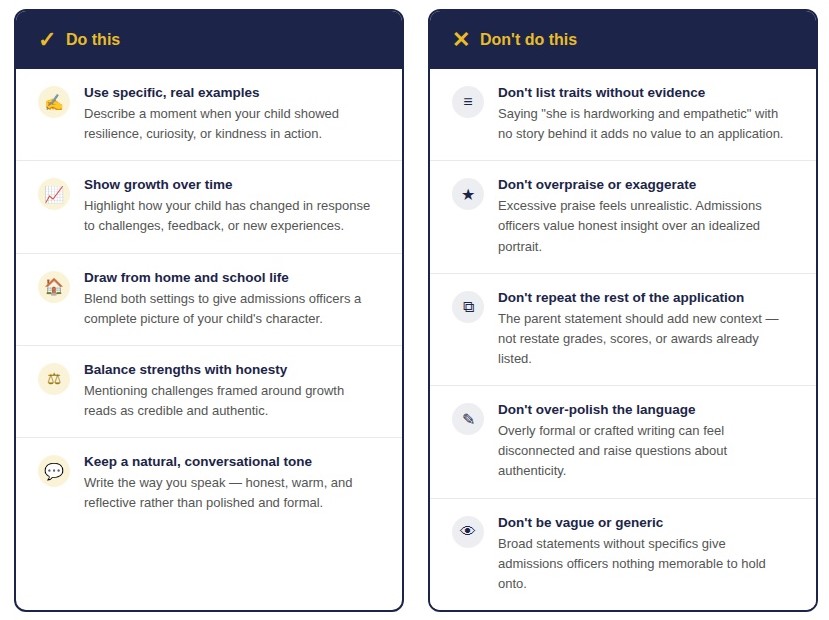
Understanding these mistakes helps families create stronger, more effective narratives. In many cases, families benefit from admissions consulting support to refine messaging and ensure alignment across all application components.
Why Do Generic or Overwritten Parent Statements Fail to Stand Out?
Generic statements rely on broad adjectives without supporting evidence. Overwritten statements can sound unnatural or disconnected from real experiences. Admissions officers prefer clarity and authenticity over polished language that feels forced. Without specific examples, the statement adds little value to the application and may be overlooked.
How Can Too Much Praise or Pressure Undermine Authenticity?
Excessive praise can make a statement feel unrealistic, while pressure-focused language may shift attention away from the child’s actual experiences. Admissions committees want balanced insight, not perfection. A credible parent statement reflects honest observation, not an idealized portrayal.
Top Tips for Avoiding Common Parent Statement Mistakes
- Do not exaggerate achievements or traits.
- Keep language natural and conversational.
- Ensure each example adds meaningful insight.
Best Practices for Writing an Authentic and Balanced Parent Statement
- Use real-life examples that show behavior.
- Highlight development and growth.
- Review for clarity and consistency.
Common Questions About Parent Statement Mistakes
Q: What makes a parent statement sound generic?
A: It relies on vague praise without specific examples or real-life details.
Q: Is it okay to mention weaknesses or challenges?
A: Yes, as long as you frame them in a way that shows growth or learning.
Q: How do I avoid overpraising my child?
A: Focus on balanced, realistic examples instead of exaggerated descriptions.
Q: What do admissions officers dislike most?
A: They dislike vague, repetitive, or insincere statements that lack authenticity.
Related Articles
Common Mistakes in Private School Applications and How to Avoid Them
How Parents Accidentally Hurt Their Child’s College Application
How to Make a Great Impression During a Private School Interview
Refine Your Child’s Application With Expert Admissions Support
A well-written parent statement can significantly strengthen a private school application when it clearly and authentically reflects a child’s personality and growth. Families often benefit from expert guidance to refine messaging and ensure consistency across all application materials.
Cardinal Education supports families through parent statement coaching, tutoring, reading and writing programs, academic coaching, executive function development, and comprehensive admissions consulting for private schools, boarding schools, and college applications.