
As the new school year approaches, K–12 families face the challenge of preparing their children for a smooth transition back into the classroom. This comprehensive guide is designed to empower parents with the essential tools and information needed for a stress-free back-to-school start!
Explore
Quick Answer For Busy Parents
A complete back-to-school guide helps K-12 children and their parents stay organized academically, emotionally, and logistically even before classes resume. This can be done by scheduling cohesive and detailed plans, making study arrangements, establishing healthier sleep routines, and creating daily menus for the kids’ meals. For ambitious families, school life can be complex and competitive. There’s no better feeling than being able to excel because of a well-structured and well-coordinated framework. We, at Cardinal Education, are here to help you build that.
The Complete Back-to-School Guide for
|
||
| K-2nd Grade
Establish Daily Routines |
||
| Logistics | Academics | Wellness |
| School Dry Run | Skill Practice | Bedtime Flow |
| 3-5th Grade
Develop Self-Management |
||
| Logistics | Academics | Wellness |
| Core Skill Review | Independence | Ownership |
| 6-8th Grade
Integrate Planning Systems |
||
| Logistics | Academics | Wellness |
| Planning System | Focused Folders | Growth Mindset |
| 9-10th Grade
Scale Academic Path |
||
| Logistics | Academics | Wellness |
| Course Sequence Roadmap | Strong, Powerful subjects | Resilience |
| 11-12th Grade
Own Timelines & Conversations |
||
| Logistics | Academics | Wellness |
| College Campus Map & Essay Search
Family Budget Discussion |
Application Dates
Map Critical Deadlines |
Build Autonomy |
What Essential Steps Are Featured In The Back-to-School Guide For My K-12 Family?
A strong back-to-school guide features a series of actionable steps tailor-made for specific grade levels. This is a definitive list of activities that enable distinguished K-12 families to stay focused and organized in the areas of academics, logistics, and wellness weeks before the first day of school.
When you have children who are on different grade levels, they have very varied and specific needs for their back-to-school experience. For your younger kids, they may need to establish daily routines and become independent. Your early teenagers could use help in maintaining their focus on long-term planning systems as they scale their academic paths. And your young adults may need more autonomy and responsibility by taking the initiative and being responsible for the outcomes.
Here’s a grade-by-grade checklist that can come in handy for you and your K-12 family.
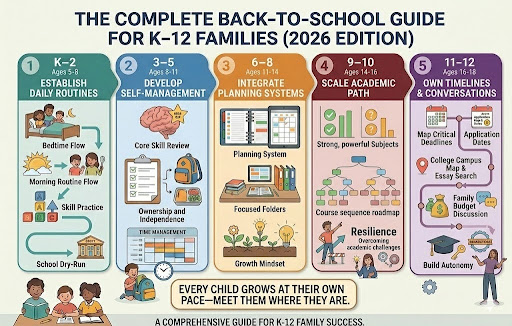
What Should My Children Prioritize In School, Depending On Their Grade Level?
For elementary school kids, the focus is comfort and excitement. Visit the school with them beforehand so the building feels familiar, and practice the drop-off routine. For middle schoolers, the transition from elementary to high school is no easy feat. That’s when many elite families seek support. Try to do a walkthrough with them in the new building, get familiar with different teachers, and ease your kids into shifting social dynamics. Lastly, high school teens need autonomy and the freedom to do things responsibly. Help them feel organized by having their schedule printed, getting their supplies ready, and ensuring their transportation is confirmed.
How Do I Set School Goals With My Child?
You can try the S.M.A.R.T. framework when setting goals with your child. It stands for Specific, Measurable, Achievable, Relevant, and Time-bound, which means that the goals you make with your kid are clear and focused, challenging but doable, matter to them and you, and are trackable through progress markers within a timeline. Goals like making progress with time management, having better study habits, and improving their reading or math skills.
Much like goal-setting with your kid, Cardinal Education also has Academic Coaching, wherein we help students/families turn their long-term goals into manageable systems, routines, and actionable steps.
Top Tips For Your K-5 Kids’ First Day of School
- Prep the night before. Lay out clothes, pack the backpack, and prep lunch together.
- Do a dry run. Walk or drive the route to school a day or two before so the morning feels familiar.
- Give them something familiar. A family photo in their pocket, a special keychain on their backpack, or a note in their lunchbox can be a quiet comfort when the day feels.
Best Socializing Practices For Your Middle School Kids
- Encourage quality over quantity. Deep friendships matter far more at this age than wide ones.
- Help them find their people through activities. Clubs, sports, and extracurriculars are the fastest way to build friendships around shared interests.
- Normalize the awkwardness. Remind your kid that feeling like an outsider sometimes is normal, not a sign that something is wrong with them.
Common Questions About Your High School Kids’ First Day Experience
Q: Is it normal for my kid to seem anxious beforehand?
A: Completely. Even confident teens feel nervous about navigating a new schedule, new social dynamics, or a bigger building. Acknowledge the feeling without trying to fix it—sometimes just being heard is enough.
Q: How much should I help them prepare the night before?
A: At this age, shift from doing it for them to doing it with them. Ask what they need rather than taking over. It builds independence while still showing you’re in their corner.
Q: What if they’re dreading a specific class or subject?
A: Use it as a chance to problem-solve together by tutoring, forming a study group, or simply adjusting their mindset about the challenge ahead.
Q: What is the best way to handle it if my teen gets lost navigating a larger campus?
A: Reassure your child that it’s okay to get lost. If they’re worried about coming late to class, you can send them a saved photo of the campus map to reduce their anxiety.
Related Articles
Understanding the U.S. Education System: How American Schools Work from K-12 to College
Developing Effective Study Habits for Middle Schoolers Preparing for College
New Year, New Goals: Setting Academic Resolutions For Success
How Do I Prepare My Child Academically For The New School Year?
Preparing children academically for a new school year requires age-appropriate routines, organization skills, and long-term learning support. For elementary kids, their academic focus is on building the right study habits. Help them see learning as something fun rather than a chore. Read together, practice counting games, and stay consistent with a morning routine. Middle schoolers put emphasis on organization and study skills. Talk with them about academic resilience in longer-term assignments, review what subjects they struggled with last year, and instill a growth mindset. High school kids focus more on their future and strategic planning. Help create a timeline for their test dates, application deadlines, and challenging course loads. Encourage your teenager to advocate for themselves.
How Do I Choose The Right Extracurricular Activities For My Child?
Ask what your child is interested in, then work from there. A child who chooses their own activity will be more likely to stick with it even through difficulties. Their interests may vary with their personality, and that’s okay. Refrain from overscheduling their school year. One or two meaningful special interests are enough to keep them busy while also enjoying what they’re doing. Revisit their choices year to year as they grow up. Letting their extracurriculars evolve with them is what keeps it fun and fulfilling.
How Will I Know When To Get A Tutor For My Child During The School Year?
There are a few signs you’ll see that will signal it’s time to ask for assistance from a tutor. Watch out when they consistently avoid a specific topic or subject. Be keen about seeing grades dropping despite consistent effort. When they’ve stopped asking for help and have disengaged, that would be a clear indication that the child needs more academic support but hasn’t gotten the courage to ask. When kids mask their academic struggle, it’s because having to admit that they don’t know or understand something feels embarrassing. Sometimes, it’s not about the grades, though. It can be about executive function, which is why choosing the right kind of support is essential as well.
Top Tips for Being Proactive In Class As A K-5 Student
- Come to class ready to learn. Have your notebook out, homework done, and brain warmed up before the lesson starts so you don’t miss a thing.
- Raise your hand and participate. Don’t wait until you’re 100% sure you have the right answer. Actually, joining the conversation is how learning actually happens.
- Be a good classmate and contribute to the room. Listen when others are talking, offer to help a friend who’s stuck, and be someone who makes the classroom a better place. Being kind and respectful is just as important as knowing the right answers.
Best Wellness Practices For Your Middle School Kids
- Create a space for them to decompress. After long days in school, they need all the downtime they can get. Unstructured time may not look productive, but it’s genuinely healthy for their mind and body.
- Watch their relationship with screens and social media. Set healthy boundaries around their screen time and have honest conversations about what they’re consuming.
- Help them practice naming how they feel. Normalize emotional check-ins at home so they develop self-awareness at a young age and are comfortable expressing their emotions.
Common Questions about Your High School Kids’ College Prep
Q: When should we seriously start thinking about college prep?
A: Earlier than most families expect. It means making intentional course choices, exploring interests through extracurriculars, and building good academic habits well before high school comes in.
Q: As a parent, how much should I be involved in the process?
A: Guide, ask questions, and help them meet deadlines, but resist writing their essays, making their calls, or choosing their schools.
Q: Should my teen visit colleges before applying?
A: If possible, yes. Even a virtual tour or an informal campus walkthrough can help a teen get a gut feel for whether a school is the right fit.
Q: What should we look for when choosing an academic consultant?
A: Look for someone with verifiable experience, transparent pricing, and a style that clicks with your teen, since the relationship matters as much as the credentials. It’s good to ask for references and clarify exactly what’s included in their services.
Related Articles
How To Balance Academics and Extracurriculars: Time Management Tips for Students
How To Help Your Child Manage School Stress
How to Build Positive Relationships With Your Child’s Teacher
Something new always brings about something unknown, and the uncertainty of going back to school for a new academic year can bring all kinds of emotions with it. We can all do what we can to be ready for anything, but still, unforeseeable changes are bound to happen. The best thing about it, though, is that you don’t have to go through it alone. At Cardinal Education, we’re with you every step of the way—from preparation to admission to graduation.
Schedule a confidential consultation with us today.