
Traversing the unpredictable terrain of senior year? You’ll need a roadmap. Consider this month-by-month guide your personal academic GPS. We’ll provide you with the exact directions you need to bypass dead-ends, achieve application milestones, and arrive safely at acceptance.
Explore
Quick Answers For Busy Parents
For a high school senior, the college admissions timeline is straightforward and direct when it comes to the information that it shares. Every month of the year is a marker for different tasks to be done or requirements to be submitted. The application process starts even before your child’s senior year of high school. This means you need to give yourself ample buffer time to search for schools, apply for admission, wait for offers, and enroll at your chosen school.
What Does the Senior Year College Admissions Timeline Look Like?
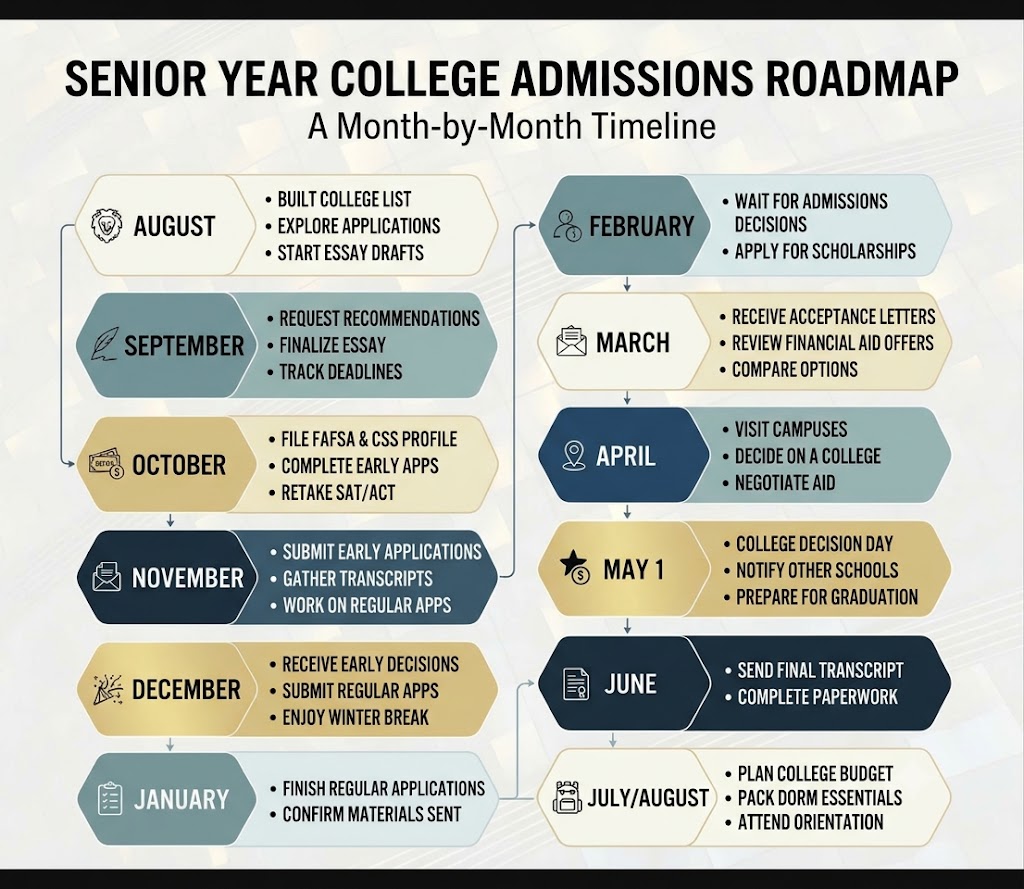
We’ve broken down the typical senior year into a manageable month-by-month college application checklist. While this is a general roadmap, it’s best to always verify exact deadlines directly on your specific college’s application portal.
Ivy League College Admissions Timeline For High School Seniors
If your child is aiming for an Ivy League or top-tier institution, the standard college timeline requires a slight acceleration. Between navigating Restrictive Early Action (REA) or Early Decision (ED) choices and tackling multiple supplemental essays and other requirements, staying organized is your biggest advantage.
Here’s a specialized timeline designed to help you manage the unique demands of Ivy League applications without last-minute hurry.
| Ivy League Applications Timeline for Senior High School Seniors | |
| Month | What You’ll Do |
| August – September | Decide whether you’re applying for: Early Decision (ED) or Restrictive Early Action (REA)
Begin writing your Common App personal statement, outlining supplemental essays Confirm letters of recommendation from 2-core subject teachers & counselor Register for your SAT or ACT tests (schedule remaining tests as needed for your application timeline). International students are welcome to apply |
| October | Finalize personal statement & supplemental essays for EA
Get official score reports from the College Board or ACT for your EA school (if required) |
| November | Start writing supplemental essays for your Regular Decision Ivy League Applications
Nov 1: Deadline for all Ivy League EA and REA applications |
| December | Receive EA and Early Decision results. It will be either Accepted, Deferred to the RD pool, or Denied
Rigorously polish your RD essays |
| January | Deadline for most Ivy League Regular Decision applications
Ensure your high school counselor submits your First Semester Senior Year transcripts (Mid-Year Report) to all applied colleges/universities. |
| February | Participate in Alumni Interviews for your RD schools
Send a brief Letter of Continued Interest or update to the admissions offices if deferred from Early school, or achieved a new major accomplishment |
| March | Receive admission results: Ivy Day.
All eight Ivy League universities release their Regular Decision admissions results on the same day, typically in the late afternoon or evening ET. |
| April | Admitted students visit campuses to get a feel for the campus culture. |
| May | National Decision Day: May 1
Submit your enrollment deposit to your chosen university If you’re on an Ivy League waitlist, submit a strong Letter of Continued Interest. (Waitlist movement usually happens in May and June) |
| June | Graduate high school and ensure your counselor sends your final official transcript to your new college. |
Timeline For Requesting Letters Of Recommendation Senior Year
- Late Junior Year (May/June): This is the opportune time to do the initial ask about college admissions letters of recommendation. Approach your teachers and ask them.
- Summer before Senior Year (July/August): Preparation phase. Reflect on experiences, memories, projects, personal challenges inside and outside of the classroom that have shown your growth in your life.
- Early Senior Year (Aug/Sept): Provide your teachers and counselor with a “Hype Sheet” a list of achievements you’ve done based on what you’ve reflected on the past summer. Add them to your Common App, Naviance, or Scoir portal for them to receive the official email link to upload their letter. Give your recommenders at least four to six weeks of lead time before your first college deadline.
- October (for Early Apps) / December (for Regular Apps): Politely check-in with your recommenders one to two weeks prior to the application deadline. Check the application portal to make sure the letters have been officially submitted.
- Spring of Senior Year (April/May): Once college results are in, send a meaningful thank-you message to every teacher and counselor who recommended you.
Top Tips For Keeping Track Of The Timeline
- Work backwards. Set a personal deadline two weeks before the official submission date.
- Schedule time for it. Block out dedicated recurring time to work on your requirements.
- Track everything. Create a master spreadsheet to monitor deadlines, requirements, and portal logins in one centralized source.
- Request early. Ask for transcripts, test scores, and recommendation letters well in advance to avoid bottlenecks.
- Celebrate small wins. Acknowledge micro-milestones like finishing an essay or submitting early.
Best Practices To Give Yourself A Headstart Before Deadlines
- Create a dedicated college email address. Use this exclusively for college applications.
- Build a data vault. Gather all the important documents and files in one repository.
- Draft your activities list early. Don’t wait until the last minute to avoid making mistakes.
- Secure an “early win”. Securing a college acceptance letter from a safety or target school takes the pressure off application season.
- Knock out the “busywork” in August. Fill out the basic information and get it done early.
Common Questions About Following Application Timelines
Q: When do college applications officially open?
A: The Common Application and most individual college applications officially open on August 1st, right before your senior year begins.
Q: When is the best time to take the SAT or ACT?
A: Aim to take your first test during the spring of your junior year. It leaves you plenty of time to study and retake it in the late summer or early fall of your senior year if needed.
Q: How late is too late to apply for college?
A: While Regular Decision deadlines usually pass by mid-January, many fantastic schools with Rolling Admissions continue accepting applications through the spring and even into the summer.
Q: When should I start asking teachers for recommendation letters?
A: The absolute best time to ask is at the end of your junior year, but at the very latest, you should request them 4 to 6 weeks before your first application deadline.
Related Articles
5 Ways To Build Executive Function In Private School Students
How To Manage Time Blindness On The ISEE & SSAT: A Pacing Guide For Students
How To Choose High School Classes That Ivy League Admissions Will Love
| Feeling overwhelmed by these deadlines? Schedule a confidential consultation with an expert advisor to build your customized roadmap. |
Month-by-Month College Admissions Roadmap For Student Athletes
| College Admission Roadmap For Student Athletes | ||
| Month | Prep | Submission |
| August & September | Ensure your account is fully set up and updated with the NCAA or NAIA Eligibility Center.
Start your Common App, finalize your college list (balancing athletic and academic fits), and request teacher recommendations. |
Finalize your highlight reel and send update emails to coaches at your target schools. Include your upcoming fall game schedule. |
| October | Take official or unofficial campus visits. Try to meet with the coaching staff and current team members. | Finalize essays for Early Action/Early Decision apps—especially if a coach is explicitly supporting your early application. |
| November | National Signing Day (Early):
The early signing period opens. Sign your National Letter of Intent (NLI) if you have an official offer |
Meet the November 1 or 15 EA/ED application deadlines. |
| December & January | Finish and submit any remaining Regular Decision applications. | Send your prospective coaches your first-semester senior grades and any new athletic stats or winter highlight videos. |
| February & March | Football Signing Day: The regular signing period for Division I and II football typically begins in early February. | Carefully evaluate your athletic scholarship offers alongside standard financial aid packages. (Ask coaches clear questions about what is guaranteed for four years). |
| April & May | Amateurism Certification: Starting April 1, log into you NCAA Eligibility Center account to request your final amateurism certification.
If you are planning to be a preferred walk-on, finalize those details with the coaching staff. |
May 1st (National Decision Day): Submit your enrollment deposit to your chosen college. |
| June & July | Final Transcripts (Crucial Step): Have your high school counselor send your final official transcript with proof of graduation to BOTH your new college’s admissions office AND the NCAA/NAIA Eligibility Center.
Get the summer workout packet from your new college coach and start preparing for the collegiate level. |
|
How Do I Balance Senior Year Classes With College Application Deadlines?
Treat your applications as if they were an extra class. Schedule time to work on it, not only when you have free time. Focus on your GPA and take care of it. Your first semester senior year grades are checked by admissions officers.
Turn your applications into micro-tasks. Break them down into manageable 20-minute chunks. Schedule possible long weekends well in advance for days that you’ll spend drafting and polishing essays. Reach out to your teachers.
If you’re feeling overwhelmed with the amount of work, be honest with them. Many will be gracious enough to give an extension if they’re asked politely and proactively. Step back from minor commitments so you can focus on your core passions and your applications.
Top Tips To Successfully Submit Student Athletes’ Monthly Requirements
- Set end-of-the-month alerts.
- Maintain a recruitment-specific checklist.
- Build in buffer time for travel and tournament commitments.
- Confirm receipts.
Best Practices To Avoid Cramming For Submissions For Student Athletes
- Coordinate with your coach. Always confirm that your coach has submitted any necessary athletic recommendations or support forms well before deadlines.
- Schedule around athletic seasons. Plan your intensive application drafting during off-season weeks to avoid competing priorities with games and training.
- Update athletic resumes early. Keep your highlight reels and stats updated monthly so you aren’t scrambling before a coach’s deadline.
- Regularly monitor your NCAA or NAIA portal to ensure all amateurism and transcript requirements are completed.
- Be aware that some schools have earlier athletic ‘pre-read’ or recruitment deadlines that differ from the general student body.
Common Questions about Late Submissions
Q: Will colleges accept late recommendation letters or test scores?
A: Yes, most colleges offer a grace period for supporting documents (like transcripts and letters) as long as your main application was submitted on time.
Q: Can I get an official extension on an application deadline?
A: You can usually get an extension for extenuating circumstances (like severe illness or natural disasters) by directly calling the admissions office.
Q: Are there any colleges still accepting applications after the standard January deadlines?
A: Yes, hundreds of excellent colleges use Rolling Admissions and continue accepting applications through the spring and summer.
Q: Does submitting my application right at the deadline minute look bad?
A: No, admissions officers don’t penalize you for submitting on the exact deadline day, but doing so risks technical failures from server crashes.
Related Articles
How To Create A Personalized College Prep Checklist
Mastering the “Why This College” Essay: Research Tips and Winning Templates
Evaluating Campus Culture And Fit: How To Choose The Right School Environment
College applications don’t always have clear roads ahead, but what you can count on is a map that leads you in the right direction.
If you ever feel lost in the middle of the process, you’re not alone. Whether it’s organizing, strategizing, applying, or submitting, we’ve got you covered. Partner with us on this journey, and together we’ll ensure your child reaches their dream destination.
Schedule a confidential consultation with us today.