
Cardinal Education is an independent educational consulting company. We are not affiliated, associated, authorized, endorsed by, or in any way officially connected with any public or private school.
Quick Answer for Busy Parents
Founded in 1909, St. Albans School is an Episcopal all-boys day and boarding college-preparatory school in Washington, DC, serving roughly 592 students in Grades 4–12. Featuring 100% college matriculation, the school offers boarding starting in Grade 9. Testing includes an on-campus exam for Grade 4, the SSAT or ISEE for Grades 6–8, the SSAT, ISEE, or HSPT for Grade 9, and optional testing for Grades 10–11. Through its Coordinate Program with National Cathedral School, students access extensive coeducational academic, artistic, and athletic opportunities.
Why Do Families Choose St. Albans School?
St. Albans traces its founding to a bequest from Harriet Lane Johnston, niece of President James Buchanan, which provided for the establishment of the school. St. Albans opened in fall 1909 with 34 students under its first headmaster, Earl Lamont Gregg.
Families are drawn to St. Albans’s blend of rigorous academics, its identity as a church school open to all faiths, and the Coordinate Program with National Cathedral School, which the school describes as giving students the benefits of both a single-sex education and coeducational opportunities. St. Albans is chartered by the Protestant Episcopal Cathedral Foundation, alongside National Cathedral School and Beauvoir School.
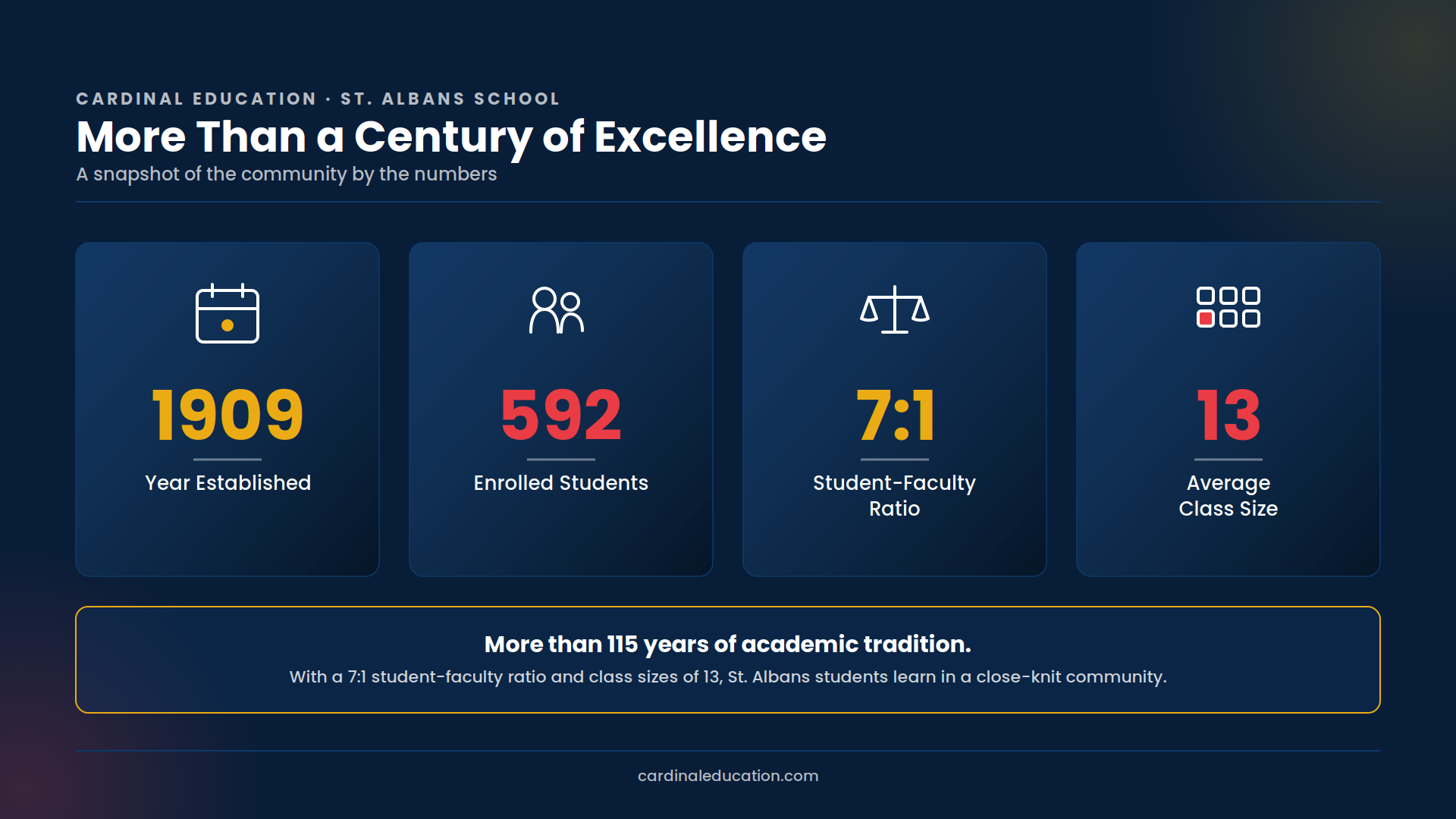
In addition, many parents cite the school’s strong focus on character development and sense of community as key factors in their decision. The supportive environment fostered by dedicated faculty encourages boys to grow intellectually, morally, and socially throughout their years on campus.
How Hard Is It to Get Into St. Albans School?
St. Albans is a highly selective school that does not publish an official acceptance rate, attracting a large pool of qualified applicants each year. The admissions process is holistic, evaluating each candidate as a whole person rather than relying solely on test scores. Admission weighs the applicable test score (on-campus testing for Grade 4, SSAT/ISEE for Grades 6–8, SSAT/ISEE/HSPT for Grade 9, or optional testing for Grades 10–11) alongside transcripts, recommendations, essays, and an interview.
Beyond academic metrics, the admissions committee looks for students who demonstrate character, leadership, and a sincere interest in the school’s community. A strong application typically highlights academic achievement alongside extracurricular involvement and a clear alignment with the school’s mission—particularly an appreciation for its Episcopal identity and the collaborative nature of the Coordinate Program.
Top Tips for a Strong Application
- Register for the SSAT or ISEE early if applying to Grades 6–11, testing no later than early January.
- Attend the Admissions Open House in late October to see both the Lower and Upper Schools in session.
- International applicants should confirm the earlier December 1 deadline for the SAO portal.
Best Practices for Families
- Ask directly about the Coordinate Program with National Cathedral School during your visit.
- Prepare your son for a genuine interview conversation about character and community fit.
- For Grade 4 applicants, confirm the specific on-campus testing date as soon as it’s announced.
What Is St. Albans School’s Admission Process?
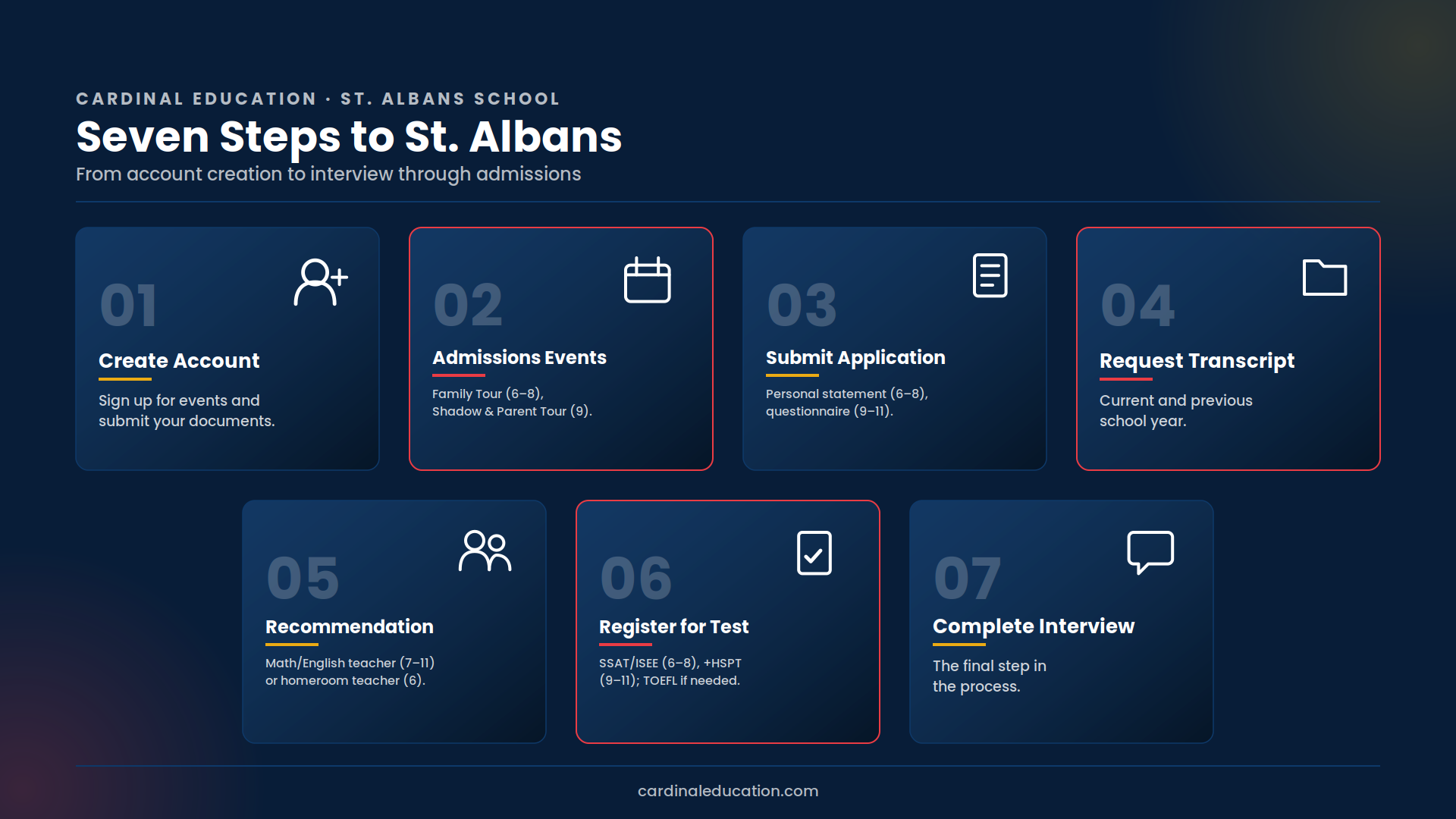
Creating an account in Ravenna is the first step in St. Albans School’s admission process. There, you will be able to sign up for events and submit the required documents for your application.
- Attend Admissions Events
- Family Tour (Grades 6-8)
- Shadow Visit (Grade 9)
- Parent Tour (Grade 9)
- Submit Online Application
- Personal Statement (Grades 6-8)
- Applicant Questionnaire (Grades 9-11)
- Request Transcript
- Current year & previous school year
- Designate Recommendation
- Current math & English teacher (Grades 7-11)
- Current & prior year homeroom teacher (Grade 6)
- Register for Standardized Test
- SSAT or ISEE (Grades 6-8)
- SSAT, ISEE, or HSPT (Grades 9-11)
- TOEFL (Non-native English Speakers)
- Complete Interview
Note for International Applicants: St. Albans accepts the Standard Application Online (SAO) for international students, but applicants must still set up a profile in Ravenna by December 1 and notify the admissions office via email. Non-native English speakers are strongly encouraged to submit TOEFL scores alongside the SSAT or ISEE.
What Are St. Albans’s Application Requirements?
Personal Statement & Applicant Questionnaire
The student essay provides the admissions committee with a direct sense of your child’s personal voice, critical thinking, and intellectual curiosity. Grades 6–8 applicants complete the Personal Statement (responding to two specific prompts in Ravenna), while Grades 9–11 applicants complete the Applicant Questionnaire (answering seven prompts).
How to write a compelling student essay: Focus on highlighting a particular moment of discovery rather than summarizing an entire list of extracurriculars. Specific, narrow examples make a stronger impression. Learn how to develop an authentic writing voice that helps your statement stand out.
Transcripts
Applicants must request official academic transcripts covering the prior school year and the current academic year (first and second quarters) through the Ravenna portal.
How to support academic performance: If grades have been a genuine struggle, improving them before applying requires targeted, consistent support—not last-minute cramming. This is where tutoring and academic coaching help strengthen the student’s key skills months before applications are due, allowing students to demonstrate meaningful, sustained academic growth.
Recommendations
Recommendations are managed and submitted electronically via Ravenna. Grade 6 applicants require forms from two homeroom teachers (current and prior year). Grades 7–11 applicants require recommendations from their current math teacher and current English teacher. The system emails confidential evaluation forms directly to each educator, and your Ravenna dashboard automatically updates once submissions are complete.
How to get the best recommendation letter: To secure a strong recommendation letter, ensure your child builds genuine relationships with teachers and mentors. Recommenders should highlight your child’s leadership, behavior, and academic impact on the community.
Standardized Testing
Grades 6–8 applicants submit SSAT or ISEE scores. Grade 9 applicants may submit scores from the SSAT, ISEE, or HSPT. Standardized testing is optional for Grades 10–11 applicants.
(Note: TOEFL is strongly encouraged for non-native English speakers).
How to prepare for the SSAT or ISEE: Effective test preparation involves more than just content review; it builds a deep understanding of exam-specific question formats, pacing strategies, and underlying academic skills. Personalized coaching helps students master these exams with confidence. Learn more about private school test prep.
Student Interview
Every applicant completes an individual 1-on-1 student interview integrated directly into their mandatory campus visit. For Grades 6–8, the interview takes place during the Family Tour; for Grade 9, it occurs during the full-day Shadow Visit.
How to prepare for the admissions interview: Approach the interview as a conversation rather than a performance. Students should be ready to discuss their interests, while parents should articulate why St. Albans is the right fit. Comprehensive interview preparation helps families communicate with confidence and authenticity.
Have Questions About Your Son’s Application?
Cardinal Education’s consultants help families navigate St. Albans’s grade-specific testing requirements and build a complete application.
What Is Student Life Like at St. Albans School?
Student life at St. Albans School is a balanced blend of rigorous academic inquiry, creative artistic expression, competitive athletics, and character-building global exploration.
Beyond the classroom, students are encouraged to engage in diverse extracurricular activities and leadership opportunities, fostering strong brotherhood and lifelong connections within the Cathedral Heights community.
Academics
Academic life at St. Albans balances a classic liberal arts core with deep intellectual exploration, providing advanced coursework and coordinated cross-registration options with National Cathedral School (NCS).
| Metric | Overview & Academic Feature |
| Academic Divisions | Lower School (Grades 4-8) and Upper School (Grades 9-12) |
| Upper School Coeducation | Coordinated academic classes and electives shared with National Cathedral School (NCS) |
| Public Service Focus | Home to the St. Albans School of Public Service (SPS) summer program |
| Academic Skills Support | Dedicated instruction in note-taking, close reading, annotation, and public speaking |
This structured curriculum equips students with critical analytical skills, persuasive communication, and independent research habits required for higher education.
Arts
The arts program at St. Albans offers hands-on creative training across performance and visual media, utilizing studio spaces and collaborative venues shared with National Cathedral School.
- Visual Arts Offerings: Studio courses spanning Art & Design, Contemporary Art Practices, Printmaking, Sculpture, and Digital Media.
- Performance Opportunities: Comprehensive music and theater productions coordinated with National Cathedral School.
- Dedicated Facilities: Purpose-built sculpture labs, computer-aided design tools, and visual arts studios.
- Summer Grants: Specialized grants like the Parents’ Association Visual Arts Summer Fellowship to deepen artistic mastery.
Students develop creative confidence and technical skill, sharing their work with the school and local community through regular exhibitions and showcases.
Athletics
Home of the Bulldogs, St. Albans athletics emphasizes high participation, physical conditioning, and high-level competition.
| Athletic Metric | Program Statistics |
| Mascot & Identity | Bulldogs |
| Varsity Sports | 14 varsity sports competing in the Interscholastic Athletic Conference (IAC) |
| Sports Performance | Dedicated Athletic Performance Department led by full-time Strength & Conditioning coaching staff |
| Facilities & Health | Remodeled weight room with 8 Olympic lifting stations and two full-time Certified Athletic Trainers |
The athletic department supports both novice competitors and recruited student-athletes through disciplined coaching, physical training, and team play.
Clubs
Student organizations provide vibrant opportunities for play, leadership, and shared passions outside the traditional classroom.
- Diverse Offerings: Dozens of interest-based organizations spanning gaming, culinary hobbies, robotics, and political debate.
- Student-Led Leadership: Opportunities to manage publication boards, service groups, and special interest clubs alongside faculty advisors.
- Lower School Clubs: Winter offerings ranging from building the yearbook and lifting weights to photography, reading, and chess.
- Upper School & Coed Clubs: Advanced options including the Government Club (co-led with NCS), debate societies, and community initiatives.
These student-run clubs build dynamic communities, allowing students to explore passions—however serious or playful—with their peers.
Global Programs
Flagship international fellowships, exchange programs, and study-abroad trips extend student learning far beyond campus borders.
| Global Program Category | Details & Key Offerings |
| Endowed Travel Fellowships | 13 endowed summer grants supporting independent global research and travel |
| Regional & Cultural Fellowships | K.S. Wu Fellowship (Pacific Rim study), Montgomery Raiser Fellowship (cultural immersion), and Class of 2007 Fellowship (service in Africa) |
| Civic & Social Impact Grants | Teplitz Family Fellowship (Civil Rights and Social Justice) and Bishop John T. Walker Fellowship (intensive social service) |
| Exchanges & Study Abroad | Faculty-led immersion trips and homestays across France, Spain, India, Australia, and beyond |
These endowed global programs foster civic responsibility, deep empathy, and an expanded worldwide perspective.
Notable Alumni of St. Albans School
The legacy of St. Albans School is best reflected in the remarkable achievements of its graduates, who embody the institution’s longstanding commitment to intellectual rigor, civic duty, and character development. Across public service, space exploration, fine arts, investigative journalism, and elite athletics, St. Albans alumni have consistently risen to prominent leadership roles on both national and global stages.
- Al Gore (Class of 1965): Served as the 45th Vice President of the United States, a U.S. Senator, and a U.S. Representative. He was co-awarded the 2007 Nobel Peace Prize for his pioneering international advocacy and public education on global climate change.
- Michael Collins (Class of 1948): Apollo 11 astronaut who piloted the Command Module Columbia in lunar orbit while Neil Armstrong and Buzz Aldrin performed the first human moonwalk, securing his legacy as one of aviation and space exploration’s key figures.
- Jeffrey Wright (Class of 1983): Acclaimed Tony-, Emmy-, and Golden Globe-winning actor whose extensive career spans classic theater and major film productions, including Angels in America, Westworld, The Hunger Games, and The Batman.
- David Ignatius (Class of 1968): Prize-winning journalist, long-time associate editor and foreign affairs columnist for The Washington Post, and best-selling novelist of political and spy thrillers, including Body of Lies.
- Jonathan Ogden (Class of 1992): Pro Football Hall of Fame offensive tackle, 11-time NFL Pro Bowler, and Super Bowl XXXV Champion with the Baltimore Ravens, widely regarded as one of the dominant linemen in football history.
These distinguished graduates demonstrate how an educational foundation rooted in critical inquiry, ethical responsibility, and community values prepares students to leave a lasting impact across diverse disciplines.
Expert Guidance for Your St. Albans School Application
St. Albans is a highly selective school, and navigating its admissions process—which varies by grade level and involves distinct testing requirements, international deadlines, and the complexities of the Coordinate Program—can be challenging.
Cardinal Education’s consultants provide expert guidance to help families demystify these requirements, strategically prepare for every stage, and build a competitive, well-supported application that highlights your son’s unique potential.
Related Reading
The Coordinate Program: How St. Albans and National Cathedral School Share a Campus
Chapel at St. Albans: Twice-Weekly Talks in the Little Sanctuary
Did You Know?
St. Albans’s school hymn, “Men of the Future, Stand,” is sung by the St. Albans Chorale, while a 2023 Chapel Talk titled “Women of the Future, Stand” reflected on the school’s Coordinate Program with National Cathedral School.
Frequently Asked Questions
Is St. Albans a religious school?
Does St. Albans require standardized testing?
What coeducational opportunities does St. Albans offer?
What is St. Albans School known for?
Does St. Albans offer boarding?
St. Albans gave our son a rigorous education and a genuine community, from chapel to the playing fields. Cardinal Education helped us navigate the grade-specific testing requirements so nothing caught us by surprise.
— Parent of a 9th Grader