
This guide helps you know where to start, what steps to take, and when things will happen in different parts of the private school search process.
Explore
Quick Answer For Busy Parents
The right private school for your child is the school where they can thrive the most in curricular and extracurricular aspects. By knowing his or her learning style and needs, you’ll get a deeper understanding of what kind of school would best help them progress in different areas. By setting realistic cost estimates that fit your family’s criteria, creating a shortlist of prospective schools, attending campus tours, and speaking with faculty and students alike, you’ll get a better perspective of your child’s growth potential and be able to make a wise decision about which school to apply to.
What To Look For When Choosing A Private School
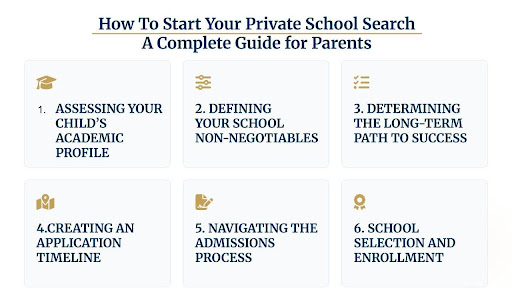
As you begin your search for a private school, it would be beneficial for you and your family to consider these three key pillars: understanding your child’s unique learning style, establishing your non-negotiables, and mapping out your child’s long-term path to success.
Choosing a private school for your child is an extensive process. Between the list of requirements, multiple essay submissions, a handful of potential choices, and a line of other hopeful students wanting to get admitted, managing these can feel overwhelming. We understand that as a parent, the responsibility rests on your shoulders. The reason why we’re here is to guide you in the best possible way, so that your child can secure a bright future.
Understanding Your Child’s Learning Style For Private School
The first step to take when looking for a private school starts inside your home. This is about getting to know and understand your child’s learning style and needs. Not everyone learns in the same way, and not every student has the exact same needs. Why is this important? Because this is the building block that eventually sets up the whole path to his/her academic success. Observe how your child is when learning something new. Do they need visuals to support their understanding? Do they take down notes, or do they have a very retentive memory? By knowing your child’s learning style and needs, you’ll be able to discern if your child can thrive in traditional, highly structured classrooms or if they need progressive, project-based environments, which is crucial for building a strong, authentic narrative for competitive applications.
Strategic Institutional Alignment: Defining Your Core Criteria
There are different reasons as to why choosing a private school would be the best academic choice for your child. While reasons may vary for every family, the need to have a baseline criterion for what you’re looking for in a private school should be established as early as possible. Some of the pertinent factors to consider are the school’s values, the academic curriculum, the class size, and the school’s arts and sports programs. Examples of what to consider are if the school’s mission aligns with your family’s core beliefs, if their student representation is diverse and inclusive of different nationalities and ethnicities, if their curriculum creates a balance between academics and extracurriculars, or if their community cultivates an environment of service and good moral character.
The search should not be a simple checklist, but a strategic exercise in finding where your family’s core values intersect with the school’s mission. This includes evaluating campus culture—whether it’s progressive or traditional—to ensure optimal strategic fit for your child’s compatibility and long-term success.
Determining The Long-Term Path to Success
When you and your family have finally found the school that understands your child’s learning style and caters to their learning needs while giving your child the autonomy to grow, the trajectory of their success eventually follows. Once your family has made a choice, there’s an alignment that happens between the school’s mission and vision and your child’s core beliefs about ambition, hard work, and achievement. When they feel nurtured, supported, and encouraged to be at their best in an academic setting, they usually do better than what’s expected of them. Ultimately, the right school for your child is the one where they will most likely thrive and strive to be the most exceptional version of themselves.
Top Factors That Make Or Break A Private School Decision
- Academic fit and learning philosophy.
- School culture and core values.
- Extracurriculars and Resources.
- College preparation.
Best Practices When Searching For Private Schools
- Start the process early.
- Go beyond the brochure.
- Talk to the experts (faculty and students).
- Be open, but stick to your non-negotiables.
Common Questions Asked of Private School Admissions Offices
Q: What specific traits or qualities are you looking for in a prospective student to ensure they thrive here?
A: We look for curious, adaptable, and empathetic students who are eager to engage with our community both academically and socially.
Q: How do you support students who are advanced academically, as well as those who might need extra help?
A: We utilize differentiated instruction, offering enrichment opportunities for advanced learners and tailored support from learning specialists for those who need it.
Q: What is the school’s view on homework, and how much time should we expect our child to spend on it each night?
A: We treat homework as purposeful reinforcement rather than busywork, typically following the standard “10 minutes per grade level” rule each night.
Q: What does a typical school day look like for a student in my child’s grade?
A: A typical day balances core academic blocks with specialized subjects like art or STEM, alongside dedicated time for recess and collaborative projects.
Related Articles
Private School Admissions: Understanding What Schools Look for in Applicants
How Parents Can Support the Private School Admissions Process
Common Mistakes in Private School Applications and How to Avoid Them
The Strategic Parent Statement: Building an Authentic Narrative
The Parent Statement is one of the most critical, high-stakes components of the application. It goes beyond transcripts to convey your child’s character, growth, and personality, serving as your direct voice to the admissions committee.
- Show, Don’t Tell: Instead of using vague descriptions like “hardworking” or “kind,” provide concrete anecdotes that show resilience, curiosity, or passion. A well-crafted narrative builds a compelling case for admission.
- Common Pitfalls to Avoid: Admissions officers recognize generic, over-praised, or insincere statements. The goal is to articulate your family’s values and how your child aligns with the school’s mission in an authentic way.
High-Stakes Application Prep: Interviews and Writing Samples
- The Interview: The interview assesses a child’s communication skills, character, and overall fit. Preparation is key: students should be coached to engage in a genuine conversation, demonstrating intellectual curiosity and maturity, not just reciting memorized answers.
- Proctored Writing Samples (PWS): Many competitive schools use the PWS as a key assessment tool. This requires the ability to think critically and write persuasively under pressure. Strategic preparation for this component is often overlooked but essential.
Private School Application Timeline for Parents
| Time Frame | Key Actions |
| Early Start (12-18 months prior) | Candidacy development, strategy, skill-building, and refinement for compelling narrative. |
| Fall (September to November) | Complete applications, submit essays, collect recommendation letters, and request transcripts. |
| October to January | Schedule student interviews, attend parent meetings, take standardized tests (SSAT/ISEE), and attend tours. |
| December to March | Application deadlines, submit final documents, and await decision letters. |
| March to April | Receive admission offers, compare options, notify selected school, and submit enrollment paperwork. |
This early start (12 to 18 months prior) is not just for the organization but also to allow ample time for your child’s development—the strategy, skill-building, and refinement necessary to build a personal narrative before the application crunch. A suggested strategic approach is to apply to the school’s major entry points, 6th grade and 9th grade. This is when the institution accepts a large volume of new students.
Best Grade Levels To Apply For Private School Admissions
For Pre-K and Kindergarten, start researching for private schools when your child is around the ages of three or four. This way, you can apply in the fall of their Pre-K year. Middle School, on the other hand, their entry point is generally the 6th grade. It would be recommended that you start campus tours and test preps in the spring of your child’s 4th-grade year, then submit the application during the fall of their 5th-grade year. For High School applications, 9th grade is the typical entry point, and this grade is a pivotal entry point for elite private high schools. If you plan on looking for standardized test preps, you can begin in the spring of 7th grade, then apply during the fall of your child’s 8th-grade year.
Step-by-step Timeline For The Private School Admissions Process
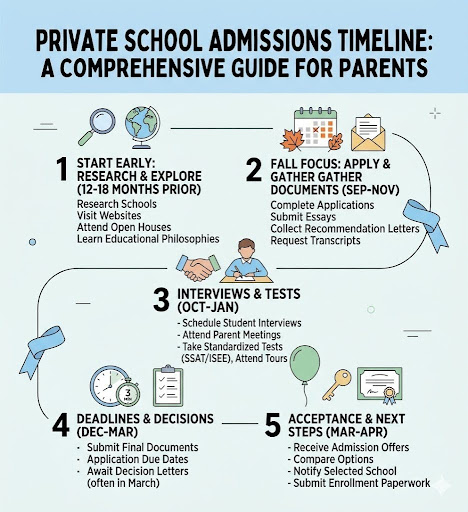
Start early and gather as much information as you can. When the fall season comes (September to November), gather documents and apply. This would include completing the applications, submitting the essays required, collecting the recommendation letters and requesting your child’s transcripts.
The interviews and tests happen within the October to January time frame. This is when you schedule student interviews, attend parent meetings, have your child take the Standardized Tests (SSAT/ISEE) and attend tours.
Within the window of time between December up to March the following year, this is when most of the deadlines happen and when the major decisions are being made. What’s crucial is that you submit the final documents, abide by application due dates, and await for decision letters.
Finally, the acceptance letters arrive and the next steps are made from March to April. This is when you’ll receive admission offers, compare your options, notify your selected school, and submit the enrollment paperwork.
Note: If you live in a major metropolitan area, local schools often form a regional consortium and agree to release decisions and require deposits on the exact same dates (typically between mid-February and mid-March). Be sure to ask your admissions officers if they follow a consortium timeline or if they operate on a rolling admissions basis
What To Do After Getting Accepted To A Private School
Your family receives the acceptance letter you’ve been waiting for: big congrats! Now comes the enrollment process to seal the deal. By spring, you’ll finally secure your spot by signing the contract and paying the deposit. After that, you will decline the other offers given by other private schools as a way of practicing good admissions etiquette. From April to May, you’ll set up your payment plan through the school’s tuition portal. After all that’s done, you’ll submit the final paperwork between May to June. This includes information like medical and immunization forms, as well as the formal request for the end-of-year transcripts. By the time summer comes, you and your family will be ready for the onboarding process.
Top Tips For Keeping Up With Your Child’s Application Timeline
- Track specifics in a master spreadsheet.
- Color-code your progress.
- Follow up on recommendations strategically and respectfully.
- Schedule standardized testing early.
- Organize and categorize parent and personal statements.
Best Practices For Going to Private School Campus Tours and Open Houses
- Review basic knowledge. Know the school’s mission statement, basic curriculum, and schedule structure.
- Prepare a question list. Write down three to five questions tailored to your child’s unique needs.
- Observe student-teacher dynamics. What kind of interactions are the people having?
- Use a rating system. Create a simple rubric and score the school after the visit.
Common Questions Asked About the Admissions Process
Q: What is the most important part of the application?
A: No single component outweighs the rest; your child’s transcripts, essays, recommendations, and interview are all considered equally important.
Q: What happens if documents arrive late at the admissions office?
A: While the core application must be submitted by the deadline, schools generally allow a short grace period for third-party documents like teacher recommendations or official transcripts. It depends on the school, so be sure to ask about it.
Q: Why should we engage a private school admissions consultant?
A: A consultant acts as a strategic lead, eliminating family friction and admissions anxiety while providing expert guidance on school selection, application strategy, and candidacy development to maximize your child’s success in competitive applicant pools.
Q: How do we differentiate our child in a competitive applicant pool?
A: Differentiation is achieved by building an authentic and unique personal narrative that clearly demonstrates institutional alignment—how your child’s specific talents, interests, and future goals perfectly match the school’s mission and community needs.
Related Articles
Understanding the U.S. Education System: How American Schools Work from K-12 to College
Navigating Private School Open Houses and Tours
How to Balance Academics and Extracurriculars: Time Management Tips for Students
Finding the right school for your child often comes with dedicated focus, undivided time, and a whole lot of effort.
As a parent, you want to do everything possible to give your child the best kind of life—and having an amazing education is part of it. Within a limited amount of time, you take the steps, follow the instructions, and wait for the final decision. Somewhere in the middle, it can get overwhelming and confusing, but it doesn’t have to be. Take the guesswork out of your timeline and add more certainty and direction to your search.
Schedule a confidential consultation with us today.