
Preparing for the SSAT in Seattle requires a clear study guide and consistent practice. Follow our expert strategies to help your student succeed at Seattle’s top independent schools.
In This Guide
There is a certain type of family conversation that takes place frequently in Seattle households during fall months. A parent sees the date on the calendar, calculates the deadline for the SSAT registration, and understands that time runs out quickly for their 7th grader and there is only a general idea of how to prepare for the test. If this scenario describes your situation, then you are definitely not too late and definitely not the only one. Indeed, to get into one of the leading independent schools, such as Lakeside School, University Prep, The Bush School, and Seattle Country Day School, they require more than just strong grades; they use the SSAT score to assess academic readiness and reasoning skills.
While having a great score does not automatically mean admission into a school, proper preparation will help gain confidence and the required skills for this process. This article will focus on how to make an effective SSAT study plan, determine when to start, and how to approach the test day with confidence.
Quick Answer for Busy Parents
The best way to prepare for the SSAT as a Seattle student is to launch a structured 8–12 week study plan that combines timed practice tests, targeted vocabulary building, and a Seattle-based tutor or admissions consultant familiar with local school expectations.
Rather than relying on last-minute cramming, students should focus on consistent weekly practice, regular review of errors, and full-length mock exams that build both academic skills and test-taking stamina. Students applying to the most selective schools often benefit from stretching that window closer to a full semester.
When Should Seattle Students Start Preparing for the SSAT?
Most Seattle families should begin preparing their children for the SSAT 8 to 12 weeks prior to the actual date of their examination; however, elite families who apply for admission into very selective schools could gain an advantage by beginning their preparation a whole semester before the exam day. Early preparation will give the child adequate time to build vocabulary, strengthen reading comprehension skills, improve their quantitative reasoning skills, and learn how to pace themselves on the SSAT. Consistent practice spread across several months generally beats studying intensively over a short period.
Related Article: How Important Are Entrance Exam Scores Like the SSAT, ISEE, HSPT, and TOEFL in Boarding School Admissions?
How Far in Advance Should You Book an SSAT Test Date in Seattle?
Seattle SSAT testing dates fill up faster than most families expect—particularly fall test dates at local testing venues near Downtown Seattle, Bellevue, and Mercer Island that align with Round 1 application deadlines. Register as soon as target schools are identified—early registration provides more flexibility on date and location and gives students time to:
- Complete preparation without feeling rushed.
- Retake the SSAT if appropriate during early winter testing windows.
- Focus on essays, interviews, and other admissions requirements afterward.
- Reduce scheduling conflicts with school, athletics, and extracurricular activities.
Rule of Thumb: Book first, plan second. Lock in the test date, then build the study plan backward from it—not the other way around.
What Does a Realistic 10-Week SSAT Study Timeline Look Like?
An organized schedule helps students improve steadily without becoming overwhelmed—building skills gradually rather than trying to master every section at once.
| Timeline Block | Primary Focus | Action Plan |
| Weeks 1-2 | Diagnostic & Baseline | Take an initial diagnostic test under realistic timed conditions to identify strengths and priority areas for improvement. |
| Weeks 3-4 | Foundational Skills | Build daily vocabulary routines while reviewing core math concepts and reading strategies. |
| Weeks 5-6 | Timed Section Drills | Practice individual SSAT sections under strict time limits and start maintaining a detailed error log. |
| Weeks 7-8 | Full Mock Testing | Complete full-length practice tests under realistic testing conditions; refine section-by-section pacing. |
| Week 9 | Targeted Error Review | Focus on the most challenging question types from your error log and reinforce remaining weak spots. |
| Week 10 | Taper Confidence | Complete a light review, organize test-day logistics, and reduce study intensity to ensure rest before test day. |
Students who consistently review their mistakes often improve more than those who simply complete large numbers of practice questions. Understanding why an answer was wrong prevents the same error from recurring on test day.
Is It Ever Too Late to Start SSAT Prep Before Application Deadlines?
Beginning later than planned doesn’t automatically mean a student can’t improve. While an 8–12 week timeline is ideal, even a shorter window can produce meaningful gains when sessions are focused. Students working within a tighter timeline should prioritize:
- Taking an initial diagnostic test immediately.
- Reviewing the highest-value, high-frequency concepts first.
- Completing timed practice instead of untimed drills.
- Focusing on recurring mistakes rather than trying to learn every possible question type.
- Working with an experienced tutor if significant improvement is needed quickly.
A first SSAT score isn’t necessarily final, either—many families don’t realize there’s often still time for a retake, particularly if testing in early winter is still an option for your target school’s specific deadline.
Unsure where your child currently ranks on the SSAT scale? Schedule a diagnostic consultation with Cardinal Education to evaluate baseline scores.
What Are the Best SSAT Study Strategies and Practice Resources for Seattle Students?
The most effective way to prepare for the SSAT exams includes a combination of full-length practice tests, targeted vocabulary drills, and “error-log” review—ideally done with the help of an expert tutor who knows what the most selective private schools in Seattle look for when making their admission decisions. Success isn’t determined by how many total hours a student studies; it comes from using study time efficiently, practicing under realistic conditions, and reviewing mistakes carefully.
Related Article: SSAT or ISEE? Which Test Should Your Child Take?
Why Do Timed Mock Tests Matter More Than Untimed Practice?
Untimed practice is useful for first learning new concepts, but the SSAT is ultimately a timed exam. Timed mock exams help students:
- Build endurance for a multi-hour exam.
- Internalize pacing for each question style.
- Identify bottlenecks before test day.
- Develop confidence under realistic exam conditions.
- Practice strategic skipping (knowing when to skip difficult questions and return to them later).
Full-length timed practice tests are some of the most high-impact items in any preparation strategy. After each practice test, students need to spend as much time analyzing the errors as they did in taking the test itself. Keeping an “error log” of what was missed, why, and how to solve it correctly—drives significantly more score improvement than simply taking test after test.
SSAT vs. ISEE: Which Test Should Your Seattle Student Take?
Not every Seattle private school requires the same test, and many accept either. Both assess reading, verbal reasoning, and mathematics, but they differ in structure, scoring, and question style:
| Metric/Feature | SSAT | ISEE |
| Quantitative Style | More abstract, logic- and puzzle-based reasoning | More straightforward, standard school-math phrasing |
| Essay Section | Unscored (sent directly to schools as a writing sample) | Scored on structure, development, and mechanics |
| Best Fit Student | Students strong in creative problem-solving & pattern recognition | Students who prefer direct, curriculum-aligned math problems |
| Seattle Acceptance | Accepted by virtually all local independent schools | Accepted by many Seattle private schools; some express a preference |
Before committing to a prep plan, families should:
- Confirm which exams each target school accepts.
- Compare the structure and scoring of both tests.
- Consider which format better matches the student’s natural strengths.
- Decide early so preparation can focus on one exam rather than splitting time between two.

Should You Hire a Local Tutor, Take a Prep Course, or Study Independently?
Students generally choose one of three approaches, and the best option depends on learning style, current academic baseline, timeline, and admissions goals:
- Private Tutoring: Offers highly individualized instruction that adapts dynamically as the student progresses. This is especially valuable for applicants targeting Seattle’s most competitive independent schools, as a tutor who knows the local landscape can shape a plan around specific target school expectations.
- Prep Courses: Follow a structured curriculum with consistent practice alongside peers. This is a good fit for self-motivated learners who benefit from scheduled classroom instruction.
- Self-Study: Offers maximum flexibility for highly organized students but requires strong self-discipline and won’t provide the personalized feedback needed to catch recurring structural mistakes.
How Do You Build an SSAT Study Schedule and Manage Test-Day Stress?
An effective SSAT study plan involves dividing the SSAT study process into manageable weekly segments, with vocabulary, quantitative reasoning, and reading being studied in weekly chunks, and having one taper week prior to the test to avoid burnout and test-day stress. Prolonged study does not always lead to improved outcomes; a reliable and consistent study plan that balances skill building and timed practice works best.
Related Article: 5 Ways to Build Executive Function in Private School Students
What Should a Weekly SSAT Study Schedule Include?
Short, consistent daily sessions beat occasional weekend marathon study days. Here is a recommended weekly breakdown:
| Day | Primary Focus | Focus Area & Tasks |
| Monday | Verbal Reasoning | 20 mins vocabulary flashcards + 30 mins analogy and synonym practice. |
| Tuesday | Quantitative Reasoning | Core math concept review + targeted problem-solving drills. |
| Wednesday | Reading Comprehension | Practice 2–3 reading passages under strict timed conditions; strategy check. |
| Thursday | Mathematics Achievement | Practice multi-step math problems; update math error log. |
| Friday | Mixed Practice | Short mixed-section drills and vocabulary reinforcement games. |
| Saturday | Mock/Timed Practice | Full-length timed practice section or a full mock exam block. |
| Sunday | Rest & Error Review | Review missed questions in detail, update Error Log, and rest. |
Key Daily Habits to Maintain:
- Daily vocabulary review (15–20 minutes).
- Regular reading from challenging nonfiction and fiction.
- Weekly review of recurring entries in the Error Log.
- One or two full-length timed mock exams per month, increasing in frequency as test day approaches.
How Do You Prevent Burnout in the Final Two Weeks Before the SSAT?
The final stretch should reinforce confidence, not introduce brand-new material—trying to cover too much in the last two weeks tends to raise stress without improving performance. Instead, students should:
- Review existing notes and vocabulary rather than starting new resources.
- Complete one or two final timed practice tests to keep pacing sharp.
- Focus specifically on correcting recurring errors.
- Maintain healthy, consistent sleep habits.
- Continue exercising and taking regular study breaks.
- Gradually reduce study time in the final few days before the exam.
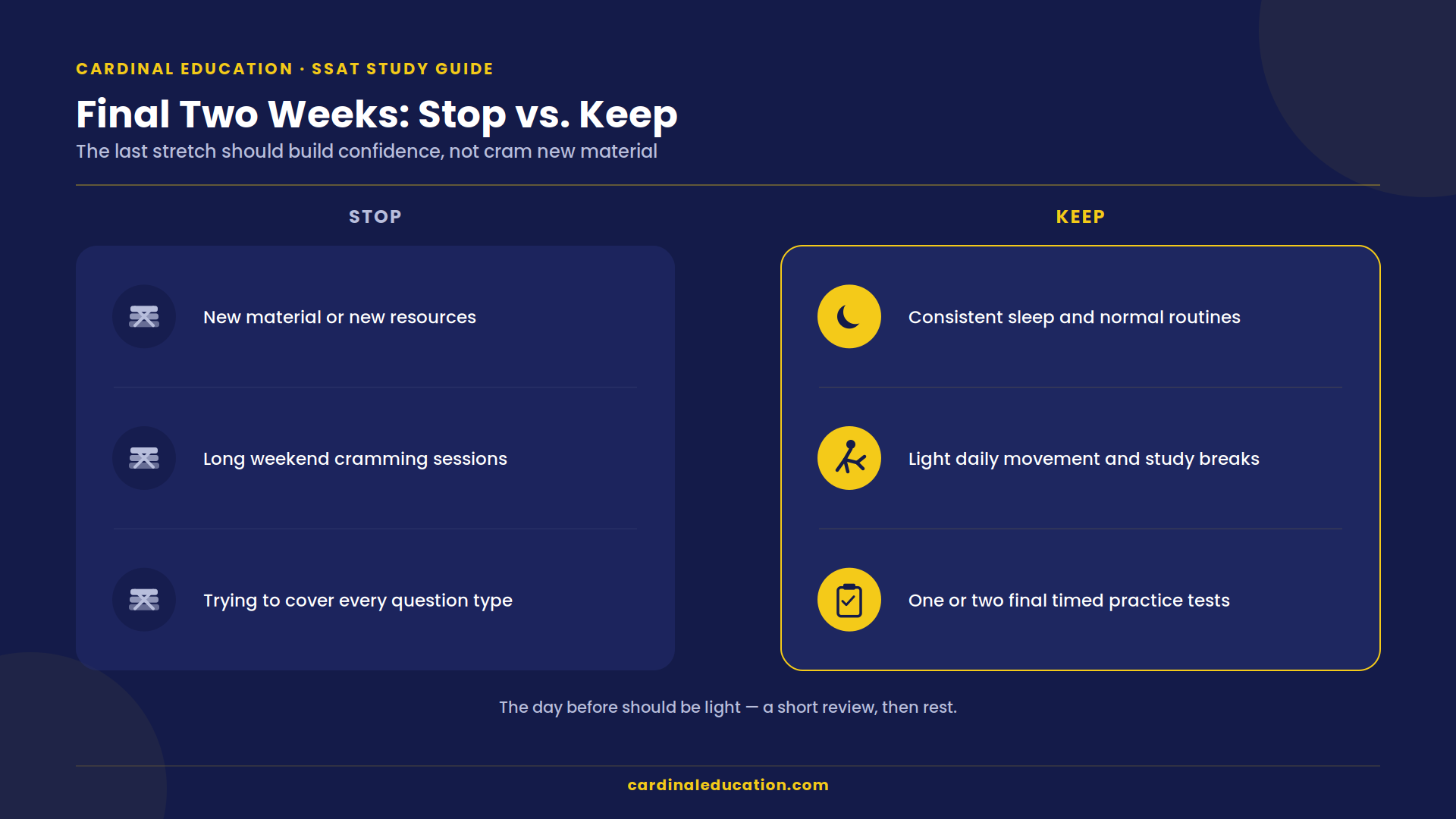
The day before the SSAT should be light—a brief 15-minute review of vocabulary or formulas is fine, but students are usually far better served by relaxing, prepping testing materials, and getting a full night’s sleep.
What Should a Seattle Student Do the Morning of the SSAT?
Test day should feel familiar, not rushed. Before leaving for the testing center, students should:
- Wake up early enough to avoid any rushing or panic.
- Eat a familiar, balanced breakfast.
- Dress comfortably in layers for variable testing room temperatures.
- Bring all required identification, admission tickets, and approved testing materials.
- Arrive early—parking near several Seattle testing sites (especially around Capitol Hill or North Seattle locations) can be tighter and busier than expected.
During the exam itself:
- Read directions carefully before starting each section.
- Keep an eye on the clock without obsessing over every second.
- Skip unusually difficult questions and return to them if time permits.
- Stay focused on one question at a time instead of dwelling on previous sections.
Reach Your SSAT Goals With Cardinal Education
A strong SSAT score isn’t the whole admissions picture, but for Seattle families targeting schools like Lakeside, University Prep, or The Bush School, it’s often the first concrete data point that shapes what’s possible on the rest of the application. Preparing for the SSAT is about more than a test score—it’s about helping students build the confidence, executive functioning, and academic skills to succeed throughout the admissions process.
At Cardinal Education, we help Seattle families navigate every stage of the admissions journey. Our experienced educators provide personalized standardized test tutoring, executive functioning coaching, interview preparation, and comprehensive private school admissions consulting.
Ready to strengthen your child’s application? Contact us today.
Related Article: The Role of Admissions Consulting in Personalized Learning