
Cardinal Education is an independent educational consulting company. We are not affiliated, associated, authorized, endorsed by, or in any way officially connected with any public or private school.
Speak with an Admissions Expert
Quick Answer for Busy Parents
Rye Country Day School admits students through a seven-step process running from August to February. Families submit the application by December 15, complete interviews, questionnaires, testing, transcripts, and recommendations by January 10, and receive decisions on February 5. Every applicant interviews on campus, and every applicant from Pre-Kindergarten upward completes some form of assessment, though the format changes substantially by grade. The school publishes its own admit counts and application volumes, which show that Pre-Kindergarten, Kindergarten, Grade 4, Grade 6, and Grade 9 are the grades where meaningful numbers of seats open.
Why Do Families Choose Rye Country Day School?
Founded in 1869, Rye Country Day has spent more than a century and a half operating under a single idea, stated in its motto: “Not for Self, but for Service.” The school describes its mission as providing students from Pre-Kindergarten through Grade 12 with an excellent education using both traditional and innovative approaches, in a nurturing environment that pushes students toward their maximum potential academically, athletically, creatively, and socially. Four core values organize the work, which the school arranges to spell out its own initials: respect and responsibility, commitment to personal and academic excellence, diversity within an inclusive community, and service.
What families tend to notice first is the structure. All three divisions share one campus in Rye, so a child entering at Pre-Kindergarten can stay thirteen years without a transition. The school also runs a six-day academic cycle rather than a five-day week, a scheduling choice that creates more room for electives, teacher conferences, and co-curricular commitments than a conventional timetable allows.
Academic Snapshot
| Measure | Figure |
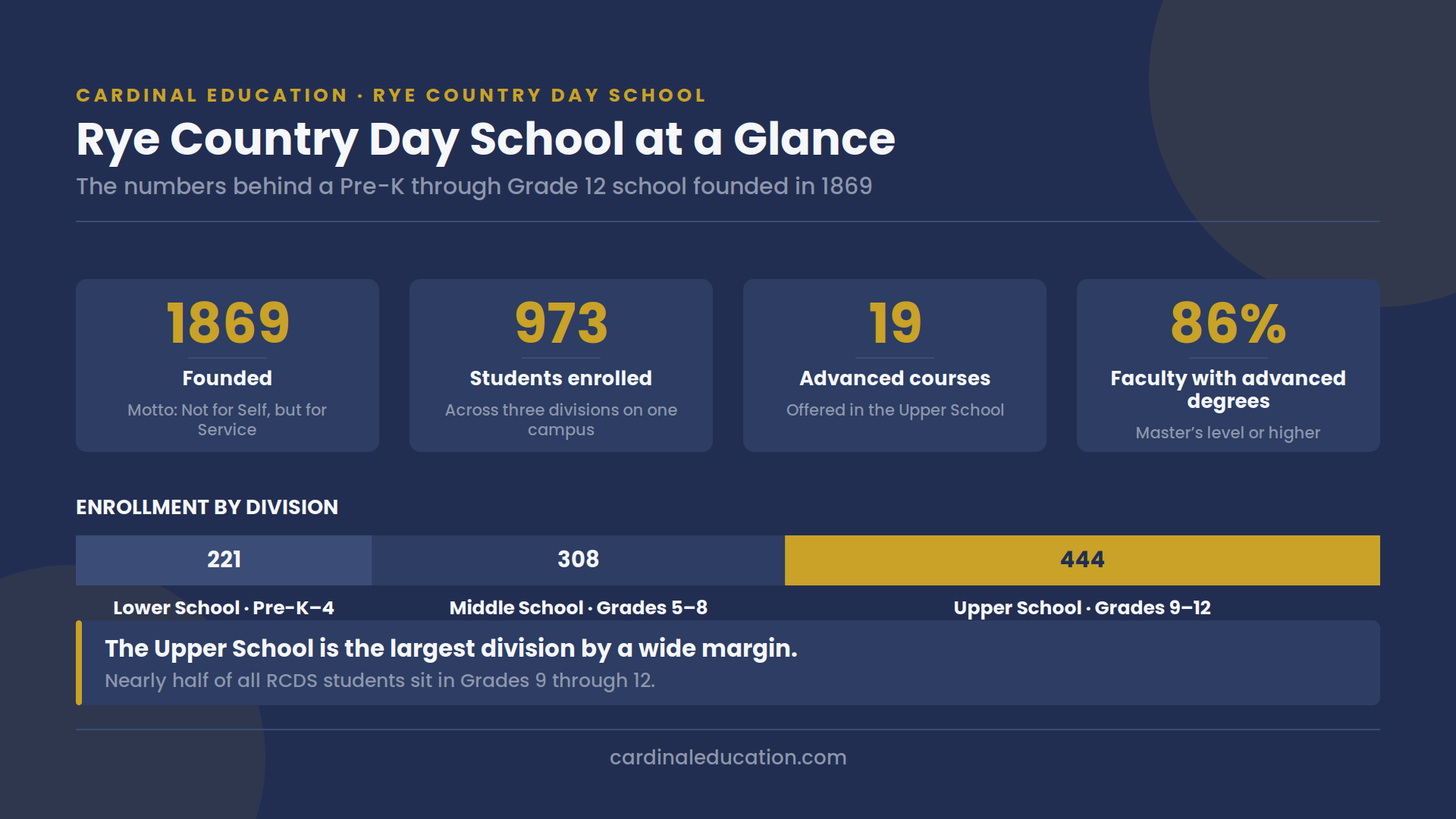
| Total enrollment | 973 students |
| Lower School / Middle School / Upper School | 221 / 308 / 444 |
| Student-teacher ratio, Pre-Kindergarten | 6:1 |
| Student-teacher ratio, Grades K to 4 | 9:1 |
| Student-teacher ratio, Grade 5 | 15:1 |
| Advanced courses offered | 19 |
| Faculty holding advanced degrees | 86% |
| Students identifying as students of color | 48.9% |
| Typical Upper School homework load | 30 to 45 minutes per course |
| Athletics | 18 sports across 68 teams |
| Graduates enrolling in college | 100% |
Daily Schedule by Division
| Division | Start | Dismissal |
| Lower School, Pre-K to Grade 4 | 8:15 a.m. | 2:50 p.m. |
| Grades 5 and 6 | 8:20 a.m. | 3:15 p.m. |
| Grades 7 and 8 | 8:30 a.m. | 3:25 p.m. |
| Upper School | 8:30 a.m. | 3:15 p.m., athletics from 3:30 p.m. |
How Hard Is It to Get Into Rye Country Day School?
Rye Country Day is genuinely selective, but a single acceptance rate misleads more than it informs here. The school publishes both how many students it admits at each grade and roughly how many apply, and the gap between grades is enormous. Worked across the grades where firm numbers exist, admitted students represent an estimated 17% of applicants, which is lower than the 25% figure circulating on several third-party sites. Treat that 17% as our estimate rather than an official school statistic. For broader context on how these numbers work, see our explainer on acceptance rates at competitive private schools.
| Grade | Approximate applications | Students admitted |
| Pre-Kindergarten | 75 | 18 to 24 |
| Kindergarten | 110 | 12 to 18 |
| Grade 4 | 47 | 18 |
| Grade 5 | 47 | 4 to 6 |
| Grade 6 | 146 | 18 to 20 |
| Grade 7 | 45 | 4 to 6 |
| Grade 8 | 40 | 5 to 8 |
| Grade 9 | 194 | 30 to 35 |
| Grade 10 | 32 | 4 to 6 |
| Grades 1, 2, 3, 11, 12 | 18 to 34 each | Varies with availability |
Two patterns jump out. Grade 6 and Grade 9 draw the heaviest application volume because they are the natural entry points into the Middle and Upper Schools. Grades 11 and 12, by contrast, open only when current students leave. The school also states that sibling and legacy applications receive priority consideration when all else is equal, and that the waitlist stays active through mid-summer.
Top Tips for Standing Out in RCDS Admissions
- Target a primary entry point rather than applying at whichever grade your child happens to be in
- Give the admissions committee a specific picture of your child instead of a polished but generic one
- Choose the test that suits your child, since the school weighs the ISEE and SSAT identically
- Ask teachers for recommendations early, well before the December holidays
- Show genuine knowledge of the school during the interview rather than rehearsed enthusiasm
Best Practices for Families Applying to RCDS
- Start roughly a year ahead, since testing, visits, and writing all compete for the same autumn weeks
- Confirm the September 1 birthday cut-off before applying to any Lower School grade
- Build a balanced list that includes peer schools, not RCDS alone
- Plan for the possibility of reapplying at a grade with more openings
- Keep your child involved in the decision, particularly from Grade 5 upward
Questions About Selectivity
Is there a waitlist at Rye Country Day School?
Yes. Applicants are admitted, denied, or waitlisted in February, and the waitlist remains active through mid-summer. Families sometimes receive movement well after the March enrollment deadline as accepted students make other choices.
Can we apply late?
Only for Grades 5 through 12, and only on a rolling second-round basis after the December deadline. There is no late round for Pre-Kindergarten through Grade 4. Families who need an extension should contact the admissions office directly rather than assuming flexibility exists.
Should we reapply if we are not admitted?
The school explicitly encourages it, particularly when the denial reflected a lack of space rather than fit. The practical move is to identify which grades open up most and aim at one of those.
The Rye Country Day Admissions Process
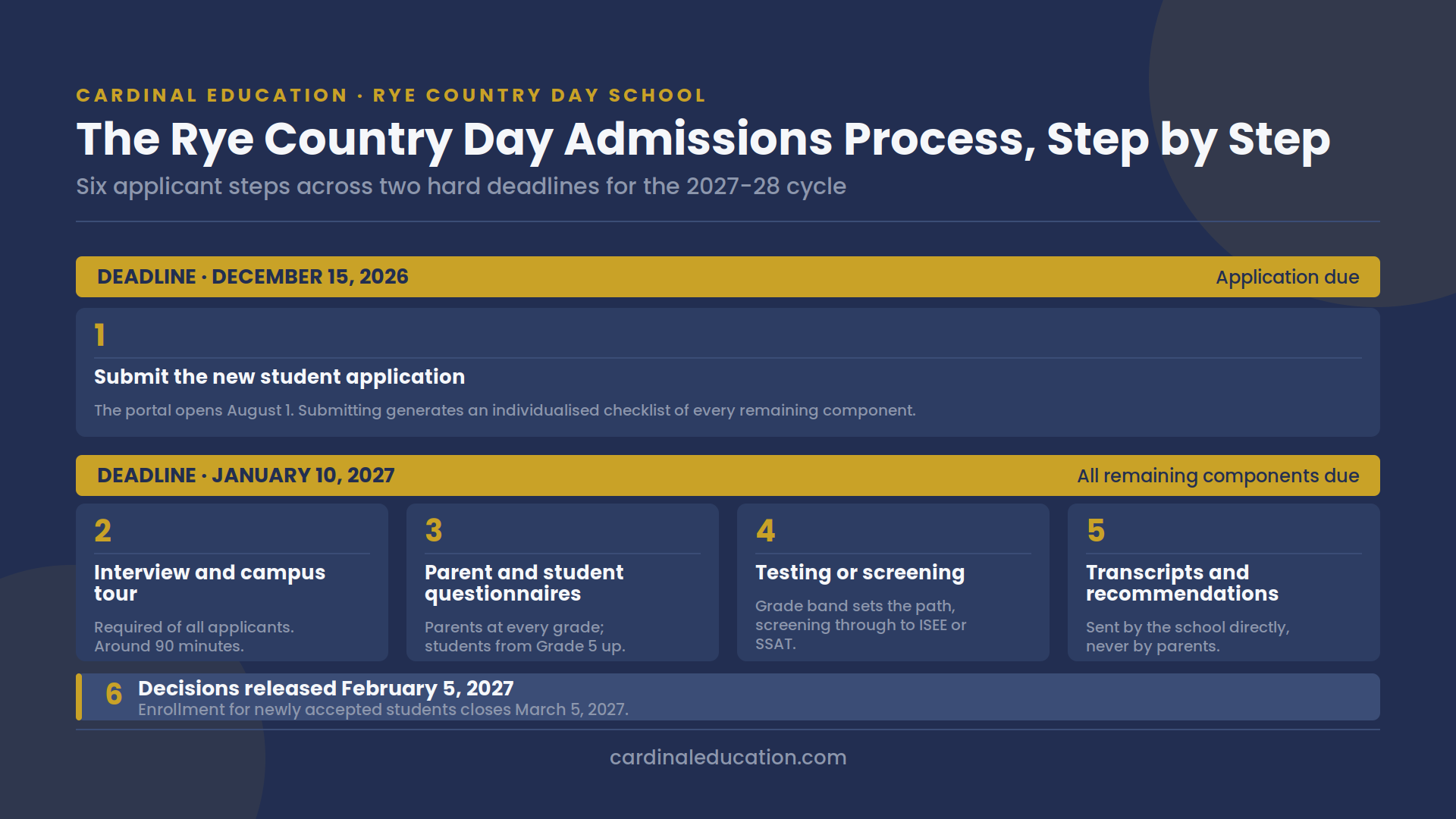
The applicant-facing process runs in six steps across two deadlines. The first closes in December, the second in January, and everything resolves on a single decision date in February.
- Complete the new student application. The portal opens August 1, and submitting generates an individualized checklist of everything else you owe. Due December 15.
- Schedule and attend the interview and campus tour. Required for every applicant, booked through the portal after the application is submitted. Due January 10.
- Submit the parent or guardian questionnaire, plus the student questionnaire for applicants to Grades 5 through 12. Due January 10.
- Complete admissions testing or screening in the format matching your grade. Due January 10.
- Arrange transcripts and recommendations, sent directly by the current school or teachers. Due January 10.
- Receive the decision online in the late afternoon of February 5, 2027. Newly accepted families enroll by March 5.
Rye Country Day Admissions Calendar and Key Dates
| Event | Date | Applies to |
| Application portal opens | August 1, 2026 | All applicants |
| Open House | October 25, 2026 | All prospective families |
| Interviews and tours | September 2026 to January 2027 | All applicants |
| Individual screenings and Grade 4 classroom visits | October 2026 to January 2027 | Pre-K, Kindergarten, Grade 4 |
| Group visits | November 2026 to January 2027 | Pre-K and Kindergarten |
| ISEE session hosted at RCDS | November 7, 2026 | Grades 4 to 12 |
| ISEE session hosted at RCDS | December 6, 2026 | Grades 5 to 12 |
| Application deadline | December 15, 2026 | All applicants |
| ISEE session hosted at RCDS | January 3, 2027 | Grades 4 to 12 |
| All remaining components due | January 10, 2027 | All applicants |
| Decisions released | February 5, 2027 | All applicants |
| Enrollment deadline | March 5, 2027 | Newly accepted students |
Rye Country Day Application Requirements
The school accepts both its own application and the Standard Application Online used across Fairchester Consortium schools. Whichever route you take, the components are the same, and the ones outside your direct control are the ones that most often run late. Our overview of the private school application walks through how these pieces fit together.
Testing and Screening by Grade
This is the part of the process families most often get wrong, because the format changes four times between Pre-Kindergarten and Grade 12. Applicants to Grades 5 and above choose between the ISEE and the SSAT, which the admissions committees treat as equivalent. Score reports go to RCDS using the ISEE code 334965 or the SSAT code 6208.
| Grade applying to | Assessment format | Duration |
| Pre-K and Kindergarten | Individual screening plus a separate group visit | 20 to 30 minutes, plus 45 to 60 minutes |
| Grade 1 | Standardized small-group assessment with up to four students | 35 to 45 minutes |
| Grades 2 and 3 | ISEE Primary 2 or ISEE Primary 3, registered through E3n | Per test format |
| Grade 4 | ISEE Primary 4 plus a required third grade classroom visit | Visit runs 8:15 to 11:00 a.m. |
| Grades 5 to 12 | ISEE or SSAT, weighed equally | Per test format |
The Grade 4 classroom visit deserves particular attention because families frequently mistake it for optional. It is required. Applicants spend a morning inside a current third grade class, taking part in activities and interacting with students and teachers.
Interview and Campus Tour
Interviews run about 90 minutes and take a different shape depending on grade. Families applying to Pre-Kindergarten through Grade 4 attend without the applicant. From Grade 5 upward, the student interviews first, then parents or guardians interview separately. Only one parent needs to attend, though the school welcomes both, and campus visits include a student-led tour. Sound interview preparation is less about scripting answers than about arriving with real curiosity.
Questionnaires
Parents complete a questionnaire for every applicant, and students applying to Grades 5 through 12 complete their own. Both submit through the portal. The parent questionnaire functions much like a parent statement at other schools, and the same advice applies. Specific beats flattering. A story about what your child actually does on a Saturday tells the committee more than a paragraph of adjectives.
Transcripts and Recommendations
Transcripts and recommendation forms must come directly from the current school or from teachers. Rye Country Day cannot accept these from parents under any circumstances, which means your timeline depends on other people’s calendars. Ask early, and confirm submission rather than assuming it happened.
Not sure which entry point gives your child the best odds?
We help families read the grade-by-grade numbers honestly, choose between the ISEE and SSAT, and prepare for interviews that are genuinely two-way conversations.
Speak with an Admissions Expert
Questions About Testing and Scheduling
Does RCDS host its own test dates?
Yes. While families may test at any site, Rye Country Day runs three ISEE sessions on campus for the 2027-28 cycle: November 7, 2026 for Grades 4 to 12, December 6, 2026 for Grades 5 to 12, and January 3, 2027 for Grades 4 to 12.
Who registers for testing?
Parents and guardians do, through the ISEE or SSAT websites directly. The school does not register students on your behalf, and score reports must be directed to RCDS at registration.
What if we need to retake a test?
Build the possibility into your calendar from the start. Everything must be complete by January 10, so a first attempt in late autumn leaves room that a January attempt does not.
Student Life at Rye Country Day School
Academics
The Lower School builds foundations in language arts, mathematics, social studies, science, and computer work, adding a modern language from Kindergarten. The Middle School expands into English and language arts, mathematics, science, social studies, computer science, art, Latin, and modern languages in French, Mandarin Chinese, and Spanish. The Upper School offers 19 advanced courses across English, mathematics, science, history and social science, computer science, modern languages, and physical education. Faculty support runs deep, with 86% holding advanced degrees, and the school maintains learning specialists alongside psychologists, a social worker, and counseling staff across all three divisions.
Activities
Signature programs carry real names and real substance. The STEAM Scholars Program runs a multi-year sequence of advanced coursework, mentorship, and a capstone project. The Entrepreneurship and Innovation Program takes students through idea generation, business modeling, and marketing. The Community Engagement Fellowship Program anchors the school’s public purpose work, and Global Studies supports international learning. Students publish the newspaper, the Rye Crop, and the yearbook, Echo. Robotics teams compete, Model UN fields a team, and the Makerspace and Design and Innovation Lab give students access to laser cutters, 3D printers, and CNC routers.
Athletics
Rye Country Day fields 18 sports across 68 teams, competing in baseball, basketball, cross-country, fencing, field hockey, football, golf, ice hockey, indoor track, lacrosse, sailing, soccer, softball, squash, tennis, track and field, volleyball, and wrestling. Teams compete within the Fairchester Athletic Association and NYSAIS, and the program has produced athletes who have gone on to compete at the collegiate level and beyond, including Andrew Mollerus, Class of 2012, who rowed at Harvard and competed at the 2024 Paris Olympics.

Arts
The Cohen Center for the Creative Arts anchors visual arts, where students work across clay, charcoal, and digital tools, with regular exhibitions throughout the year. Drama and dance run from the Middle School musical through the Upper School fall play and a winter choreography showcase, and the Cedar Street Dance Company gives serious dancers a performance home. Music spans the Festival Chorus, chamber ensembles, and a private lesson program.
Summer Programs
Summer at RCDS runs several distinct tracks. Summer Session offers enrichment and for-credit coursework. Wildcat Mini-Camps serve the youngest students through hands-on themes. June Sports Camps and June Strength and Conditioning Camps focus on athletic development, while the ACTION program runs a weeklong leadership and team-building intensive. Sport-specific camps in football, girls’ volleyball, and boys’ lacrosse round out the offering.
Notable Rye Country Day Alumni
- Edward Albee, Pulitzer Prize-winning playwright best known for Who’s Afraid of Virginia Woolf?
- Barbara Bush, First Lady of the United States, who attended Rye Country Day as a child
- Nick Kroll, comedian, actor, and creator of the animated series Big Mouth
- Raymond Khoury, novelist and screenwriter, author of The Last Templar
- Anna Marguerite McCann, pioneering underwater archaeologist
- Andrew Mollerus, Class of 2012, Harvard rower and 2024 Paris Olympian
What Families Say
Thanks to Cardinal Education, we felt totally prepared for the Rye Country Day School admissions process. They understood our child and the school perfectly. We couldn’t have done it without them.
— Parent of an 8th-Grade Applicant
Where to Start
The single most useful thing a family can do here is study the grade-by-grade numbers before committing to a cycle, because at Rye Country Day the entry year shapes the odds more than almost anything else in the application. Families building a balanced list often look at Horace Mann alongside RCDS, and our New York admissions consultants can help you weigh both honestly.
Start your Rye Country Day application with a plan
Grade targeting, testing strategy, interview preparation, and honest guidance on fit.
Related Reading
A Wild Summer at Rye Country Day School: Where the Fun Doesn’t Take a Vacation
Rye Country Day School’s Enriching After-School Programs
Discover the Power of STEAM at Rye Country Day School