
Cardinal Education is an independent educational consulting company. We are not affiliated, associated, authorized, endorsed by, or in any way officially connected with any public or private school.
What Dalton actually asks of applicants, what it rewards, and how to tell whether your child belongs there.
Quick Answer for Busy Parents
The Dalton School admits students at Kindergarten and 9th grade for September 2027 entry, plus Prep for Prep applicants entering 7th or 8th grade. Applications run through Ravenna and close at 12:00 PM on November 13 for every division. Middle and High School applicants must submit ISEE or SSAT scores, a parent statement, transcripts covering last year and the current fall term, and recommendations from an English teacher, a mathematics teacher, and a guidance counselor or school administrator. A campus visit with a student interview is required, not optional. Decisions post in Ravenna on the ISAAGNY timetable. Dalton publishes no acceptance rate, and fit with the Dalton Plan weighs as heavily as any score.
Why Do Families Choose Dalton School?
Helen Parkhurst opened the school in 1919 as the Children’s University School, after working alongside Maria Montessori and touring progressive schools across Europe. She had already tested her method in the high school of Dalton, Massachusetts, and the name followed her to New York. Eleanor Roosevelt admired the work enough to help broker the 1939 merger with the Todhunter School. A century later Dalton still runs on Parkhurst’s framework and still sends students off with her charge: Go Forth Unafraid.
Dalton states its mission as an education of excellence meeting each student’s interests, abilities, and needs within a common curricular framework, one that challenges students to develop intellectual independence, creativity, curiosity, and a sense of responsibility toward others. That is not boilerplate at Dalton. The Dalton Plan turns it into daily mechanics.
On current third-party assessment, Dalton holds an A+ overall grade from Niche for 2026, with A+ marks in Academics, Diversity, Teachers, College Prep, and Clubs and Activities, and a B in Sports. Parents comparing options across the city may find our roundup of how progressive, traditional, and classical philosophies differ in practice more useful than a ranking, because the gap between Dalton and a conventional prep school is pedagogical rather than qualitative.
The Dalton Plan, in Plain Terms
Three parts, all running at once.
House. A daily meeting with a designated group of peers and a House Advisor. In the High School a House holds 16 to 25 students drawn from all four grades, guided by two advisors, and the relationship typically runs the full four years. Attendance, announcements, and check-ins happen here, but the real function is that one adult knows your child well for a long time.
Assignment. An agreement between student and teacher setting expectations for a unit of work. The student makes real choices about sequencing, time management, and how to engage the material. It is the mechanism by which Dalton hands over control gradually rather than all at once.
Lab. Time set aside daily for one-on-one or small-group meetings with teachers. In the First Program teachers often initiate these. By Middle and High School the student books them, to review a hard topic, workshop a paper, debrief an exam, or propose something new. Lab is where self-advocacy stops being a word on a mission statement.
Dalton is careful to say that progressive does not mean permissive. The curriculum is demanding and the school says so. What differs is who holds the steering wheel.
Academic Snapshot
| Measure | Figure |
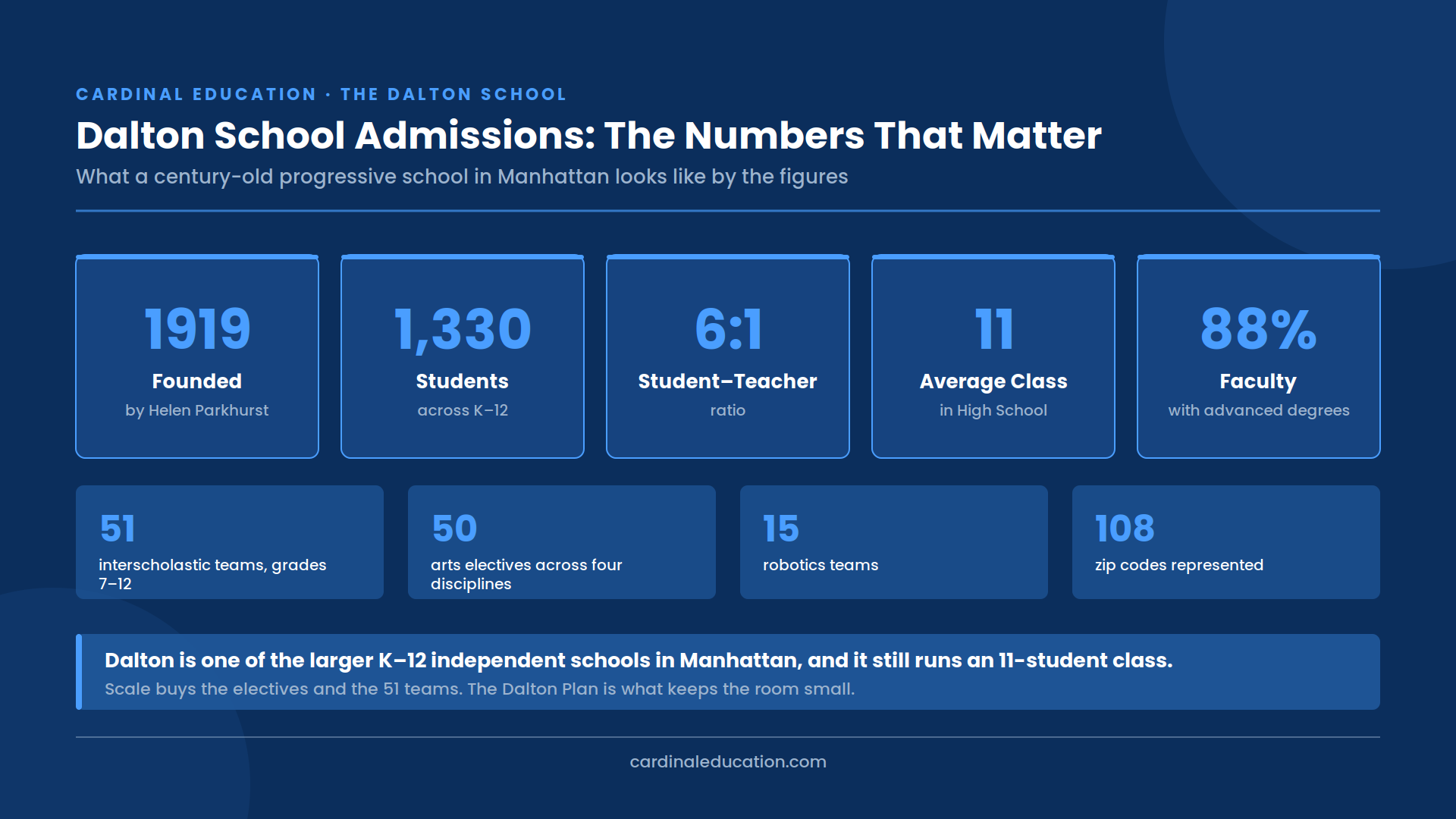
| Total enrollment | 1,330 students, K–12 |
| Students per grade | Approximately 102 |
| Student-teacher ratio | 6:1 |
| Average High School class size | 11 |
| Faculty holding advanced degrees | 88% |
| Average SAT composite | 1460 (Math 730 / Verbal 730), per Niche |
| Average ACT composite | 34 (Math 32 / Reading 34 / English 34 / Science 32), per Niche |
| College counseling team | Six counselors serving the High School |
| Accreditation and membership | NAIS, NYSAIS, ISAAGNY, New York Interschool |
| Curriculum partner | Global Online Academy, High School only |
| Testing partners | ERB for the ISEE, SSATB for the SSAT |
Student Demographics
Dalton does not publish a numerical demographic breakdown on its own pages. The figures below are Niche estimates and should be treated as approximate.
| Group | Estimated Share |
| White | 43.6% |
| Multiracial | 20.2% |
| Asian | 18.2% |
| African American | 10.5% |
| Hispanic | 7.4% |
| Female / Male | 51% / 49% |
Getting to Campus
Dalton occupies several buildings on the Upper East Side: grades K through 3 at 53 East 91st Street, grades 4 through 12 at 108 East 89th Street, and the Physical Education Center at 200 East 87th Street. Students commute in from 108 zip codes.
- Student OMNY cards. Families living more than a mile from school may receive a card valid for four free rides a day.
- Subway access. The 4, 5, and 6 stop at 86th Street and Lexington Avenue. The Q stops at 86th Street and Second Avenue.
- City bus service. The Department of Education runs free school bus service for Dalton students in grades K through 6 who meet the Office of Pupil Transportation distance criteria.
- Private routes. Door-to-door service is available for First Program and Middle School students, and a separate morning-only route serves families in the Bronx, Brooklyn, and Queens, shared with other independent schools nearby.
How Hard Is It to Get Into Dalton School?
Hard, and harder than usual this cycle. Dalton does not publish an acceptance rate, and we will not print one. Figures on aggregator sites are outside estimates with no methodology attached, and quoting them lends a precision that does not exist.
What can be stated is the shape of the opportunity. Dalton enrolls roughly 102 students per grade, and for September 2027 it is running a standard application at Kindergarten and 9th grade only, having suspended 6th grade intake after several years of unusually high retention and record-low attrition in grades K through 5. The school calls that a temporary adjustment of one or two years. Kindergarten carries the largest cohort and is the widest door Dalton offers.
For families trying to calibrate expectations across a school list, our explainer on how acceptance rates work at the most competitive private schools is a better instrument than any single percentage, because it explains why the denominators differ so much from school to school.
What Dalton Weighs
- Academic record across last year and the current fall term, read for trajectory as much as for level
- ISEE or SSAT results, with no stated preference between the two tests
- Recommendations from an English or language arts teacher, a mathematics teacher, and a counselor or school administrator
- The student interview, which runs 20 to 30 minutes and is a conversation, not a quiz
- The parent statement, for Middle and High School applicants
- Evidence that the child will use the Dalton Plan rather than merely tolerate it
- Whether the family understands what progressive education means in daily practice
Peer Schools Families Consider Alongside Dalton
Most Dalton families are also looking at Horace Mann, Trinity, Collegiate, Brearley, and Riverdale. The most instructive comparison is with Horace Mann, which is similar in scale and selectivity but conventionally structured, so the contrast isolates pedagogy from prestige. The other comparison worth making is with The Calhoun School, Manhattan’s other well-known progressive independent school, which is considerably smaller. Dalton offers progressive pedagogy at a scale that brings 51 athletic teams and 50 arts electives with it. Calhoun offers a more intimate version of a related philosophy. Neither is better. They suit different children.
Top Tips for Applying
- Apply to an open entry grade. Non-entry applications depend on attrition Dalton does not currently have.
- Submit the preliminary application as early in the window as you can manage.
- Schedule the required visit in October rather than December.
- Sit the ISEE or SSAT by early fall so a retake stays possible before the January cutoff.
- Prepare your child to describe their thinking out loud, which is the actual skill the interview tests.
- Check Ravenna regularly to confirm every document has landed.
Best Practices for Families
- Read the Dalton Plan closely and decide honestly whether it describes your child or your aspiration for your child.
- Visit with your child rather than scouting alone. Their reaction to the building is data.
- Bring stories to the parent meeting. Dalton asks about hopes for your child’s education, not about achievements.
- Where there are two parents, attend the interview and tour together.
- Build a list with genuine alternatives so that no single February notification carries the whole year.
- Start earlier than feels necessary. Self-direction is built over months, not weeks.
Common Questions About Dalton’s Selectivity
What is the Dalton School acceptance rate?
Dalton does not publish one. Third-party estimates exist but carry no stated methodology, and we do not consider them reliable enough to quote as fact. The useful figures are the published ones: roughly 102 students per grade and two standard entry points open for September 2027.
Is Kindergarten or 9th grade easier to enter?
Kindergarten offers the most seats of any entry point, which makes it structurally the widest door. That does not make it easy. It also means families who enter at Kindergarten rarely leave, which is precisely why the 6th grade intake closed for this cycle.
Does applying early improve my child’s chances?
Submitting early does not weight the decision, but it does protect your access to the calendar. Dalton contacts families to schedule interviews and visits only after the application arrives, and the school states directly that scheduling tightens as the season progresses. Early Notification is a separate matter and is limited to 9th grade applicants who are siblings of current or former students, children of Dalton graduates, or children of current faculty or staff.
The Dalton School Admissions Process
Middle and High School applicants move through six stages. First Program applicants follow a modified version, covered separately below.
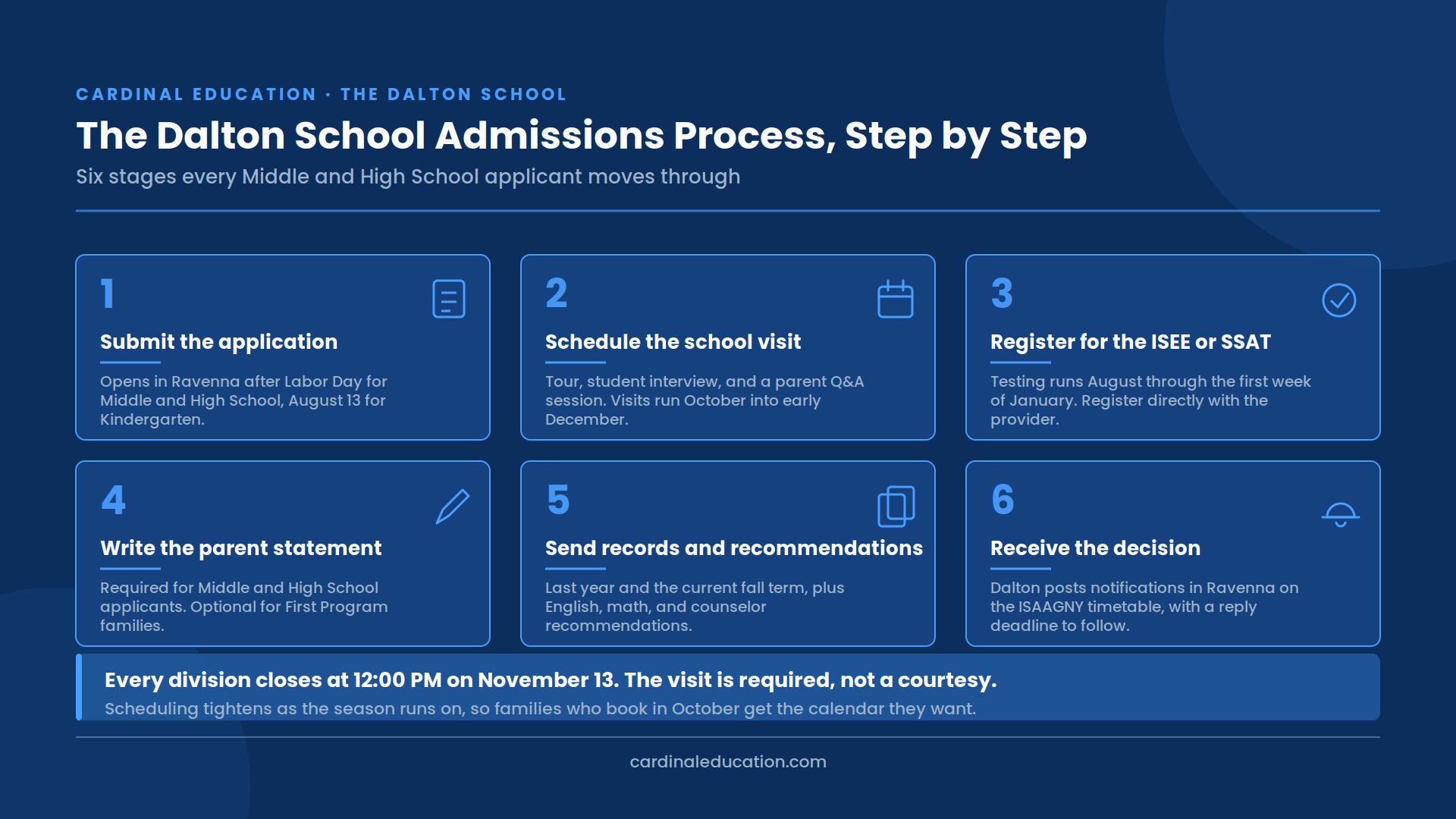
- Submit the preliminary application. Available in Ravenna after Labor Day for Middle and High School, and from August 13 at 12:00 PM for Kindergarten. Everything closes at 12:00 PM on November 13.
- Schedule and attend the school visit. A tour, a 20 to 30 minute student interview, and a parent information or Q&A session. Visits run October into early December and are required.
- Register for and sit the ISEE or SSAT. Testing happens between August and the first week of January, booked directly with the testing provider. Score reports go to Dalton from the provider.
- Write and submit the parent statement. Required for Middle and High School applicants, submitted on a Ravenna form. Optional for First Program families.
- Submit transcripts and recommendations. Report cards for last year and the current fall term, plus recommendations from an English or language arts teacher, a mathematics teacher, and a guidance counselor or school administrator.
- Receive the decision. Dalton posts notifications in Ravenna on the ISAAGNY timetable, with the family reply due at 12:00 PM one week later.
Dalton School Admissions Calendar and Key Dates
Dalton follows the ISAAGNY timetable, the shared notification and reply calendar used across greater New York independent schools. Every deadline below falls at midday.
| Event | Date | Notes |
| Kindergarten application opens | August 13, 12:00 PM | Available in Ravenna |
| Middle and High School applications open | After Labor Day | Available in Ravenna |
| Fall open houses | Fall, dates posted in Ravenna | Offered for all three divisions. Registration required. |
| ISEE and SSAT testing window | August through the first week of January | Registered directly with the testing provider |
| School visits, tours, and interviews | October through early December | Required for all applicants. Slots grow scarce late in the season. |
| Early Notification opt-in, 9th grade | November 6, 12:00 PM | Siblings, children of Dalton graduates, and children of faculty or staff |
| Application deadline, all divisions | November 13, 12:00 PM | The preliminary application closes |
| Early Notification requirements complete | November 30 | School records, teacher recommendations, and the on-site interview |
| Early Notification test results received | December 4 | ISEE or SSAT results in hand at Dalton |
| Summer birthday decision deadline, Kindergarten | May 31 | For children born in June, July, or August choosing between entry at five or six |
| Kindergarten notifications | February, per ISAAGNY | Posted in Ravenna |
| Middle and High School notifications | Per the ISAAGNY timetable | Posted in Ravenna |
| Family reply deadline | 12:00 PM, one week after notification | Per the ISAAGNY timetable |
Dalton School Application Requirements
What your family submits depends on which division you are applying to. The table below sets the three paths side by side.
| Requirement | First Program (K–3) | Middle School (4–8) | High School (9–12) |
| Preliminary application in Ravenna | Required, opens August 13 | Required, opens after Labor Day | Required, opens after Labor Day |
| Deadline | November 13, 12:00 PM | November 13, 12:00 PM | November 13, 12:00 PM |
| Student interview | Not applicable | Required, 20 to 30 minutes | Required, 20 to 30 minutes |
| Child assessment | Required, 1 hour 15 minutes | Not applicable | Not applicable |
| Parent tour | Required, runs concurrently | Required, part of the visit | Required, part of the visit |
| Parent meeting | Required, about 30 minutes, separate day | Information and Q&A session | Optional small-group Q&A on Zoom |
| ISEE or SSAT | Not required | Required | Required |
| Parent statement | Optional | Required | Required |
| Transcripts | Not applicable | Last year and current fall term | Last year and current fall term |
| Teacher recommendations | ISAAGNY Confidential School Report | English and mathematics teachers | English and mathematics teachers |
| Counselor recommendation | Included in the school report | Required | Required |
| Early Notification available | No | No | Yes, for qualifying community applicants |
The Student Interview
The interview lasts 20 to 30 minutes with a member of the Admissions staff, a faculty member, or an administrator. Middle School visits run roughly 60 to 75 minutes in total. High School visits run about 90 minutes and add a group meet-and-greet with the Head of Middle and High School Admissions before the interview itself. Dalton offers in-person and virtual interview options. The interviewer is trying to find out whether your child can sustain a real exchange about something they care about. Rehearsed answers actively hurt here. Our interview preparation builds fluency and confidence rather than scripts, because a trained ear detects a script in about ninety seconds.
Admissions Testing
Every Middle and High School applicant submits recent results from either the ISEE or the SSAT. Testing should fall between August and the first week of January, and registration happens directly with the testing provider rather than through Dalton. Preferred dates and locations fill early. Dalton states no preference between the two exams, which puts the choice squarely on your child’s profile: the tests differ meaningfully in pacing, question structure, and scoring. We break down that decision in our comparison of the SSAT and the ISEE.
The Parent Statement
Required of Middle and High School applicants and submitted through a Ravenna form. This is the one document where an adult who knows your child intimately gets to explain who they are beyond a transcript. Dalton asks parents in the interview to share hopes for their child’s educational journey, and the statement works best when it does the same: specific, honest, and about the child rather than the family. Our parent statement guidance covers the common failure modes, most of which involve writing a resume when a portrait was requested.
Transcripts and Recommendations
Dalton asks for report cards or transcripts covering the previous school year and the current fall term. Three recommendations are required: one from an English or language arts teacher, one from a mathematics teacher, and one from a guidance counselor or school administrator such as a principal, division head, or placement counselor. Teachers must have taught the student within the last year. Forms are supplied in Ravenna. Optional supplementary submissions include additional teacher or extracurricular recommendations and work samples. Note that Dalton states plainly that personal letters of recommendation are not part of its process.
The First Program Assessment
Kindergarten applicants must turn five by September 1 of the entry year. Children born in June, July, or August may enter at five or six, and Dalton adheres strictly to a May 31 deadline for that decision. The assessment lasts an hour and fifteen minutes in a child-centered room, combining group activities, one-to-one work with teacher interviewers, and free exploration with blocks, Legos, Magna-Tiles, and puzzles. Parents tour concurrently and return on a separate day for a 30 minute interview. Families who toured in the spring do not tour again. In place of teacher recommendation forms, Dalton requests the ISAAGNY Confidential School Report, usually completed by a teacher or nursery school director.
This Is the Point Where Most Families Guess
Whether Dalton suits your child is a judgment call, and it is the one that determines everything else about your year. We make that call with you, honestly, before the application work begins.
Speak with an Admissions Expert
Questions About the Dalton Plan and Daily Life
Does the Dalton Plan mean less structure?
No. Dalton addresses this head on, saying that progressive does not mean permissive. The curriculum is rigorous and interdisciplinary, and the Assignment sets clear expectations for every unit. What students control is method and sequencing within that frame, not whether the work happens.
Is Dalton competitive among students?
The school argues that its emphasis on community and inclusion produces collaboration rather than rivalry, and that supporting each other’s different pursuits is a hallmark of the student body. That is the school’s own characterization. What is structurally true is that House places a student in a mixed-grade group every single day, which makes it difficult to treat classmates as an abstract ranking.
Do students really design their own projects?
Yes, and the examples Dalton cites are unusually concrete. First graders analyzing what the wardrobes in the Little House on the Prairie books reveal about gender roles. Fourth graders adapting a novel into a play and performing it. An eighth grader studying air quality differences across New York neighborhoods against government resource allocation. Two High School students building an anatomically correct model of a human brain. In the High School this is formalized through independent study for credit, the Dalton Science Research Program, Global Online Academy, Senior Project, Senior Initiative, and Capstone projects.
Student Life at Dalton School
Academics
Dalton teaches English and language arts, history and social studies, mathematics, science, world and classical languages, computer science and engineering, music, theater, dance, visual arts, physical education, and library and museum studies, with chess taught as a subject in its own right. High School students can take courses through Global Online Academy. The library system spans a First Program library, a Middle School library, a High School library, the Museum Program, and the Archives. Engineering and computer science run more than 20 electives, and 15 robotics teams compete out of the program.
Activities
More than 75 clubs operate in the High School and more than 50 in the Middle School, with another 70 or more after-school enrichment programs for K through 6. Clubs are led by up to three students and advised by a faculty member, and Student Government oversees the whole apparatus. Students are encouraged to found new ones under a process laid out in the student handbook. Specific groups include The Daltonian, the school newspaper, and Blue Flag, the literary magazine, alongside five student publications in total. The affinity groups are Women of Color, the Asian Cultures Club, the Jewish Cultures Club, Spectrum, and HOLA, the Hispanic Organization for Latino Awareness. Chess is a genuine institution here, with more than 140 students from Kindergarten through 12th grade competing in tournaments.
Athletics
Dalton fields 21 sports across 51 interscholastic teams for grades 7 through 12, competing as the Tigers in the Ivy Preparatory School League. Fall brings cross country, football, soccer, tennis, and volleyball. Winter brings basketball, indoor track, squash, swimming, and wrestling. Spring brings baseball, golf, lacrosse, softball, tennis, track and field, and volleyball. The 32,000 square foot Physical Education Center at 200 East 87th Street holds two gymnasiums, one seating five hundred, a wrestling and aerobics room, a weight and fitness center, a sports medicine office, and locker facilities. Lucy Schell, class of 2026, was recently named a USA Lacrosse All-American.
Arts
The arts are not an add-on at Dalton, and the school traces that directly to Parkhurst, who held that the arts belonged inside the academic disciplines rather than beside them. Fifty arts electives run across visual arts, dance, theater arts, and music, and the school stages 28 main stage productions a year. Students write for Blue Flag and read publicly. Dalton is widely known for the depth of its arts offerings from Kindergarten through the High School.
Beyond the Classroom
Dalton Global Initiatives has run nine global trips in the past two years, and students take more than 300 field trips annually. Service Learning and an internships program operate alongside Health and Wellness programming. The school also runs summer programming, and long-standing traditions include a candle lighting before winter break and a Greek Festival.
Notable Dalton School Alumni
Dalton’s alumni list is unusually broad, running through government, film, letters, food, and competitive chess. A selection of independently documented names appears below, and our companion article covers the full sweep.
- Antony Blinken served as United States Secretary of State.
- Anderson Cooper is a journalist and news anchor.
- Helen Frankenthaler was a painter central to postwar American abstraction.
- Claire Danes is an actress of film and television.
- Shaun Donovan served as United States Secretary of Housing and Urban Development and as Director of the Office of Management and Budget.
- Wallace Shawn is an actor and playwright.
- Montgomery Clift was a film actor of the postwar era.
- Samuel R. Delany is a novelist and critic.
- Christian Slater is a film and television actor.
- Eric Schlosser is an investigative journalist and author.
- Dan Barber is a chef and writer on food systems.
- Josh Waitzkin is a chess player and author.
- Maxim Dlugy is a chess grandmaster.
- Ronnie Abrams is a United States District Judge for the Southern District of New York.
- Andrew Zimmern is a chef and television host.
- Tracy Pollan is an actress.
Read the full profiles in Famous Dalton School Alumni and What They Reveal About Dalton School Admissions.
A Final Word on Fit
Dalton hands a child the wheel earlier than most schools do, and that is either the making of a student or a slow unraveling. The children who flourish are the ones who book a Lab because an argument is unfinished in their head. Deciding which kind of child you have is not a job for an application season, and it is the work we care most about. Our broader approach to private school admissions consulting starts there, and families weighing several schools at once can begin with our New York admissions overview.
Get an Honest Read on Dalton
We will tell you what we actually think, including when the answer is that another school fits your child better. That candor is the whole value.
Related Articles:
The Dalton Plan Explained: What House, Assignment, and Lab Mean for Dalton School Admissions
Famous Dalton School Alumni and What They Reveal About Dalton School Admissions