
Cardinal Education is an independent educational consulting company. We are not affiliated, associated, authorized, endorsed by, or in any way officially connected with any public or private school.
Everything families need to know about applying to this Watertown, Connecticut, boarding and day school.
Quick Answer for Busy Parents
The Taft School is a coeducational, college-preparatory boarding and day school in Watertown, Connecticut, for grades 9–12 and postgraduates. Enrolling 600 students with a 5:1 ratio, Taft requires SSAT or ISEE scores for grades 9–10 and allows SAT or ACT for older students. Applications are due January 15, with decisions by March 10. The school is renowned for its Portrait of a Learner framework, strict Honor Code, and the Global Leadership and Service Collaborative.
Why Do Families Choose The Taft School?
Horace Dutton Taft, brother of President William Howard Taft, founded the school in 1890 as Mr. Taft’s School, initially in Pelham Manor, New York, before relocating to Watertown, Connecticut, in 1893. Inspired by his friend Sherman Day Thacher (founder of California’s Thacher School), Taft built a school around educating the whole student: academic, artistic, and athletic talents, alongside a deep commitment to service, captured in the school’s motto, Non ut sibi ministretur sed ut ministret (“Not to be served but to serve”).
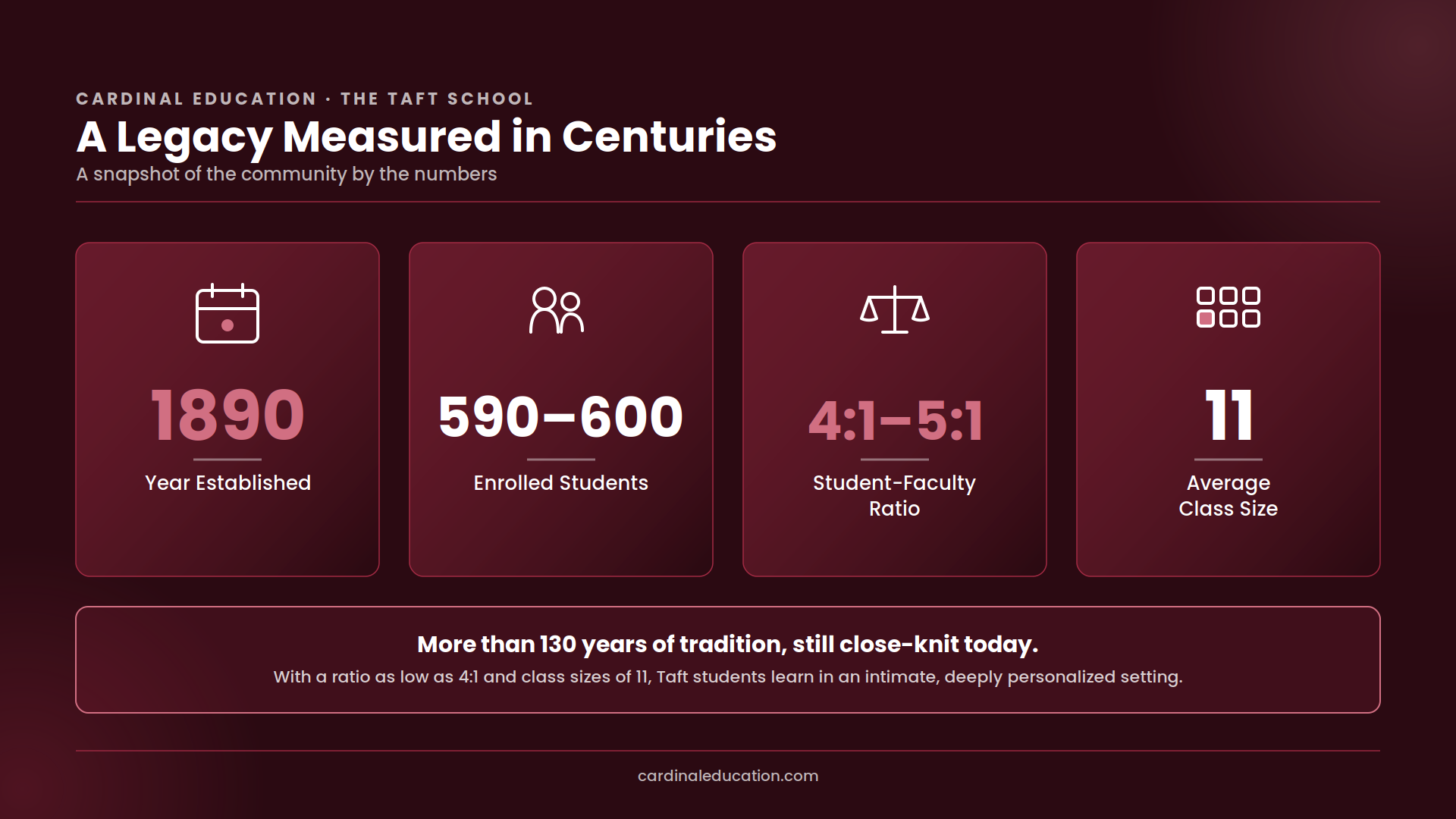
Families are drawn to Taft’s Portrait of a Learner framework, its 200-plus course catalog, and a campus that rivals many small colleges, including a 55,000-volume library and a 45,000-square-foot science and mathematics building. Taft students may also study away from campus for a semester or two, propose an independent course of study, or enroll in Global Online Academy classes.
Did You Know? Every Taft assessment, from daily homework to final exams, ends with the student’s written Honor Code pledge: “I have neither given nor received aid on this paper.”
How Hard Is It to Get Into The Taft School?
Taft does not publish an official acceptance rate; third-party estimates place it between roughly 12% and 19% among the more selective boarding schools nationally. The median SSAT score for accepted students in a recent cycle was the 87th percentile, though Taft is explicit that character and personal growth are an integral part of a Taft education and that grades and test scores don’t tell the whole story.
Top Tips for a Competitive Application
- Register for the SSAT or ISEE early, since fall and winter test dates fill up.
- Schedule an on-campus interview and tour if at all possible, since it’s strongly preferred.
- Submit every required document well before the January 15 deadline, since incomplete applications are not considered.
Best Practices for Families
- International applicants should plan for the TOEFL, IELTS, or Duolingo English Test alongside standard admissions testing.
- Highlight character and personal growth in essays, not just academic achievement.
- Ask directly about the Academic Support Program if your child has a mild learning difference.
What Is The Taft School’s Admission Process?
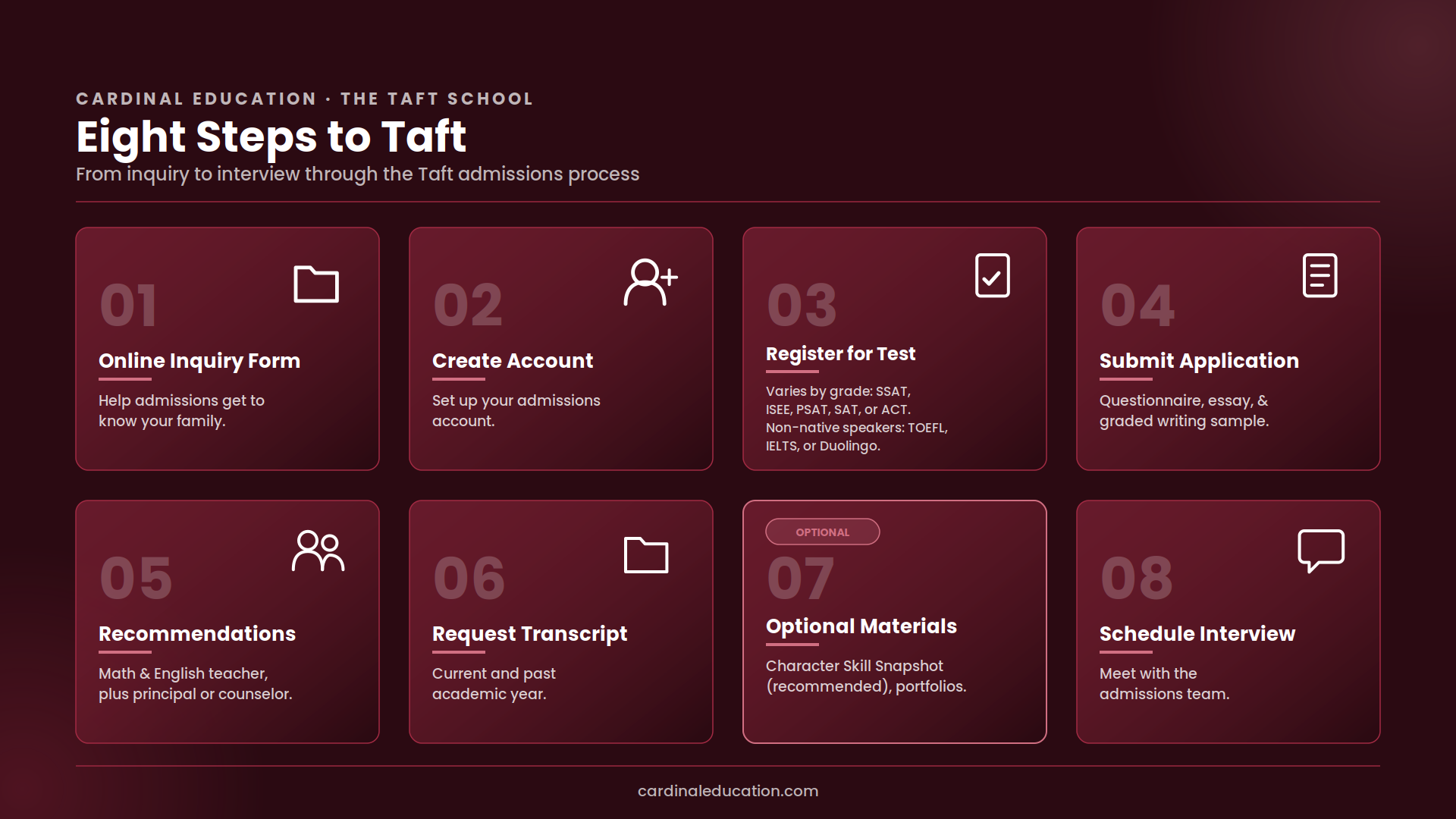
The first step to The Taft School’s admissions process is completing an online inquiry form. This will help admissions get to know your family and stay connected to the admissions team.
- Complete online inquiry form.
- Create admissions account.
- Register for standardized test.
- 9th – 10th Grade: SSAT or ISEE
- 11th Grade: SSAT, PSAT, SAT, or ACT
- 12th Grade & PG: PSAT, SAT, or ACT
- Non-Native Speakers: TOEFL, IELTS, or Duolingo English Test
- Complete online application.
- Parent Guardian Questionnaire
- Candidate Essay
- Graded Writing Sample
- Delegate recommendations.
- Current math & English teacher
- School principal or counselor
- Request transcript.
- Current & past year
- Submit optional materials.
- Character Skills Snapshot (Recommended)
- Portfolios
- Schedule interview.
Note: Applicants may complete their application using either the Gateway to Prep Schools or the Standard Application Online (SAO).
What Are The Taft School’s Application Requirements?
Candidate Essay
The candidate essay provides the admissions committee with a direct sense of your voice. Use this to share unique interests and your approach to problem-solving, offering insight into how you will contribute to the Taft community.
How to write an effective candidate essay: Focus on highlighting a particular moment of discovery rather than summarizing an entire list of extracurriculars. Specific, narrow examples make a stronger impression. Learn how to develop an authentic writing voice that helps your statement stand out.
Parent Statement
The parent statement allows you to advocate for your child by highlighting their character and personal growth, providing the admissions committee with essential context on how your family’s values align with the Taft community.
How to write a compelling parent statement: Share anecdotes that demonstrate your child’s maturity and values rather than repeating their resume. Keep your tone authentic and collaborative. Learn how to write a compelling private school parent statement.
Graded Writing Sample
The graded writing sample gives admissions an objective look at your academic writing, critical thinking, and structure in an actual classroom setting. It reveals your command of language and analytical skills beyond polished application essays.
How to develop strong writing skills: Choose a recent English or history paper with teacher feedback, a visible grade, and an analytical focus. If writing is a problem, this is where early engagement in the Program in Writing and Reading (PWR) helps students develop strong writing skills, refine their arguments, and showcase clear thesis development.
Standardized Test
Applicants for Grades 9–10 submit SSAT or ISEE scores, with no preference between the two. Grade 11 applicants may submit SSAT, PSAT, SAT, or ACT scores, while Grade 12 and postgraduate applicants submit PSAT, SAT, or ACT scores. Families should focus on test preparation that aligns with the student’s learning style, as Taft views these scores as just one part of a holistic profile.
How to support academic performance: Effective test preparation involves more than just content review; it builds a deep understanding of exam-specific question formats, pacing strategies, and underlying academic skills. Personalized coaching helps students master these exams with confidence. Learn more about private school test prep.
Transcripts
Applicants must request and upload official academic transcripts covering the prior two academic years and the current fall term directly through the Gateway or SAO portal.
How to support academic performance: If grades have been a genuine struggle, improving them before applying requires targeted, consistent support—not last-minute cramming. This is where tutoring and academic coaching help strengthen the student’s key skills months before applications are due, allowing students to demonstrate meaningful, sustained academic growth.
Recommendations
Taft explicitly requires three confidential recommendations: your child’s current math teacher, current English teacher, and the school principal or counselor. Request and submit these through Gateway or SAO by entering their contact details; the portal emails evaluation forms directly to educators and updates your dashboard upon completion.
How to get the best recommendation letter: To secure a strong recommendation letter, ensure your child builds genuine relationships with teachers and mentors. Recommenders should highlight your child’s leadership, behavior, and academic impact on the community.
Admissions Interview
The interview is a vital opportunity for the admissions committee to understand the student’s unique personality and interests, ensuring your family’s values align with the Taft community.
How to prepare for the admissions interview: Approach the interview as a natural conversation. Students should be prepared to discuss their interests, achievements, and reasons for applying to Taft. Comprehensive interview preparation helps students communicate with confidence and authenticity, making a strong impression.
Character Skills Snapshot
The Character Skills Snapshot is a tool used to understand the ‘whole child,’ measuring intangibles like resilience, initiative, and social awareness that don’t appear in grades. This online assessment also measures intellectual curiosity, teamwork, responsibility, and open-mindedness. Taft recommends completing it by January 15; please refer to the official testing portal for current fee information.
Portfolio
If your child has significant achievements in the arts, athletics, or other specialized areas, an optional portfolio allows them to showcase their talents beyond the standard application. This is an excellent way to provide context for high-level creative work or athletic accomplishments that define your child’s extracurricular engagement.
International Applicants
Non-native English speakers are strongly encouraged to submit TOEFL (105+ internet-based score), IELTS (7.5+), or Duolingo English Test (140+) results. Taft does not offer ESL courses.
Have Questions About Your Child’s Application?
Cardinal Education’s consultants help families prepare for the SSAT or ISEE and build a complete, compelling Taft application.
What Is Student Life Like at The Taft School?
Academics
Taft’s academic philosophy centers on active, seminar-style discussion and individual intellectual ownership, guided strictly by the school’s student-run Honor Code. Operating on an updated 70-minute block schedule designed to reduce daily transitions, the curriculum gives students the flexibility to pursue deep departmental inquiry or interdisciplinary study.
| Academic Program | Key Highlights |
| Graduation Requirements | 36-unit requirement: English (every term), History (4 units), Science (4 units), Foreign Language (Level III), Math (Alg II/Trig), Arts (1 term/yr) |
| Course Offerings | 200+ semester courses, including Advanced Placement, Honors, and post-AP options |
| Special Programs | Semester study away, independent research proposals, and Global Online Academy (GOA) courses |
To support this rigorous workload, students utilize peer tutoring and specialized coaching at the Moorhead Academic Center, as well as the Hulbert Taft Jr. Library’s extensive collection of over 55,000 volumes.
Arts
Creative expression at Taft is treated as a vital component of character development, encouraging students to take risks across both visual and performing disciplines. With a mandatory annual arts requirement, every student engages in studio work or stage performance, regardless of their prior experience level.
- Fine & Visual Arts: Ceramics, sculpture, drawing, painting, and photography, showcased regularly at the student-centered Mark W. Potter Gallery.
- Performing Arts: Mainstage theater productions, technical stagecraft, and dynamic studio dance ensembles.
- Music & Film: Choral groups, instrumental ensembles, student-led a cappella groups (Hydrox, Oriocos), video arts, and the campus Concert Series.
- Visiting Artists: Masterclasses and guest lectures facilitated through the endowed Rockwell Visiting Artist program.
Through constant showcase opportunities and gallery exhibitions, the arts program builds student confidence, creative discipline, and a lifelong appreciation for visual and performing culture.
Athletics
As a proud member of the Founders League and NEPSAC, Taft views physical education and team sports as essential tools for teaching leadership, resilience, and sportsmanship. Every student participates in Taft’s three-season afternoon program, choosing between interscholastic teams, intramural options, or fitness activities.
| Season | Interscholastic Sports |
| Fall | Cross Country, Field Hockey, Football, Riding (Intramural), Soccer, Volleyball |
| Winter | Basketball, Ice Hockey, Skiing, Squash, Wrestling |
| Spring | Baseball, Crew, Golf, Lacrosse, Softball, Tennis, Track & Field |
| Specialized Training | |
| On-campus Strength & Conditioning coaches, Athletic Training, and Sports Medicine | |
Whether competing for New England championships or trying a new sport at the intramural level, student-athletes develop physical literacy and strong bonds with teammates and coaches.
Clubs & Activities
Co-curricular life at Taft is overwhelmingly student-driven, offering more than 80 active clubs, identity networks, and competitive academic teams. The ecosystem adapts each year at the student activities fair, empowering students to start new initiatives or revive legacy campus groups.
- Academic Competition: Debate Club, Economics Team, Math Team, Quiz Bowl, History Club, and Model UN.
- Publications & Media: The Taft Papyrus (newspaper), Red Ink, The Global Journal, Taft Radio, and the campus yearbook.
- Cultural & Identity Groups: Mosaic, Asian Alliance, Black Alliance, SomOS Taft, Gender & Sexuality Alliance (GSA), and international affinity groups.
- Student Leadership: Senior Monitors (“Mons”), Class Committees, Day Student Council, Community Service Board, and the Global Leadership Institute (GLI).
Grounded in Horace Dutton Taft’s original founding motto, “Not to be served but to serve,” student leaders actively govern campus life, organize community service, and lead peer mentorship programs like Every Mind Matters.
Notable Alumni of The Taft School
The legacy of The Taft School is best reflected in the remarkable achievements of its graduates, who embody the school’s commitment to academic excellence, leadership, and service. Across diverse fields—including public policy, music, entertainment, literature, and national defense—Taft alumni have left an indelible mark on their communities and the world at large.
- Trey Anastasio: Lead guitarist, vocalist, and primary songwriter for the Rock and Roll Hall of Fame-inducted band Phish, Anastasio exemplifies the creative courage and musical innovation nurtured during his time at Taft.
- Peter Berg: Acclaimed director, producer, actor, and writer behind iconic works like Friday Night Lights and Lone Survivor, Berg demonstrates how Taft graduates translate storytelling and vision into impact across global media.
- Robert Taft Jr.: Former United States Senator and Representative from Ohio, Taft carried on his family’s deeply rooted tradition of public service and civic responsibility, embodying the school’s core motto, “Not to be served but to serve.”
- Jeff “Skunk” Baxter: A Grammy Award-winning guitarist for Steely Dan and The Doobie Brothers turned national defense intelligence consultant, Baxter reflects the versatility, curiosity, and non-traditional leadership fostered within the Taft community.
- Henry Beard: Co-founder of National Lampoon magazine and celebrated humorist, Beard influenced American comedy culture for generations, demonstrating the power of sharp intellectual inquiry and creative expression.
These distinguished graduates serve as a powerful inspiration to current students, illustrating that a foundation built on rigorous scholarship, strong character, and a commitment to service can lead to extraordinary success. Their accomplishments continue to define the Taft legacy, proving that students leave prepared to make a meaningful, lasting impact on the world.
With estimated acceptance rates ranging between 12% and 19% and a median SSAT score in the 87th percentile, securing admission to The Taft School is a highly competitive endeavor. Success in this environment requires more than just strong grades; it demands meticulous, strategic planning to ensure every facet of the application stands out to the admissions committee.
At Cardinal Education, our expert consultants specialize in helping families navigate these complexities with ease. We manage every detail of the process—from developing tailored testing strategies for different grade levels to optimizing each application component and platform choice. Our approach ensures that your child’s unique character and personal growth are highlighted alongside their academic achievements, creating a compelling and authentic narrative for Taft’s admissions team.
Related Articles:
Inside Taft’s Global Leadership and Service Collaborative
Portrait of a Learner: Taft’s Academic Framework and Honor Code
Frequently Asked Questions
Does Taft have a religious affiliation?
Does Taft require standardized testing?
What is the Taft acceptance rate?
What is The Taft School known for?
How big is the Asian American population at Taft?
Taft gave our son a rigorous academic foundation and a genuine sense of community, from the Honor Code to the playing fields. Cardinal Education helped us navigate the SSAT and the interview process with real confidence.
— Taft Parent