
Cardinal Education is an independent educational consulting company. We are not affiliated, associated, authorized, endorsed by, or in any way officially connected with any public or private school.
Everything Silicon Valley families need to know about applying to this Menlo Park K–8 school.
Quick Answer for Busy Parents
Founded in 2008, Synapse School is an independent Menlo Park TK–8 school serving 250–320 students with a 4:1 to 5:1 student-teacher ratio. Its curriculum centers on academics, social-emotional learning, and innovation. No standardized testing is required. Families must attend a mandatory information session before applying, typically by early January. Known for its Brainwave Learning Center partnership with Stanford University, Synapse provides a holistic, research-backed education.
Why Do Families Choose Synapse School?
Synapse opened in 2008 with just 8 students, founded by Bay Area educational pioneers Karen McCown, who also founded The Nueva School, and Dr. Anabel Jensen, president of Six Seconds. Families are drawn to the school’s HEARTS curriculum framework, which fully integrates project-based, brain-based academics with social-emotional learning, and to genuinely rare programs like the Brainwave Learning Center, a first-of-its-kind partnership with Stanford’s Graduate School of Education, and an 11,000-square-foot Makerspace.
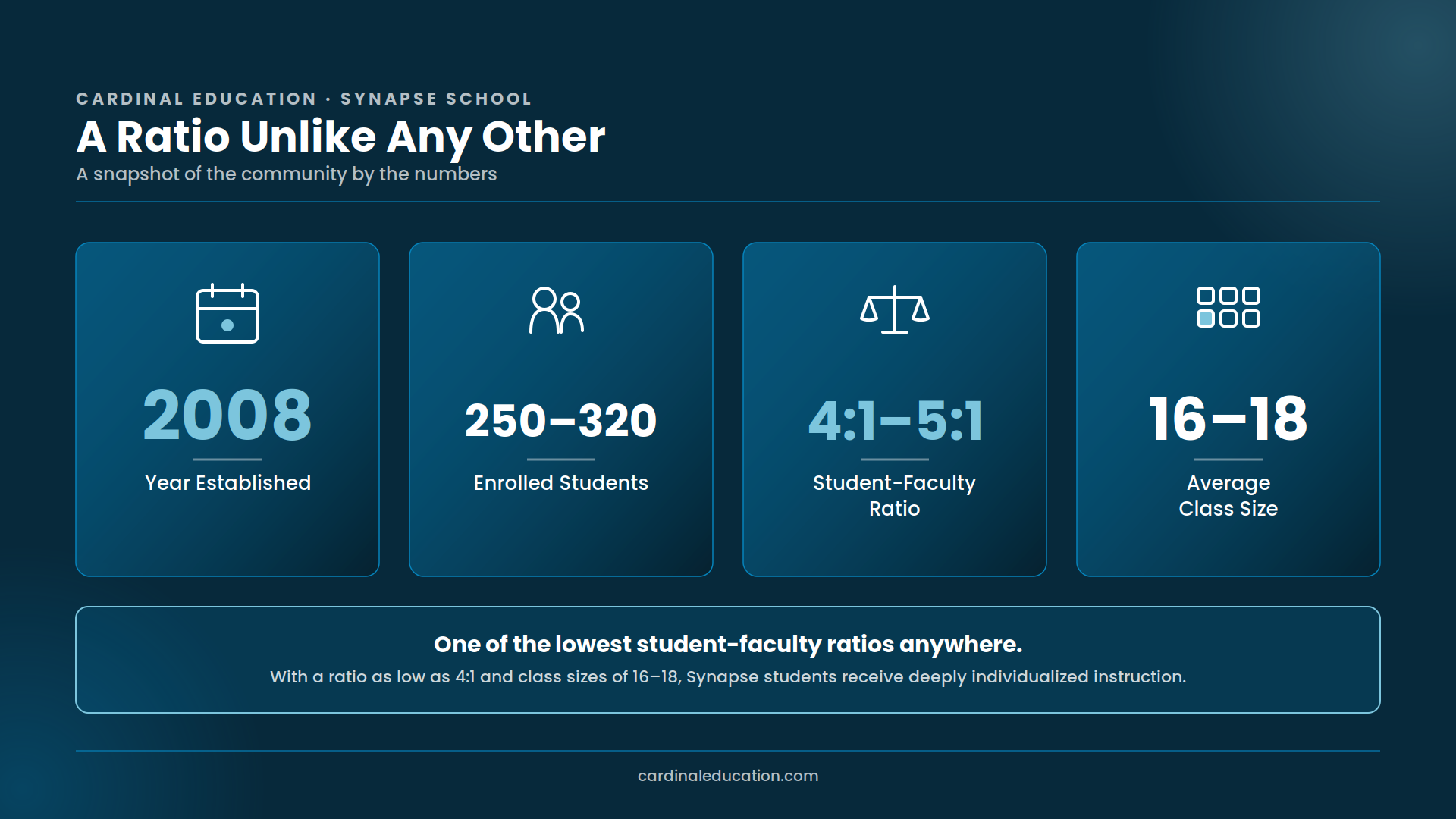
Synapse describes its location, minutes from Stanford University and surrounded by major technology companies, as central to its identity as an innovation-focused school. Every Synapse Lower School student has two full-time classroom teachers plus specialists, and every teacher and staff member is trained in social-emotional learning.
Did You Know? Synapse’s Brainwave Learning Center received a 2022 award from the International Mind, Brain, and Education Society (IMBES), selected among educators, institutions, and programs worldwide.
How Hard Is It to Get Into Synapse School?
Synapse does not publish an official acceptance rate. Because the school does not require a specific standardized test, admission is based on a holistic combination of parent and student questionnaires, a required interview (which the school treats as highly important), and the Student Experience Day.
Top Tips for a Strong Application
- Attend the required information session as early as possible, since it’s a mandatory first step.
- Apply well before the January deadline, since second-pool space depends entirely on availability after March decisions.
- Sibling families should note the earlier November deadline.
Best Practices for Elite Families
- Complete the parent and student questionnaires thoughtfully, given the interview’s high importance.
- Ask specifically about the Brainwave Learning Center and Engineering & Design Center during a visit.
- Request recommendations from current math and English teachers as soon as the portals open.
What Is Synapse School’s Admission Process?
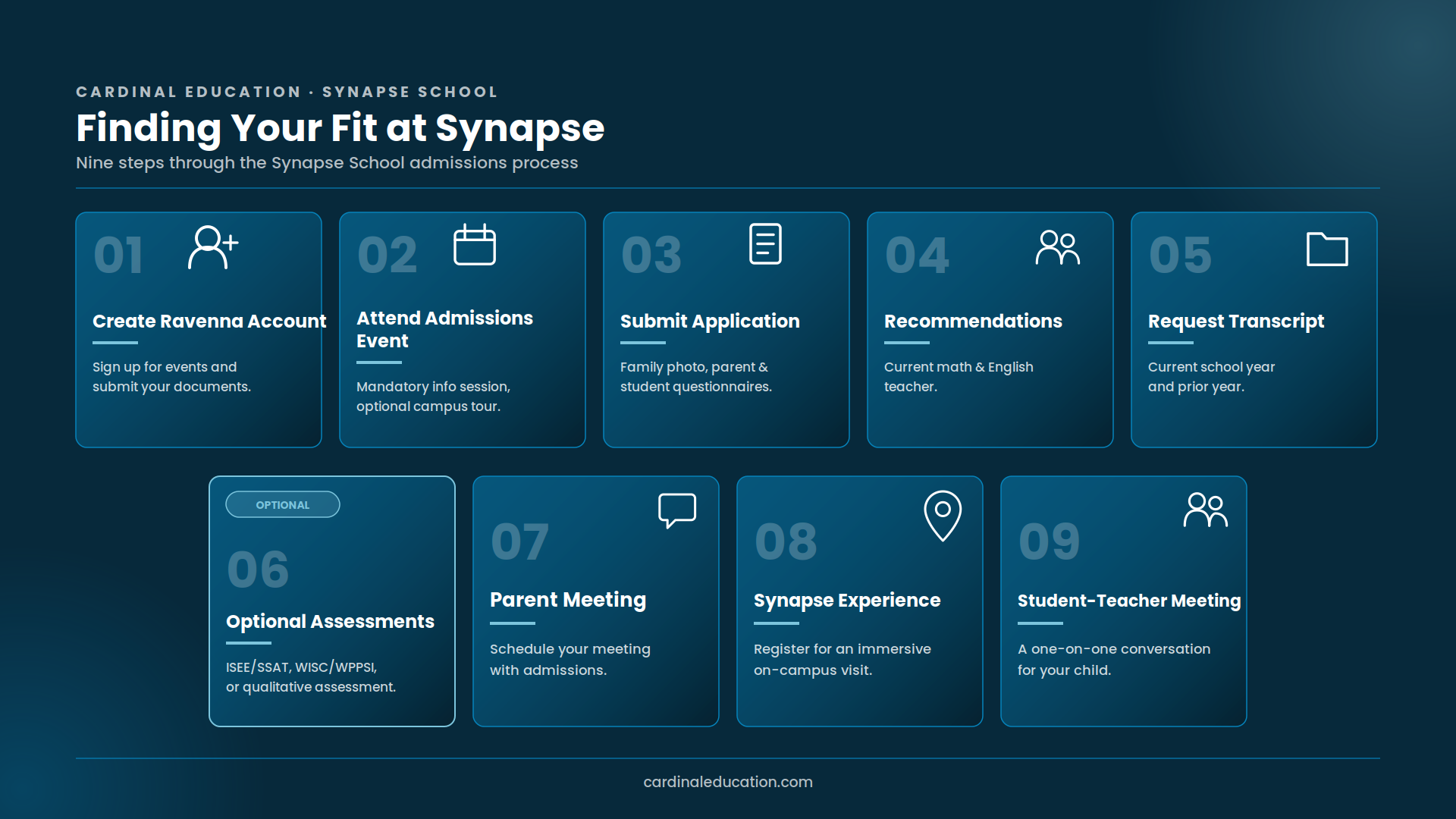
Creating an account in Ravenna is the first step in Synapse School’s admission process. There, you will be able to sign up for events and submit the required documents for your application.
- Create Ravenna account.
- Attend admissions event.
- Information Session (mandatory)
- Campus Tours (optional)
- Submit online application.
- Family Photo
- Parent Questionnaire
- Student Questionnaire
- Delegate recommendations.
- Current math & English teacher
- Request transcript.
- Current school year & prior year
- Submit optional assessments.
- ISEE or SSAT
- WISC or WPPSI
- Qualitative Assessment
- Schedule parent/guardian meeting.
- Register for Synapse Experience.
- Attend one-on-one student-teacher meeting.
What Are Synapse School’s Application Requirements?
Student Questionnaire
The student questionnaire provides the admissions committee with a direct sense of your child’s voice, offering insight into how they will contribute to the Synapse community.
How to write an effective student questionnaire: Focus on highlighting a particular moment of discovery rather than summarizing an entire list of extracurriculars. Specific, narrow examples make a stronger impression. Learn how to develop an authentic writing voice that helps your statement stand out.
Parent Questionnaire
The parent questionnaire allows you to advocate for your child by highlighting their character and personal growth, providing the admissions committee with essential context on how your family’s values align with Synapse’s mission of cultivating a project-based, innovation-focused, and emotionally intelligent learning environment.
How to write a compelling parent questionnaire: Share anecdotes that demonstrate your child’s maturity and values rather than repeating their resume. Keep your tone authentic and collaborative. Learn how to write a compelling private school parent questionnaire.
Recommendations
Request and submit confidential recommendations through Ravenna by entering contact details for your child’s current math and English teachers (a principal, counselor, or advisor is optional). The portal emails evaluation forms directly to educators and updates your dashboard upon completion.
How to get the best recommendation letter: To secure a strong recommendation letter, ensure your child builds genuine relationships with teachers and mentors. Recommenders should highlight your child’s leadership, behavior, and academic impact on the community.
Transcripts
Applicants must request and upload official academic transcripts covering the prior two academic years and the current fall term directly through the Ravenna portal.
How to support academic performance: If grades have been a genuine struggle, improving them before applying requires targeted, consistent support—not last-minute cramming. This is where tutoring and academic coaching help strengthen the student’s key skills months before applications are due, allowing students to demonstrate meaningful, sustained academic growth.
Admissions Interview
The interview is a vital opportunity for the admissions committee to understand the student’s unique personality and interests, ensuring your family’s values align with the Synapse community.
How to prepare for the admissions interview: Approach the interview as a natural conversation. Students should be prepared to discuss their interests, achievements, and reasons for applying to Synapse School. Comprehensive interview preparation helps students communicate with confidence and authenticity, making a strong impression.
Testing Policy
Synapse does not require standardized testing. Applicants may optionally submit any academic assessment, including WISC, WPPSI, ISEE, or SSAT scores, as supplemental material.
Student Experience Day
Applicants to Grades 1–8 experience Synapse’s program directly with current teachers, including a tour and, for Grades 5–8, an introduction to athletics, clubs, electives, and the Brainwave Learning Center’s research assistant program.
Have Questions About Your Child’s Application?
Cardinal Education’s consultants help families navigate Synapse’s Information Session, questionnaires, and Student Experience Day.
What Is Student Life Like at Synapse School?
Student life at Synapse School is defined by an innovative, project-based learning model where cutting-edge academics, emotional intelligence, and real-world problem-solving intersect. Students are encouraged to take creative risks, engage directly with cognitive research, and build meaningful community connections.
Academics
Synapse’s TK–8 constructivist academic framework inspires a lifelong love of learning by prioritizing active inquiry, brain-based research, and real-world project outcomes over rote memorization.
| Division | Core Focus | Key Learning Highlights |
| Lower School (TK–4) | Literacy, quantitative reasoning, SEL, & outdoor discovery | Project-based learning with weekly Nature Days via The Riekes Center |
| Middle School (5–8) | STEAM, departmentalized subjects, & personal agency | Class rotations in STEAM & Humanities; culminate in the 8th Grade Exit Ticket |
By bridging theoretical knowledge with practical application, Synapse ensures that students leave each grade level not just with academic mastery, but with the confidence to tackle complex, real-world questions.
Social-Emotional Learning
SEL serves as the foundational pillar of the Synapse experience. Embedded explicitly across every grade, the curriculum utilizes the Six Seconds EQ Model to equip students with core self-regulation and interpersonal skills.
| Component | Approach & Highlights |
| Core EQ Framework | Focuses on three goals: Know Yourself, Choose Yourself, and Give Yourself |
| Explicit Instruction | Features Self-Science (TK–4) and EQ Seminars (5–8) for daily SEL practice |
| Advisories & Community | Weekly Middle School advisories, student assemblies, and annual Change Maker projects |
Ultimately, this consistent focus on emotional intelligence empowers students to navigate the complexities of social dynamics with empathy, resilience, and a deep understanding of themselves and others.
Innovation & Engineering
Synapse’s innovation ecosystem bridges hands-on design with scientific research through a multi-faceted approach:
- Brainwave Learning Center (BLC): A pioneering research-practice partnership with Stanford University featuring an on-site electroencephalography (EEG) lab. Students participate alongside researchers to study how brain activity transforms during reading and math acquisition.
- Synapse Makerspace: Integrated fabrication facilities where TK–8 students combine physical craftsmanship with digital tools—utilizing rapid prototyping, coding, robotics, and design thinking to address real-world community challenges.
Together, these resources cultivate a mindset of iterative problem-solving and technical agility, preparing students to be the inventors and critical thinkers of tomorrow.
Athletics
Grounded in physical wellness and social-emotional growth, Synapse Athletics operates on an inclusive, no-cut philosophy. To maximize flexibility in family schedules, practices take place during the school day as part of the integrated physical education schedule.
| Level | Season | Focus/Program | Sports Offered |
| Lower School | Year-Round | Physical Literacy & Movement | Daily movement sessions and Physical Education blocks centered on foundational coordination, athletic skill building, and teamwork |
| Middle School | Fall | Interscholastic Competition (Small Schools Intermediate League) | Girls Volleyball, Cross Country, Flag Football, Soccer |
| Middle School | Winter | Interscholastic Competition | Boys Basketball, Girls Basketball |
| Middle School | Spring | Interscholastic Competition | Track & Field, Volleyball, Soccer |
By emphasizing participation and teamwork over competition, the athletics program ensures every student develops healthy habits and positive relationships that support their overall well-being and growth.
Expert Admissions Consulting for Competitive Synapse School Applications
Synapse’s highly selective admissions process is holistic rather than test-driven, placing significant weight on the Information Session, detailed questionnaires, and the Student Experience Day. Because every interaction is a critical opportunity to demonstrate fit, families need a strategic edge.
At Cardinal Education, our consultants provide expert admissions guidance to navigate these hurdles, helping you craft compelling narratives and present a genuine, standout connection with Synapse’s core academic, social-emotional, and innovative pillars.
Related Articles:
Brainwave Learning Center: How Synapse School Partners With Stanford
How Synapse Teaches Social-Emotional Learning Through Its EQ Model
Frequently Asked Questions
Does Synapse have a religious affiliation?
Does Synapse require standardized testing?
What is the Synapse acceptance rate?
What is Synapse School known for?
What is the HEARTS curriculum framework?
Synapse gave our daughter a genuine love of learning and the emotional vocabulary to navigate real challenges. Cardinal Education helped us understand exactly what the Information Session and Student Experience Day were looking for.
— Synapse Parent