
Cardinal Education is an independent educational consulting company. We are not affiliated, associated, authorized, endorsed by, or in any way officially connected with any public or private school.
Everything Dallas families need to know about applying to Grades 6–12 at this Episcopal day school.
Quick Answer for Busy Parents
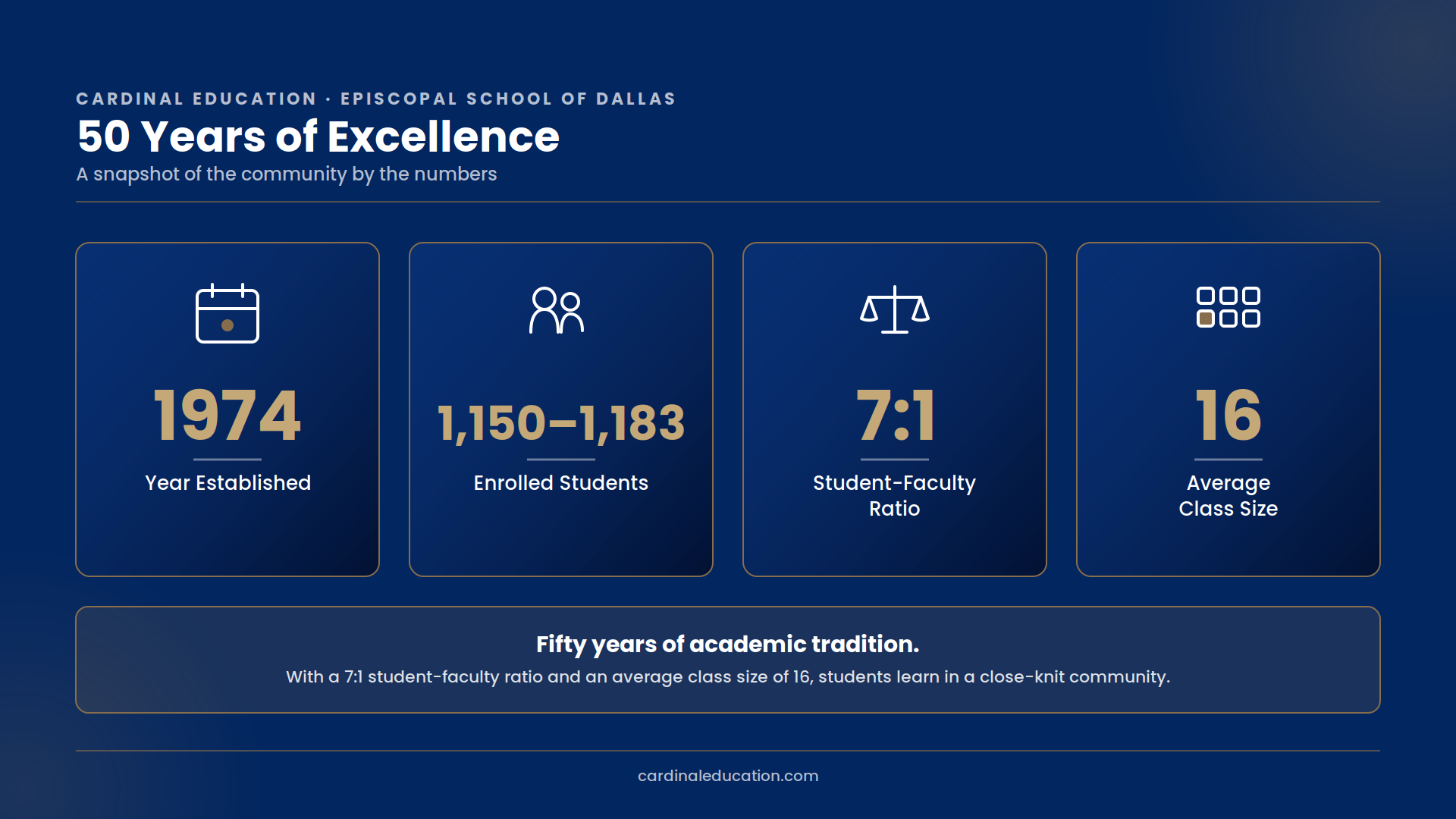
The Episcopal School of Dallas (ESD) is a faith-centered, college-preparatory day school enrolling roughly 1,150–1,183 students in PK–12 across its 39-acre campus. Known for its 300-acre outdoor education facility, Wolf Run Ranch, and a completely student-run Honor Council, ESD requires standardized testing (ISEE, PSAT, or PACT) but discourages formal test preparation. Applications for the 2027–28 academic year open September 2, 2026, with admission decisions released in mid-March.
Why Do Families Choose The Episcopal School of Dallas?
On the first day of school in 1974, the Reverend Canon Stephen B. Swann and a faculty of two gathered their eleven students around a campfire to establish the founding principles of what would become The Episcopal School of Dallas. Guided by its motto, Religio, Disciplina, Eruditio (Faith, Discipline, Sound Learning), ESD pairs rigorous college-preparatory academics with daily worship, service learning, leadership and character development, and outdoor education.
Families choose The Episcopal School of Dallas because it offers a holistic education that balances intellectual rigor with deep moral and spiritual grounding. Through daily worship, hands-on service learning, and immersive outdoor experiences, ESD fosters an inclusive, supportive community where students develop strong character, resilience, and ethical leadership skills alongside academic excellence.
By nurturing each student’s individual purpose and passion, ESD prepares graduates not only to succeed at top colleges and universities but also to lead lives of meaning, integrity, and service to others.
Did You Know? ESD’s main Dallas campus includes a working quarry for fishing and canoeing, alongside vegetable gardens and aquaponics, in addition to its 300-acre Wolf Run Ranch outdoor education facility near Anna, Texas.
How Competitive Is Admission to The Episcopal School of Dallas?
ESD does not publish an official acceptance rate. The admission committee reviews applications to build an overall picture of each child and family rather than optimizing for a single metric.
Given ESD’s reputation as one of the premier independent schools in the Dallas–Fort Worth metroplex, competition for open spots remains extraordinarily fierce across every grade level. With demand far exceeding available seats, particularly at key entry points like kindergarten, grade 5, and grade 9, standing out requires more than strong academic records. Families must present a cohesive, deeply authentic application that highlights candidate alignment with ESD’s core values.
Top Tips for a Strong Application
- Apply as soon as the window opens in September, and track the specific deadline for your child’s grade.
- Register for the ISEE (Grades 5–8) or PSAT or PACT (Grades 9–11) with enough lead time for results to arrive on schedule.
- Complete every division-specific requirement, including the writing sample for Grades 9–11.
Best Practices for Prospective Families
- Treat the application as an opportunity to give the admission committee a genuine, rounded picture of your child.
- Ask directly about Wolf Run Ranch and the student-run Honor Council during a visit.
- Confirm current division-specific deadlines directly with ESD’s admission office, since they vary by grade.
What Is Episcopal School of Dallas’ Admission Process?
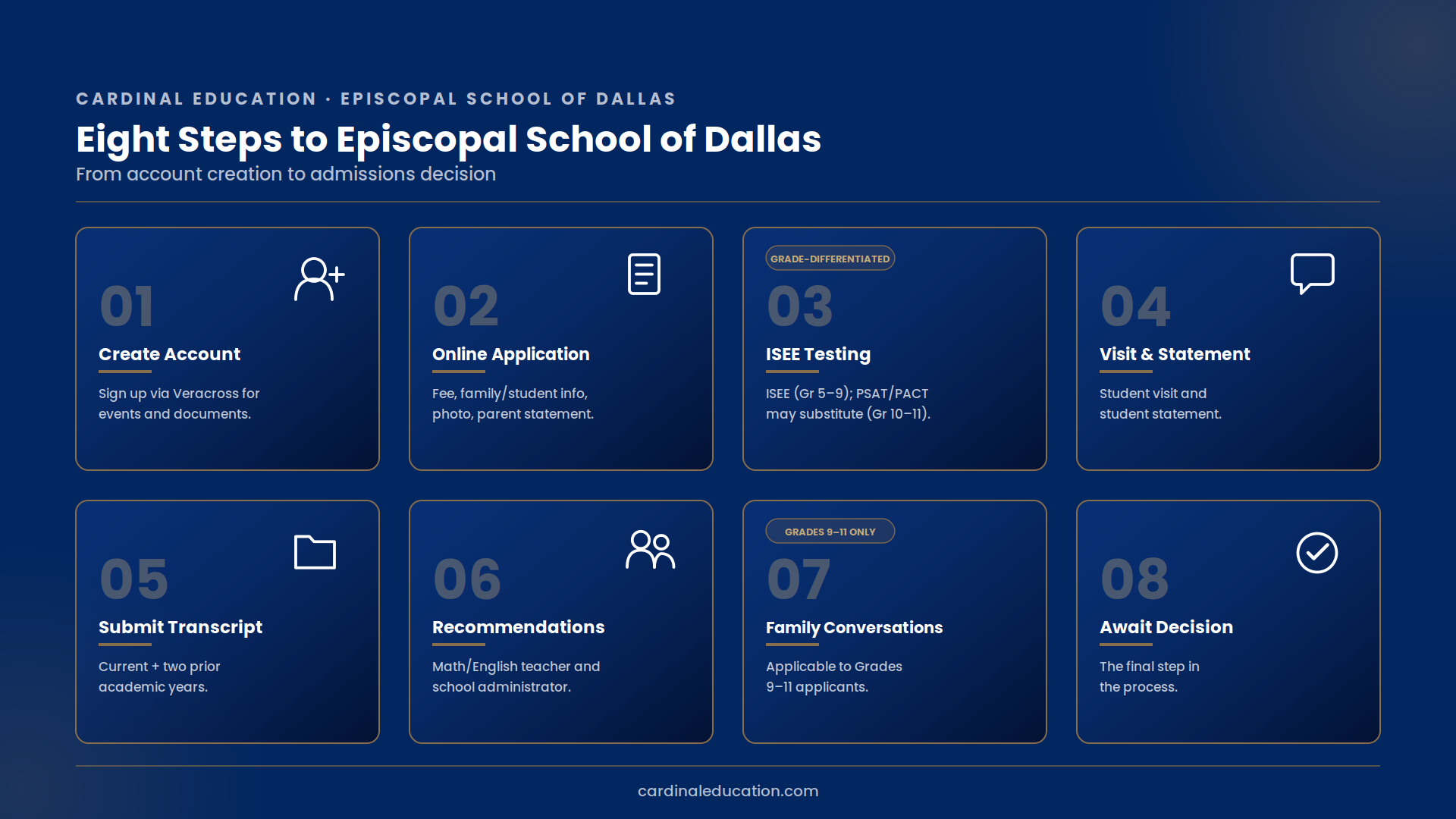
Creating an account in Veracross is the first step in The Episcopal School of Dallas’s admissions process. There, you will be able to sign up for events and submit the required documents for your application.
- Create an account in Veracross.
- Complete the online application.
- Application Fee
- Family & Student Information
- Family & Student Photo
- Parent Statement
- Schedule ISEE testing.
- Grades 5–9: ISEE
- Grades 10–11: PSAT or PACT (if completed, may be submitted in place of ISEE)
- Complete the student visit & student statement.
- Submit the transcript.
- Current & previous two academic years
- Delegate recommendations.
- Current math & English teacher
- School Administrator
- Attend family conversations (Grades 9–11).
- Await the admissions decision.
What Are ESD’s Application Requirements?
Student Statement
Applicants for Middle and Upper School (Grades 5–11) complete required student statement sections directly within the online application portal (Veracross). Upper School applicants submit short-answer responses and writing prompts designed to evaluate writing ability, critical thinking, and character.
How to write a compelling student statement: Focus on a specific moment of growth rather than a list of activities. Authenticity is key. By honing their reading and writing skills, students can produce compelling, authentic essays. Learn how to develop an authentic writing voice that helps your statement stand out.
Parent/Guardian Statement
Required for all applicants (Lower School through Grade 11), the Parent/Guardian Statement provides families the opportunity to share insights into their child’s personality, academic habits, unique strengths, and overall alignment with ESD’s mission and community values.
How to write an effective parent statement: Share anecdotes that demonstrate your child’s maturity and values rather than repeating their resume. Keep your tone authentic and collaborative. Learn how to write a compelling private school parent statement.
Standardized Test
For Grades 5–9, ESD requires current ISEE scores. Grade 10–11 applicants may submit PSAT or PACT scores alongside a graded English essay instead of taking the ISEE; otherwise, they must take the ISEE. Lower School applicants (Beginners–Grade 4) complete the CATS assessment or an age-appropriate group observation session.
How to strengthen test-taking skills: Effective test preparation involves more than just content review; it builds a deep understanding of exam-specific question formats, pacing strategies, and underlying academic skills. Personalized coaching helps students master these exams with confidence.
Recommendations
Submitted electronically through the Veracross portal, applicants for Middle and Upper School (Grades 5–11) require official recommendation evaluations from their current English teacher, Math teacher, and Head of School/Administrator. Lower School and early childhood applicants require a teacher evaluation form completed by their current classroom teacher or preschool director.
How to get the best teacher evaluations: To secure strong teacher evaluations, ensure your child builds genuine relationships with teachers and mentors. Recommenders should highlight your child’s leadership, behavior, and academic impact on the community.
Transcript
Requested electronically through the application portal, applicants applying to Grades 1 through 11 must submit official academic records, including full 1st semester/trimester reports from the current year and complete transcripts for the previous two academic years. Early childhood applicants must submit available preschool evaluations or progress reports.
How to improve academic performance: If grades have been a genuine struggle, improving them before applying requires targeted, consistent support—not last-minute cramming. This is where tutoring and academic coaching help strengthen the student’s key skills months before applications are due, allowing students to demonstrate meaningful, sustained academic growth.
Family Conversations
Required exclusively for Upper School applicants (Grades 9–11), this requirement is scheduled once Part 2 of the application is submitted. The applicant and at least one parent or guardian participate in a virtual or in-person dialogue with an ESD educator or administrator to discuss student life and community expectations.
How to prepare for the admissions interview: Approach the interview as a natural conversation. Students should be prepared to discuss their interests, achievements, and reasons for applying to The Episcopal School of Dallas. Comprehensive interview preparation helps students communicate with confidence and authenticity, making a strong impression.
Have Questions About Your Child’s Application?
Cardinal Education’s consultants help families build a complete, authentic ESD application and navigate division-specific requirements.
What Is Student Life Like at The Episcopal School of Dallas?
Student life at The Episcopal School of Dallas is a vibrant blend of rigorous academics, creative exploration, character development, and community tradition.
Beyond the classroom, students are encouraged to pursue their passions through a diverse array of extracurricular activities, spiritual formation, and outdoor learning experiences, fostering both personal growth and lasting connections within the school community.
Academics
Academic life at The Episcopal School of Dallas pairs a rigorous college-preparatory curriculum with daily opportunities for critical thinking, independent analysis, and intellectual development across all grade levels.
| Metric | Overview & Academic Feature |
| Curriculum Structure | Inquiry-based college-preparatory liberal arts curriculum across Lower, Middle, and Upper Schools |
| Advanced Pathways | 32 Advanced Placement (AP) courses offered (including AP Calculus BC, AP Chemistry, AP Environmental Science & Engineering, and AP Computer Science A) |
| World Languages | Comprehensive multi-year language tracks: Spanish, French, Latin, and Classical / Modern offerings |
| Academic Distinction | Designated as an AP School Honor Roll campus with over 120+ students annually earning AP Scholar distinction |
This structured academic framework prepares graduates for top higher education institutions through rigorous AP offerings, small seminar-style classes, and dedicated faculty mentorship.
Arts
The fine arts curriculum provides hands-on creative training across performance and visual mediums, supported by dedicated campus facilities and professional artist-educators.
- Performance Disciplines: Robust programs in Theater, Choir, Band, Orchestra, and Speech & Debate with seasonal showcases.
- Visual Arts: Specialized coursework in studio art, sculpture, ceramics, photography, and digital imaging.
- Specialized Facilities: Features a Proscenium theater, black box theater, ceramics and sculpture studios, student art gallery, and digital darkroom.
- Exhibitions & Productions: Annual major theater and musical productions, art showcases, and participation in the ISAS Fine Arts Festival.
Students build technical proficiency and creative confidence while sharing their artistic talents with the campus and broader community.
Athletics
The Eagles athletic program focuses on high participation, personal discipline, and championship-level competition across regional independent school leagues.
| Athletics Metric | Program Statistics |
| Mascot & Team Identity | Eagles |
| Interscholastic League | Southwest Preparatory Conference (SPC) |
| Team & Sport Offerings | 70+ interscholastic teams across 19 sports (including Football, Lacrosse, Field Hockey, Soccer, Basketball, Track & Field, Tennis, Golf, and Cross Country) |
| State & League Success | Regularly competes for SPC Championships, including multi-time SPC titles in Girls and Boys Lacrosse, Field Hockey, and Golf |
| Athletic Facilities | Stephen B. Swann Athletic Center, 55,000 sq ft complex, outdoor stadium, indoor track, dance studio, and wrestling rooms |
The athletic department supports both novice competitors and recruited collegiate athletes through disciplined coaching, strength and conditioning programs, and team play.
Extracurricular & Leadership
ESD features flagship, multi-year initiatives designed to extend learning outside the traditional classroom through service, outdoor immersion, and student leadership.
- Outdoor Education Program: A K–12 progressive wilderness and outdoor learning curriculum anchored by the 300-acre Wolf Run Ranch facility.
- Community Service Learning: A multi-tier service requirement progressing from local volunteer hours to upper-class advocacy campaigns and Senior Capstone projects.
- Clubs & Student Governance: Extensive student-led organizations, honor societies, student council, and peer mentorship programs.
These signature programs foster civic responsibility, self-reliance, and purpose-driven leadership embedded directly into the daily student experience.
Traditions & Events
Campus life is anchored by longstanding traditions that reinforce school unity, spiritual reflection, and community identity.
| Tradition | Description |
| Daily Chapel | Daily community worship and gathering at the All Saints Chapel |
| Senior Retreat | A 30-year tradition held at Wolf Run Ranch for seniors to set class goals and leadership vision |
| Campfire Foundation | Ceremonial traditions honoring the school’s founding story around Father Swann’s 1974 campfire |
| ISAS Arts Festival | Annual participation in regional independent school visual and performing arts showcases |
These shared customs unite students, faculty, and alumni across generations, fostering an enduring sense of belonging within the ESD community.
Notable Alumni of Episcopal School of Dallas
The legacy of Episcopal School of Dallas is best reflected in the remarkable achievements of its graduates, who embody the school’s commitment to academic rigor, creative expression, and community leadership. Across diverse fields, including athletics, technology, entertainment, and public service, ESD alumni have left an indelible mark on their communities and the world at large.
- Gray Malin: An internationally acclaimed fine-art photographer, entrepreneur, and author best known for his aerial photography collections depicting high-fashion and luxury travel destinations.
- Charlotte North: One of the most decorated players in women’s lacrosse history—a two-time Tewaaraton Award winner, national champion at Boston College, and World Champion with Team USA.
- Drew Moor: A long-time Major League Soccer defender who played over 15 seasons with FC Dallas, Colorado Rapids, and Toronto FC, winning multiple MLS Cup titles.
- Barrett Brown: A prominent journalist, author, and essayist who gained national attention for his investigative writing, which has been featured in publications like Rolling Stone and Wired.
- Carlyn Ray: Renowned glass artist and founder of Dallas Glass Art and the non-profit Art Reaching Out (ARO), creating large-scale custom installations for civic and private spaces across the country.
These distinguished graduates serve as a powerful inspiration to current students, illustrating that a strong foundation built on purpose and intellectual curiosity leads to extraordinary success. ESD graduates consistently matriculate to prestigious universities nationwide, equipped with the tools and confidence to make a meaningful, lasting impact on the world.
ESD’s admissions process is highly competitive, demanding a strategic, holistic approach. While the school explicitly discourages heavy, redundant test preparation, the admission committee meticulously evaluates each candidate to build a rounded, genuine picture of the student.
Cardinal Education’s consultants provide the expert guidance families need to navigate division-specific requirements and craft an authentic, compelling application that effectively highlights their child’s unique potential.
Related Articles:
Wolf Run Ranch: Outdoor Education at The Episcopal School of Dallas
Episcopal School of Dallas’s Student-Run Honor Council
Frequently Asked Questions
Is ESD a religious school?
Does ESD require standardized testing?
What is The Episcopal School of Dallas known for?
How big is the Asian American population at ESD?
How does Wolf Run Ranch factor into an ESD education?
We were pretty overwhelmed going into the ESD application. Cardinal Education helped us through the whole thing, and honestly, the best part was how they helped us show who our son actually is, not just stats on paper. It really helped the school see why he’d be a great fit.
— ESD Parent