
St. Paul’s School Admissions Consulting
Guidance for Families Applying to New Hampshire’s Fully Residential Episcopal Boarding School
Cardinal Education is an independent educational consulting company. We are not affiliated, associated, authorized, endorsed by, or in any way officially connected with any private or public school, including St. Paul’s School.
As Seen On




















About the School
About St. Paul’s School
St. Paul’s School is a fully residential Episcopal boarding school in Concord, New Hampshire, enrolling roughly 540 students in Grades 9 through 12. Founded in 1856 by George Cheyne Shattuck Jr., the School sits on 2,000 acres its community calls Millville, and it is one of the only independent secondary schools in the country where every single student and every single teacher lives on the grounds. There are no day students. That one structural fact shapes everything else: advisers are neighbors, classroom conversation carries into the dining hall, and the School’s stated mission, to educate students to build purposeful lives in service to the greater good, gets practiced around the clock rather than recited at assembly.
St. Paul’s School Fast Facts
Location
325 Pleasant Street, Concord, New Hampshire
Type
Independent, coeducational, Episcopal, 100% boarding
Grades
9–12, known on campus as Third through Sixth Form
Enrollment
Approximately 540 students from 37 states and 28 countries
Campus
2,000 acres, including 25 miles of wooded trails and four ponds
Residential Structure
19 houses, with faculty living in residence
Athletics
NEPSAC Class A/Division I and the Lakes Region League, competing as Big Red
Accreditation
New England Association of Schools and Colleges
Application Deadline
January 15
College Outcomes
Graduates matriculate overwhelmingly to four-year colleges and universities
Academic Snapshot
Student-Faculty Ratio
5:1
Average Class Size
10
Teaching Faculty
112
Areas of Study
Arts, humanities, languages, mathematics, sciences
Humanities Electives
More than 30
Science Laboratories
14
Art Courses
62
Ancient Languages Taught
2 (Latin and Greek)
Advanced Placement
No AP curriculum; honors and advanced courses instead
For the full admissions guide, including requirements, student life and the alumni record, see our complete St. Paul’s School profile.
St. Paul’s School Admissions Timeline and Events
St. Paul’s runs on a single January deadline, but the interview window opens seven months earlier, and that is the date most families miss. The School also travels: admissions officers attend school fairs and Ten Schools Admission Organization receptions across the country each fall, and will arrange interviews for families while they are in the area.
Application Deadline
January 15
On-Campus Interviews
June through January
Virtual Interviews
September through January
Interview Prerequisite
Gateway Part 1 must be submitted before you can schedule
Standardized Testing
Any accepted test taken within one year of the deadline; January retake results are still considered
Fall Travel Season
Ten Schools receptions, diversity roundtables and secondary school fairs, September through November
The School publishes a state-by-state travel and events calendar and updates it regularly. Our full profile carries the complete schedule; confirm dates against the School’s own calendar before you plan travel.
What Makes St. Paul’s School Admissions Unique?
Two things set this process apart. First, the interview sits at step three of seven, not at the end, and it opens in June. Families who treat it as a final formality find the good slots gone. Second, St. Paul’s asks for remarkably little formal writing. There is no long personal essay. The required writing is a set of short answers on the Gateway form, most capped at 300 characters, plus a graded paper your child already wrote for class. Saying something real about kindness, curiosity or perseverance in two or three sentences is harder than filling a page, and it is exactly what the School is testing.
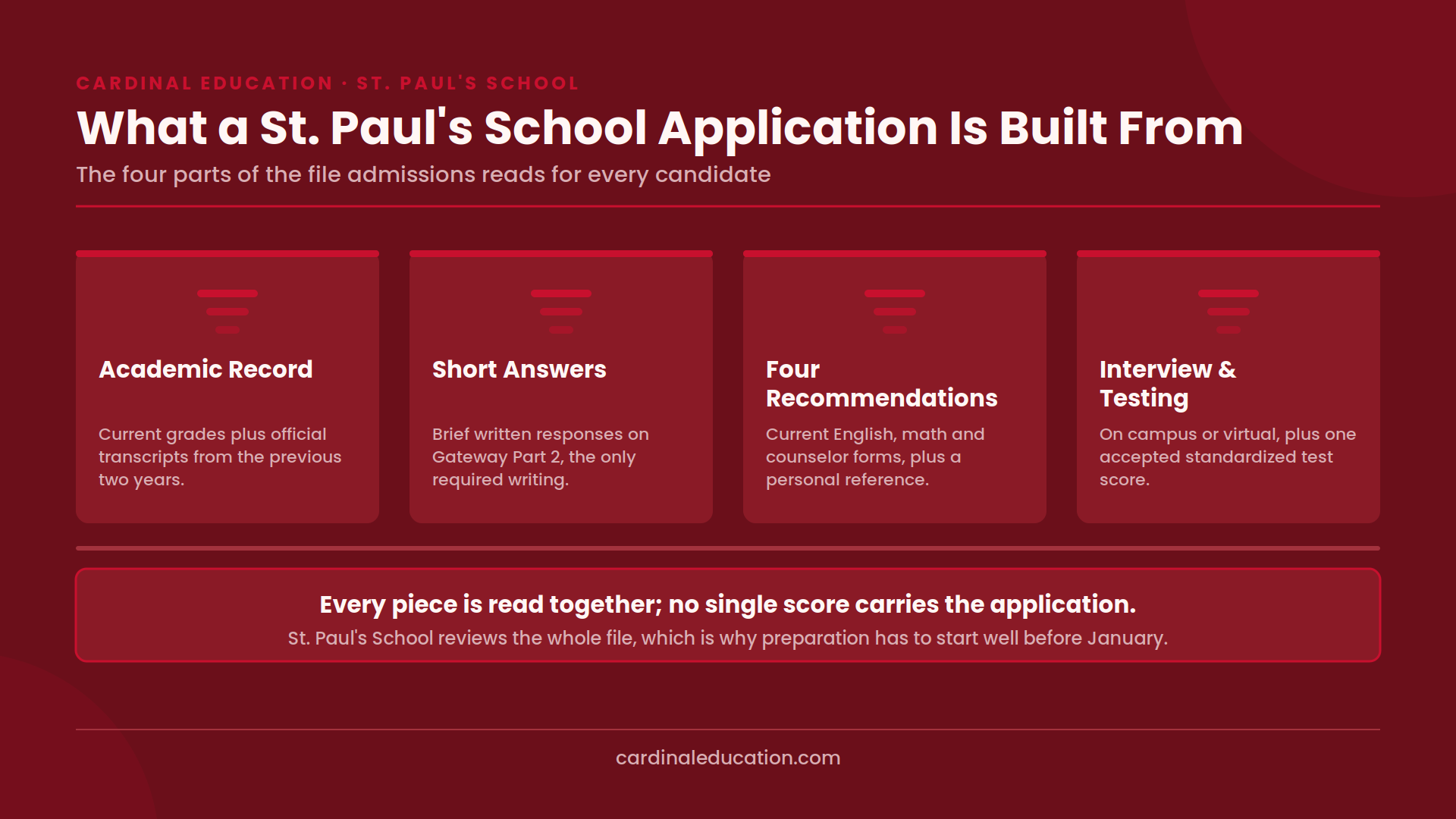
Everything is submitted through Gateway to Prep Schools. A complete file has twelve pieces, and the School reads them together rather than ranking them.
Top Tips for Applying
- Submit Gateway Part 1 early, because you cannot book an interview until it is in.
- Book the interview in summer or early fall rather than waiting for the winter rush.
- Choose a graded writing sample your child is proud of, with the teacher’s comments still on it.
- Ask current-year English and math teachers first; those two forms must come from this year.
- Take an accepted standardized test early enough that a January retake is still an option.
Best Practices for Families
- Read the short-answer prompts as character questions, not accomplishment questions.
- Let your child write their own answers; St. Paul’s expects applicant writing without assistance, including from AI tools.
- Use the parent statement to describe how your child is supported, not to re-list their awards.
- Visit if you can, and take the virtual tour if you cannot.
- Keep a single shared checklist so nothing in a twelve-part file goes missing in January.
What the St. Paul’s School Application Requires
-
01Standardized Testing
Testing is required of every applicant. St. Paul’s accepts the SSAT, ISEE, PSAT, PreACT, ACT and SAT, and the test must be taken within one year of the deadline. There is no grade-by-grade requirement; any accepted test works. Most candidates sit the SSAT or the ISEE, and a proctored diagnostic taken early is the cheapest way to find out which one suits your child before the stakes are real.
-
02Short Answers and the Graded Writing Sample
Gateway Part 2 carries the School’s own short-answer prompts, which ask about a personal strength, a recent curiosity, a teacher outside the family and a hard-won accomplishment. The graded writing sample is a longer piece from this academic year, in English, ideally from English class, submitted with teacher feedback and a short form describing the assignment. Because the writing is brief and already graded, preparing a proctored writing sample is the closest analogue for building the on-demand clarity these prompts reward.
-
03Recommendations
Four recommendations are required: current English teacher, current math teacher, principal or counselor, and a personal reference. A special interest recommendation is optional. Those first three forms must come from current teachers, though a block-schedule student may substitute history or science. Asking well, and early matters more here than at schools where a single generic form will do.
-
04Interview
Interviews happen on the grounds from June through January and virtually from September through January. Parents and students should both expect to talk. Structured interview preparation is worth the time, not to rehearse answers, but so your child can speak naturally about what they actually care about.
-
05Optional Supplementary Materials
Student athletes, artists, actors, classical ballet dancers and musicians are encouraged to send work directly to the relevant department. This is a genuine channel, not a courtesy, and for a serious artist or recruit it is often the most differentiating thing in the file.
How Cardinal Education Helps
We start with your child, not the application. Before anyone drafts a short answer, we want to know whether a fully residential school in central New Hampshire is genuinely right for them, and we will tell you honestly if we think it is not. From there the work is concrete: boarding school admissions strategy, test selection and preparation, interview readiness for both student and parent, and the kind of executive function coaching that makes a twelve-part January file manageable. Asian American families navigating this process will find more detail on our St. Paul’s School admissions page written specifically for them.
“Navigating the secondary school search from Manhattan can quickly turn into an overwhelming process. When we zeroed in on St. Paul’s, Cardinal Education provided the clear-eyed, strategic direction we desperately needed. They kept us well ahead of the June interview timeline, helped refine our son’s Gateway short answers so his voice shone through without sounding over-coached, and brought executive-level structure to the entire application. Their candid advice throughout made all the difference, and seeing him thrive in Concord has validated every decision.”— Parent of a St. Paul’s School Class of ’28 Student, Manhattan, NY
St. Paul’s School Admissions FAQ
What tests does St. Paul’s School require?
Does St. Paul’s School require an essay?
When should we schedule the St. Paul’s interview?
How large is the Asian American population at St. Paul’s School?
Can international students apply to St. Paul’s School?
Is St. Paul’s School only for ninth graders?
Considering St. Paul’s School?
A St. Paul’s application rewards a child who can say something true about themselves in three sentences. That capacity is built over years, not over a December weekend. If your family is considering Millville, the useful time to talk is now.